


If you're considering a storage business sale, you're probably in one of two positions. You're either an owner thinking, "I should sell while trading is solid", or you're a buyer trying to work out whether the asking price reflects a real operating business or just a fenced yard with containers on it.
Those are not the same thing, and too many deals get muddled because people treat them as if they are.
In the UK, self-storage is no longer a fringe property type. The sector reached 2,129 facilities in 2024, with a national occupancy rate of 81.6%, according to valuation benchmarks for storage warehouse businesses. That matters because buyers don't assess a self-storage site like a pile of metal boxes. They assess it like an income-producing business with property risk, customer risk and operational risk all wrapped together.
A good sale comes from preparation, not hope. A good purchase comes from underwriting what can go wrong, not just what looks attractive in the brochure.
Preparing Your Storage Business for Maximum Value
Owners often start too late. They ring a broker when they're tired, when a lease issue appears, or when they think occupancy "looks good enough". By then, the business has already told a story to the market, and it may not be the story you'd choose.
The mindset change is simple. Stop thinking like an operator who fills units week by week. Start thinking like a seller who must prove that the business can trade cleanly, predictably and without chaos.
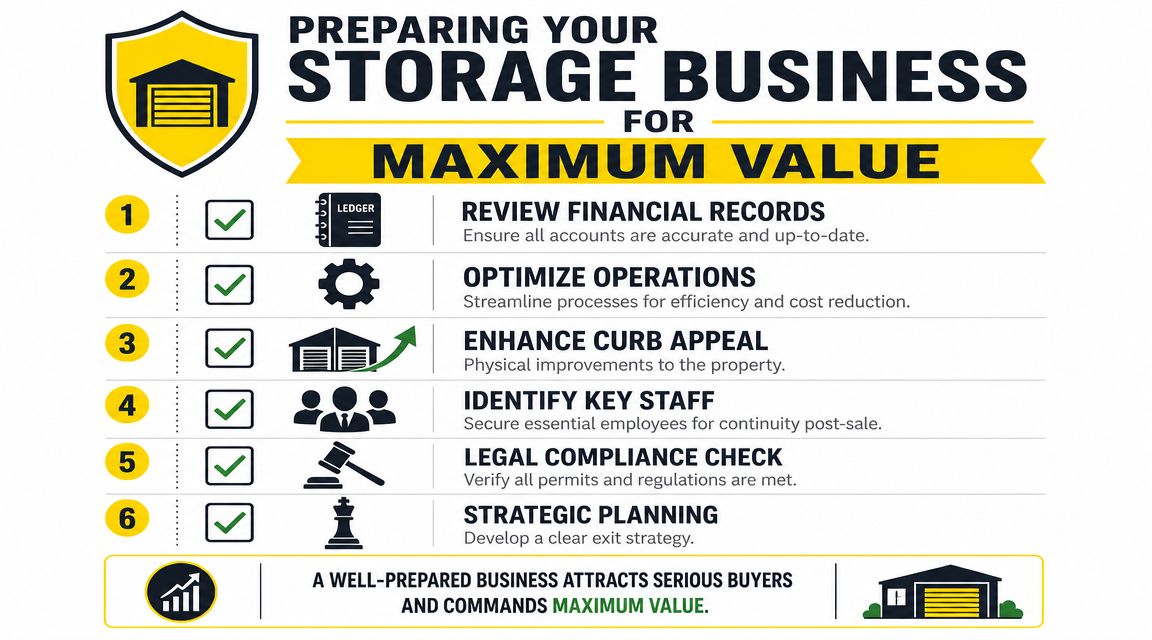
Get your numbers commercial, not personal
The first job is to strip out noise. If the business pays for non-business costs, if family members are on payroll without a clear role, or if maintenance is booked irregularly, a buyer will discount your figures because they can't trust what they're seeing.
A clean seller pack usually includes:
- Management accounts: Up-to-date records that reconcile to bank statements and filed accounts.
- Customer data: Unit mix, occupied versus vacant space, churn patterns, arrears and bad debt.
- Rate card history: What you charge now, what you've discounted, and where you held firm.
- Contracts and obligations: Supplier agreements, insurance documents, utilities, leases, finance agreements and staff terms.
- Maintenance records: Gates, CCTV, surfacing, drainage, lighting, container repairs and pest control.
- Compliance paperwork: Planning, land title documents, any environmental reports and site permissions.
If you want a useful parallel outside storage, Stewart Accounting's business sale tips are a sensible reminder that value usually improves when records, systems and management reporting are in order well before launch.
Practical rule: If a buyer has to assemble the story themselves from scattered emails, missing invoices and verbal explanations, they'll assume the risk is higher than it needs to be.
Don't chase occupancy at the expense of income
This is one of the biggest mistakes in a storage business sale. Owners push units out at discounted rents to make the site look full. On paper, occupancy looks impressive. In reality, rate integrity has been damaged.
A more credible approach is the one set out in CTA Acquisitions' guidance on selling a storage unit business. Sellers should test the location and demand first, then quantify occupancy, rate and supply dynamics before going to market. Buyers look at local demographics, competing sites, unit mix and any nearby pipeline. They don't underwrite occupancy in isolation.
That means your pre-sale review should answer questions like these:
- Are your current rents in line with the local market, above it, or below it?
- Are you full because demand is strong, or because pricing is weak?
- Is there incoming supply nearby that could cap future rate growth?
- Which part of your customer base renews reliably, and which part is short-term churn?
For operators with a strong business customer base, it also helps to understand how firms use storage in practice. The patterns described in business storage use cases often create steadier occupancy than purely move-driven demand.
Package the business so it looks transferable
Buyers pay better for a business that doesn't depend on the owner's memory, mobile phone or goodwill.
That means systematising the basics:
- Enquiry handling: Who answers, how leads are followed up, and how pricing is approved.
- Site routines: Opening checks, lock checks, cleaning, collections, repairs and incident reporting.
- Customer onboarding: Reservation forms, ID procedures, contracts and move-in process.
- Debt control: When reminders go out, who calls, and what happens next.
- Local marketing: What channels generate usable enquiries and which ones waste time.
A tidy site helps, but transferability closes deals. If the operation keeps running when you step back for a fortnight, you're much closer to having something buyers want.
How to Accurately Value Your Storage Business
A storage business isn't valued by adding up containers, fencing and a bit of land, then hoping for the best. That's an asset view. A buyer is buying future income, plus the risk attached to producing it.
That is why valuation work starts with net operating income, then tests how secure that income really is.
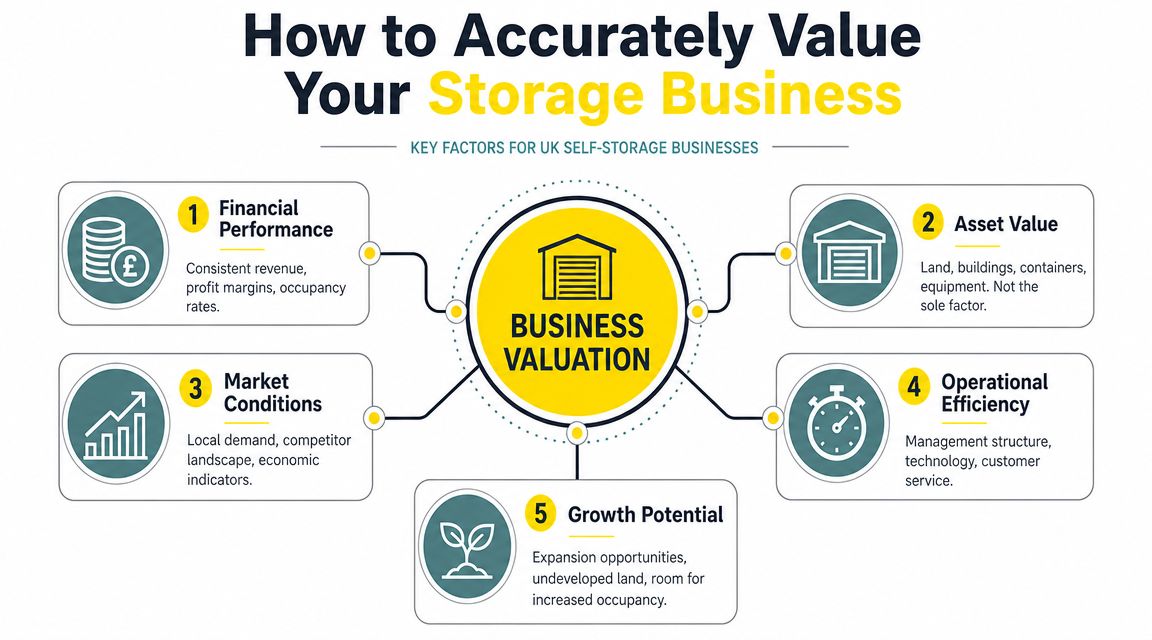
Start with clean net operating income
In practical terms, net operating income is the income left after normal operating costs, before debt and owner-specific choices distort the picture. Sellers often overstate it by leaving in unsustainably low maintenance, understating admin, or ignoring vacancy and bad debt. Buyers often understate it by assuming every line item is fragile.
The work is to get it honest.
A sensible valuation review usually checks:
| Item | What matters |
|||
| Income | Storage rent, ancillary income, collection quality and discount history |
| Costs | Staffing, repairs, insurance, rates, utilities, security, software and marketing |
| Normalisation | Removing one-off costs and owner-specific expenses that won't continue |
| Stability | Whether income is recurring or dependent on short spikes |
| Headroom | Scope to improve rates, occupancy quality or operating efficiency |
If you're selling, your job is to make adjustments defensible. If you're buying, your job is to challenge them.
Revenue quality matters more than many owners think
Not all occupied units are equal. A facility filled with short-stay residential move-ins can look busy but still produce uneven cash flow. A facility with a solid base of small business customers often reads differently to a buyer because the renewals can be more operationally embedded.
Recent UK market evidence points that way. Commentary drawing on ONS business demography trends notes that the UK has millions of active enterprises, with microbusinesses forming most of the business base. Those firms are more likely to need small, flexible space than a full warehouse lease. In valuation terms, recurring SME use such as stock holding, tools, archived records and e-commerce overflow can support a stronger pricing conversation than one-off moving demand alone.
Buyers don't just ask, "How full is it?" They ask, "Who is paying, why do they stay, and how easily can that income disappear?"
For anyone benchmarking customer demand, looking at the range of self-storage units used by households and firms can help frame what unit mix attracts durable business rather than occasional traffic.
The multiplier is really a risk judgement
People like shorthand. They talk about multiples and cap rates as if there is a single market answer. There isn't. The same level of profit can attract very different offers depending on the risk wrapped around it.
A buyer usually looks harder at:
- Location quality: Accessibility, surrounding demand and competing supply.
- Income consistency: Whether rents are stable or propped up by heavy discounting.
- Operational depth: Whether the business runs on systems or on one person.
- Site quality: Layout, condition, security and ease of expansion.
- Customer mix: Whether the revenue base is broad and repeatable.
That is why valuation arguments fall apart when owners insist on pricing from replacement cost alone. Replacement cost may inform a floor in some situations, but a buyer still comes back to sustainable income and the risk of defending it.
Choosing Your Sales Channel Broker vs Private Sale
Once the business is prepared and sensibly priced, the next decision is how to bring it to market. Some owners should use a specialist broker. Some can sell privately. Plenty start privately, waste months, then appoint a broker after the best momentum has gone.
The right route depends on your deal size, your experience and how much confidentiality matters.

What a specialist broker does well
A proper self-storage broker does more than advertise. They position the asset, qualify buyers, control information flow and keep the deal moving when the lawyers start circling the same points for weeks.
That usually helps in four areas:
- Buyer reach: They know who is actively acquisitive, including trade buyers, investors and local operators.
- Pricing discipline: They stop weak early offers from anchoring the whole process.
- Confidentiality: They can release information in stages rather than putting sensitive material in public view.
- Process control: They manage viewing order, bid deadlines, heads of terms and the inevitable last-minute wobble.
The downside is straightforward. You pay a fee, and you need to choose carefully. A generalist high street agent may understand industrial property but still miss the trading drivers that matter in storage.
Why private sales appeal, and where they go wrong
Private sales are attractive because owners think they will save commission and keep control. That can be true. It can also be expensive in less obvious ways.
The common problems are familiar:
| Private sale advantage | Private sale risk |
|||
| No broker fee | You may underprice or overprice the business |
| Direct contact with buyers | You may disclose too much too early |
| Control over timing | The process can drag because nobody is driving it |
| Flexibility | Timewasters and poorly funded buyers take up management time |
A private sale works best when the seller already knows the likely buyer pool and has the discipline to run the process like a transaction, not a conversation.
If you go private, insist on proof of funds or proof of financing early, use confidentiality agreements before releasing detailed information, and keep a structured question log. If you don't, due diligence starts before you've even agreed whether the other side is real.
Marketing Your Business and Navigating Due Diligence
Marketing a storage business isn't about shouting the loudest. It's about giving serious buyers enough information to engage, while holding back enough detail to protect the operation until they're qualified.
The strongest sales process usually starts with a confidential information memorandum. It doesn't need glossy nonsense. It needs a clear account of the site, the income, the customer profile, the operational model and the property position.
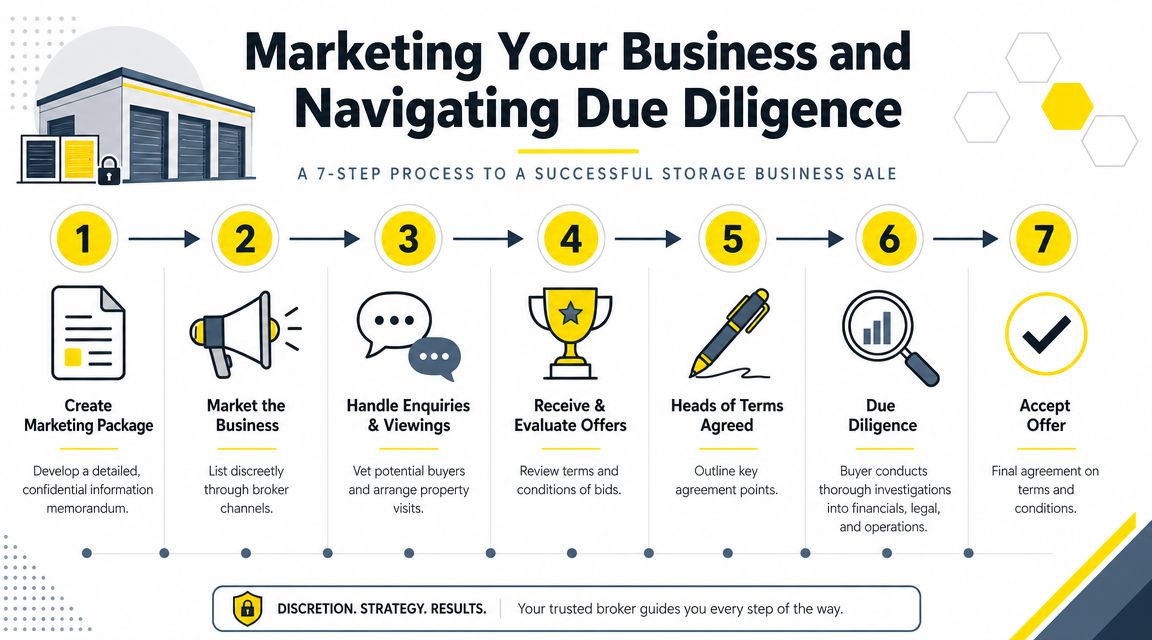
Market the strengths, but don't hide the friction
A buyer can cope with a drawback. What they dislike is discovering it late.
Good marketing packs usually show:
- The trading picture: Historic performance, current occupancy profile, arrears, unit mix and pricing logic.
- The property picture: Ownership structure, lease terms if relevant, access, yard layout, security and condition.
- The demand case: Local trade area, competition, access routes and customer profile.
- The upside case: Operational improvements, unused capacity, better rate management or expansion potential where supportable.
Leave out fantasy. If you have no evidence that rates can move, say less. If there is a practical growth angle, show why it is credible.
Operationally minded buyers will also look for evidence that customers use storage in ways that are sticky rather than casual. That is why broader business process content, such as how smaller firms handle stock and supplies through inventory management, can be useful context when explaining recurring commercial demand.
Due diligence is where soft assumptions get tested
This stage is where many sellers become irritated because the questions feel repetitive. They are repetitive. Buyers ask the same things in different ways because they are trying to find inconsistency.
Expect scrutiny across three fronts:
Financial due diligence
Buyers will test revenue recognition, discounts, debtor quality, expense patterns, VAT treatment where relevant, and any adjustments used in the valuation.Operational due diligence
They will want to understand staffing, software, site access, security procedures, complaints, insurance claims, maintenance backlog and customer concentration.Legal and property due diligence
This is often where UK deals get awkward, particularly for container sites and mixed industrial locations.
The UK-specific issues matter. According to guidance discussing self-storage acquisition risks in the UK, buyers need to underwrite planning and environmental exposure, not just revenue. The same source notes the Environment Agency's position that 1 in 6 properties in England are at risk of flooding, which can affect insurance, downtime and lender appetite. Planning status can also be decisive, especially where land use, lawful storage use or expansion potential are unclear.
If planning is messy, title is unclear, or flood exposure hasn't been examined, buyers don't simply "take comfort later". They reduce price, ask for protections, or walk away.
What sellers should have ready before the questions land
The easiest diligence process is the one prepared in advance. I would want a seller to have, at minimum:
- Planning records: Permissions, lawful use evidence, conditions, site history and any correspondence with the local authority.
- Environmental information: Flood-related material, drainage information, contamination reports if they exist, and insurance history.
- Title documents: Ownership, rights of access, easements, restrictions and boundary clarity.
- Commercial files: Major customer contracts if any, supplier contracts and employee terms.
- Operational evidence: Repair logs, incident records, security procedures and complaint handling.
When those documents are ready, the tone of the deal changes. Buyers still negotiate hard, but they spend less time worrying that the unknown is worse than the known.
Final Negotiations Closing and Sale Alternatives
By the time heads of terms are agreed, many owners think the hard part is over. It isn't. At this point, price becomes contract language, and contract language decides who carries risk if something turns out to be different from what was expected.
A clean final negotiation focuses on a short list of points. Purchase price is only one of them.
What really gets negotiated at the end
Solicitors will deal with the documents, but commercial decisions still need the principals to stay engaged. The usual pressure points are:
- Warranties: Statements about the business and property that the buyer relies on.
- Indemnities: Specific protections for known risks, such as a planning issue or historic dispute.
- Working capital and apportionments: What is included, what is adjusted and from what date.
- Retention or deferred sums: Money held back pending a defined issue.
- Handover support: How long the seller stays available and what help is expected.
One practical mistake is arguing over headline price while conceding heavily on warranties and post-completion support. A "better" price can become a worse deal if the obligations attached to it are vague.
Keep completion grounded in reality
A sensible handover plan matters more in storage than many sellers expect. Access systems, gate codes, payment setups, arrears processes, customer communications and emergency procedures all need continuity.
Experienced buyers usually ask for a structured transition period. They don't want mystery. They want introductions to key suppliers, clarity on unresolved maintenance items, and a reliable transfer of operating knowledge.
A short closing checklist often helps:
| Closing issue | Why it matters |
|||
| Customer communication | Prevents confusion and unnecessary churn |
| Access control transfer | Keeps the site secure from day one |
| Supplier novation or replacement | Avoids service interruption |
| Staff briefing | Protects continuity and morale |
| Data handover | Ensures bookings, contracts and account records transfer cleanly |
A full sale isn't always the best answer
Some owners should not sell outright yet. If the business is profitable but not fully matured, or if there is unresolved planning or site work, another route may create a better outcome.
The alternatives are often more strategic than people assume:
- Lease the whole facility to another operator: Useful where the owner wants income and less day-to-day involvement.
- Management buyout: Worth considering if trusted staff already run much of the operation.
- Partial equity sale: A partner can bring capital or operational depth while the original owner de-risks personally.
- Delayed sale after clean-up: Sometimes the best decision is to spend time fixing records, rates or compliance before returning to market.
The right answer depends on what you're trying to solve. Retirement, fatigue, debt reduction, expansion capital and estate planning all point to different deal structures.
Your Storage Business Sale A Summary
A storage business sale often starts with a simple assumption. The site is full enough, the rent roll looks decent, and a buyer will see the value. In practice, UK deals turn on the details behind those headline numbers.
The best outcomes come from treating the sale as three things at once: an operating business transfer, a property transaction, and a risk assessment. Occupancy still matters, but serious buyers look harder at planning status, the mix of domestic and business customers, churn, rent discipline, bad debt, local competition, and how much of the income will hold up after handover. A facility with ordinary occupancy and clean fundamentals can sell better than one with fuller units but weak records or planning uncertainty.
That is where many sellers either protect value or lose it. Clean accounts help, but they are only part of the picture. Buyers pay more confidently when the licence position is clear, rate increases are evidenced, customer contracts are organised, and there are no awkward surprises in access control, maintenance history, or title documents. If a buyer has to guess, they usually price for the worst case.
Buyers should stay disciplined. Sellers should get organised.
Even where legal commentary comes from outside the UK, the underlying point still holds. Kons Law for Connecticut business sales highlights that deal structure, liabilities, and handover terms affect the outcome as much as the agreed price. In UK self-storage transactions, that usually means careful work on warranties, indemnities, property title, planning review, and what the seller must deliver on completion.
A good sale is rarely the one with the noisiest asking price. It is the one that stands up in due diligence, reaches exchange without repeated retrades, and leaves both sides clear on what is being bought, what is being transferred, and where the risk sits.
If you need flexible self storage or business space while planning your next move, Container Self Store offers secure, practical options in Nottingham and Nottingham for households, tradespeople and growing businesses.