You've just carried the last box out of a Lenton flat, but your new room won't be ready for another fortnight. Or perhaps a kitchen refit in Mapperley has turned every usable surface into a workbench. In Nottingham, personal storage usually solves a timing problem, not a permanent lack of furniture.
The right choice comes down to two formats: an indoor storage room or a drive-up container. Indoor rooms are cleaner and easier for smaller, more delicate loads. Containers win when you're moving bulky items, tools or stock directly from a vehicle. Pick the wrong format and you'll pay for space that's awkward to use. Pick the right one and moving, renovating or running a small business becomes much simpler.
Why Nottingham Residents Are Turning to Personal Storage
A student leaving a Lenton flat for the summer needs space for boxes, bedding and a bike. A couple selling a Wollaton terrace may have to clear furniture before completion, while a Mapperley homeowner could need somewhere for appliances and dining furniture during a kitchen refit. These are everyday Nottingham situations where a short-term unit solves a timing problem quickly.
Nottingham's customer mix keeps demand moving. University of Nottingham and Nottingham Trent students create regular summer clear-outs. Renters in shared houses need flexibility because tenancy dates rarely align, and house moves near the A52 and M1 can leave a gap between leaving one property and entering the next. Small businesses also use units for stock, tools and paperwork.
National figures confirm that storage demand is driven mainly by domestic customers rather than long-term warehousing. The UK Annual Industry Report records £1.3 billion in annual turnover, 67.5 million square feet of lettable space, 3,143 stores and average occupancy of 74.5%, rising to 79.6% for mature stores. It reports that 76% of storage use comes from domestic customers, with lack of space at home the main reason for storing belongings.
Storage follows movement
Nottingham's population grew by 5.9% between the 2011 and 2021 censuses, from just under 305,700 to around 323,600, according to the Office for National Statistics census figures. More residents place pressure on flats, terraces and family homes, especially when spare rooms, hallways and garages already hold everyday items.
House moves create another clear reason to rent temporarily. The Nottinghamshire market report records 6,079 residential transactions in the four towns it tracks over the last 12 months, using HM Land Registry price-paid data. Not every transaction leads to a booking, but furniture often needs somewhere to go during a chain, downsizing, decorating or a delayed completion.
Home-based traders, online sellers and self-employed tradespeople have a different need. A unit keeps packaging, tools, seasonal stock and archived documents out of the spare bedroom. The UK sector's 96.6% churn rate, recorded in the same national report cited above, shows how frequently units are re-let. For Nottingham customers, storage is usually a flexible holding point between properties, projects or deliveries, not a substitute for a long-term warehouse.
Unit Types and Sizes Available Locally
Start with the shape of your load, not the first price you see. Indoor rooms and containers measure differently in practice because door width, height, loading route and vehicle access can matter as much as floor area.
Indoor rooms for organised household storage
Indoor rooms sit inside a managed building, usually behind corridors, lifts or access-controlled doors. They range from compact 9 sq ft lockers to rooms of about 150 sq ft or more, with Container Self Store also describing indoor options up to 200 sq ft in Nottingham.
A 9 to 15 sq ft locker works for a Lenton student storing boxes and luggage. A 25 to 50 sq ft room is more suitable for the contents of a one-bed flat, particularly if you dismantle beds and stack boxes properly. Larger rooms suit staged house moves, family overflow or renovation furniture.
Drive-up containers for bulky loads
A drive-up unit lets you park a car or van directly outside the door. The format is especially useful for furniture, tools, garden equipment, motorbikes, trade materials and e-commerce stock. Container sizes commonly include 10 ft and 20 ft options, with larger formats available at some sites.
Check the practical specifications before booking. Ask about the roller-door width, internal height, floor loading, ventilation, pallet handling and forklift access. A 20 ft container may be ideal for a Beeston house move if the removal van can load straight through the door. It's less suitable if you're storing paperwork that needs a more stable indoor environment.
| Size / Format | Approx Floor Area | Best For | Nottingham Example |
|---|---|---|---|
| 9 to 15 sq ft indoor locker | Compact room | Boxes, luggage and student belongings | A Beeston student clearing a room for summer |
| 25 to 50 sq ft indoor room | Small to medium room | One-bed flat contents | A tenant moving from Sherwood into shared housing |
| 75 to 100 sq ft indoor room | Large room | Staged house moves | A couple between properties near the A52 |
| 100 to 150 sq ft indoor room | Very large room | Renovation furniture or family overflow | A Mapperley home undergoing a major refit |
| 10 ft drive-up container | Ground-level container | Bulky furniture, tools and stock | A tradesperson working across Nottingham |
| 20 ft drive-up container | Large ground-level container | Whole-house loads or business overflow | A vehicle-assisted move from Beeston |
Use a storage unit size guide before accepting a quote. Measure wardrobes, sofas and appliances, then allow room for a walkway. Filling every corner saves little if you can't reach the item you need.
Indoor Rooms Versus Drive-Up Containers
The choice is straightforward once you compare how you'll use the unit.
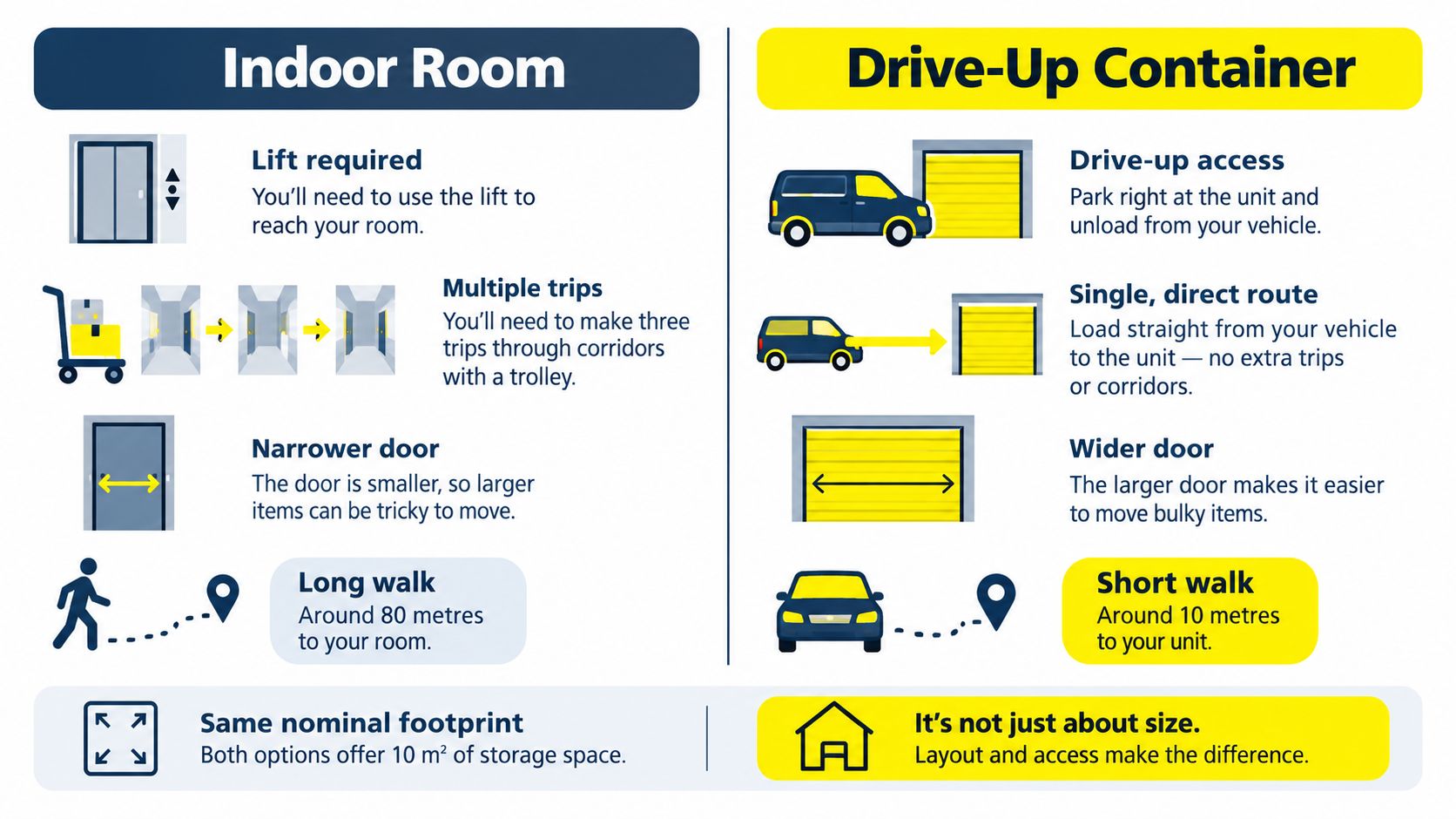
An indoor room suits lighter household goods, documents, clothing and furniture that you want to keep inside a building. You'll normally use a trolley and may need a lift or corridor route. That takes more trips, but the indoor setting can feel more controlled and comfortable during loading.
A drive-up container suits anything heavy, awkward or frequently accessed. You reverse a car or van to the roller shutter and move items directly from vehicle to unit. There's no lift, long corridor or repeated carry through a reception area.
Compare the trade-offs
| Consideration | Indoor room | Drive-up container |
|---|---|---|
| Loading | Trolley, lift or corridor may be needed | Park directly outside |
| Best contents | Furniture, clothing, documents and household goods | Tools, stock, garden equipment and bulky furniture |
| Access | Often controlled through a building | Direct ground-level entry |
| Security approach | Building access control, CCTV, alarms and individual locks | Steel container, gated site, CCTV and a secure padlock |
| Space efficiency | Good for labelled, stackable boxes | Strong for large or awkward items |
| Weather exposure | Loading takes place indoors or under cover | Loading takes place at the container door |
Security depends on the site, not just the word “indoor” or “container”. A well-managed container compound can be more convenient than an indoor building with a difficult loading route. Conversely, an indoor room may be the sensible choice for sensitive household items or records.
My rule is simple. Choose an indoor room if you'll visit occasionally and want a building-based environment. Choose a drive-up container if your van, trolley or lifting routine is central to the job.
Security, Access Hours, and On-Site Support
In Nottingham, convenience can matter more than a small difference in floor area. Independent local tracking describes 10 self-storage facilities, 6 positively identified operators and 1 planning submission in the last 12 months, indicating a relatively constrained local supply pipeline, as reported by this Nottingham self-storage market guide.
That constraint makes immediate availability valuable. A cheaper unit in Lenton or the Lace Market isn't a bargain if you have to carry furniture a long way or can't enter when your removal van arrives. A site with straightforward access near the A52 or close to junction 25 of the M1 may save more time and effort than a slightly smaller headline price.
Four checks before you pay
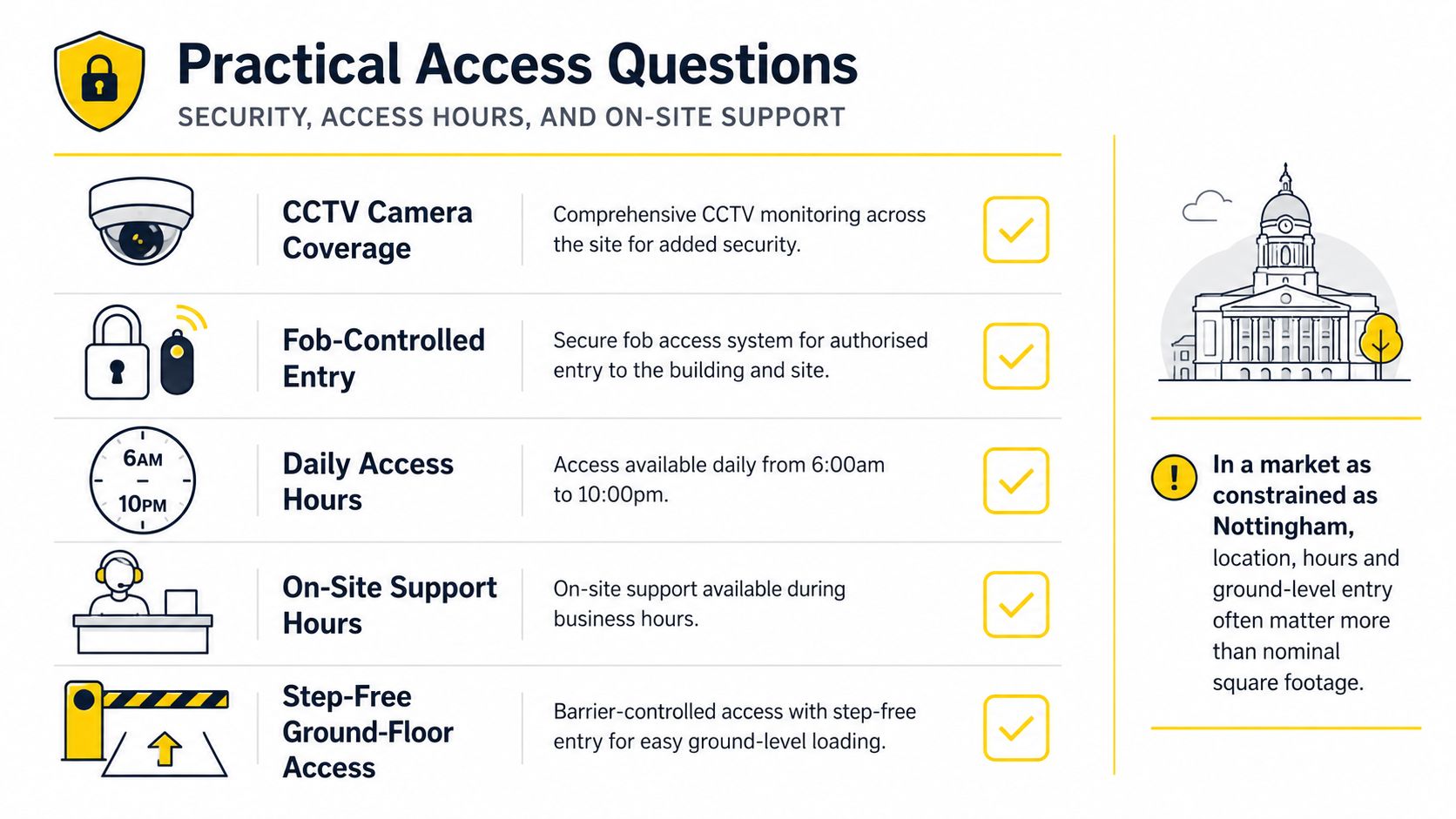
- CCTV coverage: Ask where cameras point, how the loading area is monitored and whether footage is retained.
- Controlled entry: Look for PIN-gated or fob-controlled access rather than an open compound.
- Access hours: Confirm whether your moving schedule fits the site's actual hours. Nottingham city-centre pay-and-display parking operates Monday to Sunday from 8am to 10pm, according to the Nottingham City Council parking report. Don't assume a nearby parking arrangement gives you storage access outside those times.
- Human support: A staffed site can resolve a failed lock, lost code or awkward delivery. An unmanned site may cost less, but you'll be handling problems alone.
Nottingham City Council also identifies facilities with 24-hour access and 24/7 CCTV monitoring for permit holders in some city-centre parking locations, as described in its latest city-centre parking updates. That isn't a storage specification, so ask each operator for its own confirmed hours and monitoring arrangements.
For a fuller checklist, use this guide to secure self storage. Access hours, CCTV, alarms and staffing should come before price in your comparison.
Who Each Unit Size Is Really For
A size chart only helps when you can recognise your own belongings in it. Start by listing the rooms you're clearing, then separate bulky furniture from stackable boxes.
Match the unit to the person
A 9 to 15 sq ft locker is a student solution. Someone in Lenton or Beeston clearing a room for the summer can store suitcases, bedding, books and boxed kitchen items without paying for a full room.
A 20 to 40 sq ft indoor room suits a one-bed move, bedroom refit or short-term house share change. It's enough for dismantled furniture and boxes if you stack vertically and leave access to the back.
A 50 to 80 sq ft room is the practical middle ground for a full house move staged over a month. It can hold a meaningful amount of furniture, but you'll need a loading plan. Don't treat it as a dumping space.
A 100 to 150 sq ft room fits renovation storage, family overflow and small e-commerce stock. If you're clearing a Mapperley home for builders, this range gives you room to separate furniture from tools and household boxes.
A 160 sq ft or larger drive-up container is for whole-house contents, trade equipment and business overflow. Tradespeople benefit from loading directly from a van, while online sellers can organise stock, packaging and dispatch supplies at ground level.
| Unit Size | Best For | Typical Contents |
|---|---|---|
| 9 to 15 sq ft | Students and light personal storage | Luggage, books, bedding and boxes |
| 20 to 40 sq ft | One-bed moves and room refits | Bed frames, wardrobes, chairs and cartons |
| 50 to 80 sq ft | Staged house moves | Sofas, tables, appliances and packed rooms |
| 100 to 150 sq ft | Renovations and small sellers | Household furniture, stock and packaging |
| 160 to 320 sq ft container | Trades and business overflow | Tools, equipment, pallets and whole-house contents |
If you're planning a garden office or external storage project rather than renting a unit, a guide to 10×10 shed pad contractors can help you think about base preparation and load support. It's a different solution, but the same principle applies: plan the footprint around the contents.
Sizing rule: Estimate your load in cubic metres first, then match it to floor area. Don't choose a unit by floor area alone.
Smart Packing and Loading Tips That Save Time
A storage unit becomes expensive clutter when you can't find anything. Spend an hour planning before the first box reaches the site.
Draw a rough floor plan on the back of an envelope. Mark the door, create a central walkway and divide the unit into zones such as kitchen, bedroom, tools and documents. Number boxes with the zone and sequence, for example “K3” for the third kitchen box, then keep a matching list on your phone.
Load for retrieval, not maximum capacity
- Build a stable base: Put heavy, durable items against the walls and on the floor. Stack lighter boxes above them.
- Protect vulnerable items: Keep fragile goods off the floor and away from pressure points. Don't place televisions or mirrors under furniture.
- Leave a walkway: A narrow route to the back is more valuable than one extra row of boxes.
- Keep frequent-access items near the door: Put tools, documents, seasonal clothing and delivery packaging where you can reach them first.
- Use the right containers: Plastic crates are a sensible choice for drive-up units, particularly where damp air can enter from the surrounding environment. Raise goods on pallets or battens.
- Avoid sealing upholstery in plastic wrap: Furniture needs air circulation. Use breathable covers instead, and make sure items are clean and dry before storage.
For house moves, this moving house storage guide is useful when you're deciding what to load first and what needs to remain accessible.
On moving day, book a trolley if the site provides one, buy the correct padlock, save your access code offline and photograph the unit door for your own records. Label the outside of every box clearly. A well-organised unit should let you find a saucepan, document folder or power tool without unloading half the room.
Pricing, Contracts, and How to Compare Providers
The lowest weekly rate rarely shows the full cost. Nottingham storage prices depend on unit floor area, indoor or container format, floor level, access arrangements and length of stay. A ground-floor container may cost more than a small indoor room, but it can reduce loading time and vehicle handling.
Weekly rolling contracts suit students, short renovation jobs and uncertain moving dates. Longer commitments may reduce the effective rate for a house move or small business, but only choose one if you're confident the storage period justifies it. Flexibility matters when a property chain changes or a project runs late.
Check the full price
Ask about each of these before comparing quotes:
- Headline rent: Confirm the exact unit format and floor area.
- Deposit or administration fee: Ask whether either is refundable.
- Insurance: Check whether cover is mandatory, what it includes and whether your existing policy applies.
- Lock costs: Find out whether you need to buy a specific padlock and what replacement costs.
- Access charges: Confirm whether late, out-of-hours or delivery access costs extra.
- Changes in size: Ask how easily you can downsize or move to a different unit.
| Criterion | What to Check | Why It Matters in Nottingham |
|---|---|---|
| Location | Distance from the M1, A52 and your home | A convenient route reduces repeated driving |
| Format | Indoor room or drive-up container | Loading method affects time and effort |
| Security | CCTV, alarms, gates and lighting | Your goods need protection beyond a padlock |
| Access | Days, hours and vehicle arrangements | Moving schedules don't always fit office hours |
| Staffing | On-site support and contact method | Help matters when access or locks fail |
| Contract | Notice period, fees and renewal terms | Short projects need flexibility |
| Total cost | Rent, insurance, deposit and extras | The headline weekly rate isn't the final bill |
My view: Pay for the access pattern you'll actually use. A convenient, secure unit often beats a cheaper unit that adds repeated carrying, longer driving and restricted hours.
Getting Started and Booking Your Nottingham Unit
Begin with a rough inventory. Count the rooms involved, list the largest items, and separate furniture from boxes, tools, and appliances. This gives you enough information to shortlist a room size or container length without measuring every chair.
Follow this booking sequence
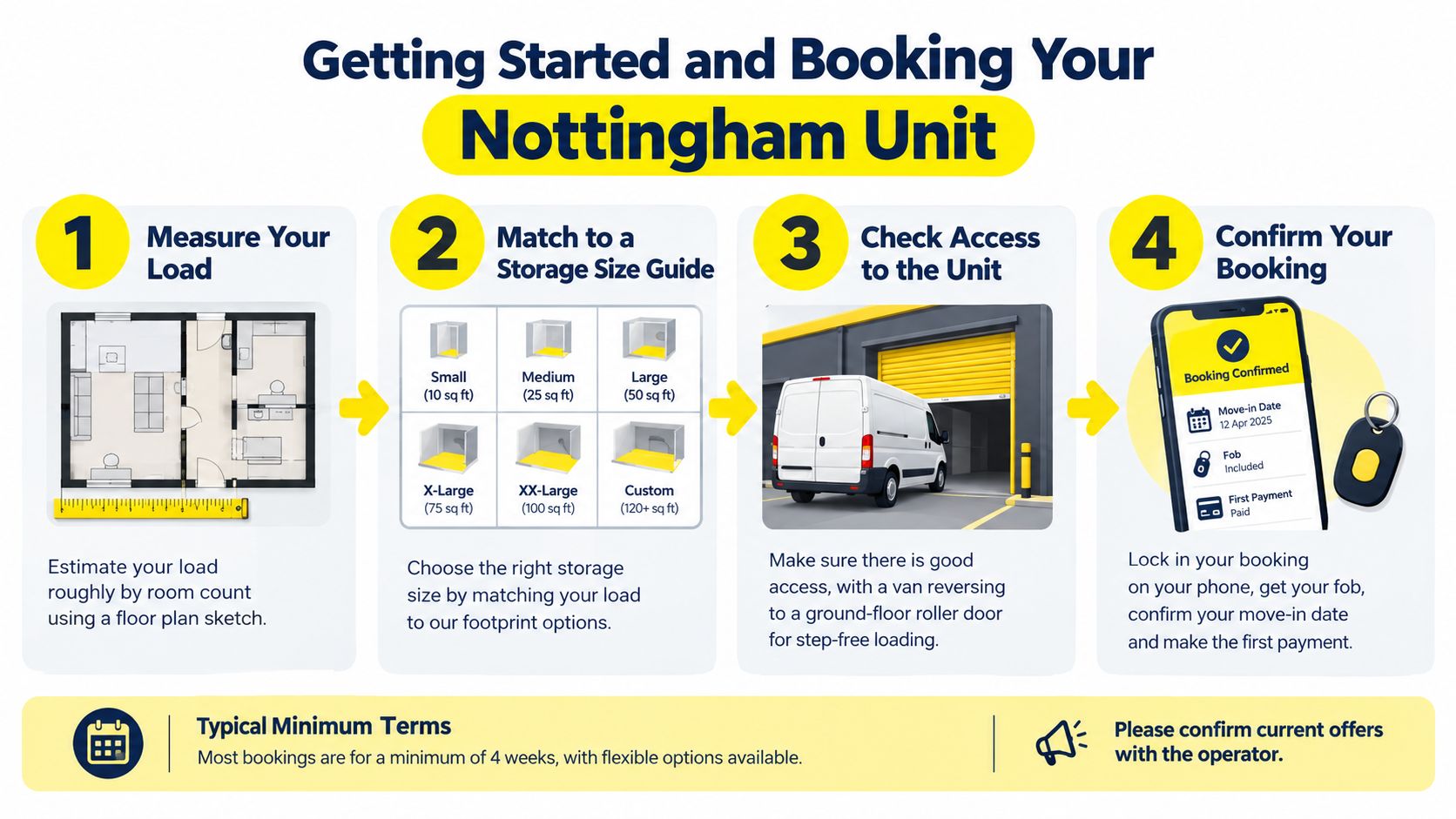
- Measure the load by room: Identify whether you are storing a bedroom, one-bed flat, full house, renovation contents, or business stock.
- Choose the likely format: Pick an indoor room for lighter, organised household goods. Pick a drive-up container for bulky items, tools, stock, or vehicle-assisted loading.
- Request comparable quotes: Ask about the nearest move-in date, availability, contract length, insurance, access hours, and every one-off charge.
- Confirm the documents: Prepare photo ID, proof of address, and a payment method. Many operators can confirm bookings on the same day, subject to their checks.
- Plan move-in: Arrive during staffed hours where possible. Accept the site walkthrough, test your access code, and inspect the lock before loading.
- Load in order: Put heavy items down first, protect fragile goods, keep a route to the back, and place items needed soonest near the door.
Busy moving periods put pressure on local availability. Ask providers to confirm a unit is held for your moving day instead of relying only on a general size chart. The right capacity is no help if you cannot access it when the van arrives.
Container Self Store offers Nottingham indoor rooms from compact lockers to larger units, plus ventilated 10 ft and 20 ft drive-up containers, gated access, CCTV-monitored compounds, on-site staff, and 7-day access, according to its published service information. Use its size guide and quote tools to compare the format, access, and contract that suit your move.
Container Self Store covers both storage formats in Nottingham. Visit its site to check the size guide, request an online quote, and choose a unit that matches how you will load and access your belongings.