You've got orders to pack, but the spare room is already full. Cartons line the hallway, tools are taking over the van, and stock is split between your home and a small office. A Nottingham business often reaches this point before it needs a full warehouse: it needs usable space that can keep pace with trading without adding a long property commitment.
That's the practical choice behind storage for business stock and inventory in Nottingham. Flexible storage can put stock, packaging, equipment or records outside your working premises, while a warehouse lease may suit a business with larger, predictable volumes and daily logistics needs. The right option depends not just on rent, but on the full cost and on how well you can keep track of what's stored.
Why Nottingham Businesses Need Flexible Stock Storage
A local online seller might start with a few shelves of products and packing materials in a spare room. As orders grow, cartons spread into the hallway and the car becomes a backup store. A tradesperson faces a similar squeeze when tools and materials fill a van that also needs to be ready for the next job. In both cases, the problem isn't a lack of floor space. It's that stock has become harder to organise, access and protect.
Nottingham has an active business base. The city council's 2024 Economic Growth Plan, drawing on Centre for Cities analysis, reported 299 firms per 10,000 residents in the wider Nottingham area in 2022. It also recorded a 13.2% business-birth rate, compared with 12.4% across the UK, and a 9.7% business-death rate, below the UK average of 11.1% (Nottingham City Council's Economic Growth Plan). That combination points to a broad, renewing pool of local enterprises, from new retailers and service firms to established businesses adjusting their space as they grow.
A flexible unit can bridge the gap between storing everything at home or work and taking on a conventional warehouse. You can keep stock, tools or packaging in a separate space and adjust your arrangements as trading changes. It won't do the job of a fulfilment operation or a staffed warehouse, but for many smaller firms it can relieve pressure without requiring a large industrial commitment.
The key is to treat storage as part of your operations, not as a place to put whatever no longer fits. If you can reach stock easily and know what's there, an external unit can help your business stay organised. If the unit becomes a jumble of unidentified cartons, it has only moved the problem elsewhere.
Self-Storage vs Warehousing for Stock
Self-storage and warehousing solve different problems. A flexible unit gives a business its own space for stock or equipment, often with straightforward access and fewer fixed property obligations. A warehouse can provide room for larger volumes, more structured logistics and, depending on the operator, services that support receiving, picking and dispatch.
The local warehouse market has faced significant capacity constraints. The Nottinghamshire Core and Outer Housing Market Areas Logistics Study reported that strategic-warehouse vacancy in its study area reached 0.3% in 2021, compared with approximately 5% considered the minimum for a functional market with normal choice and availability (Nottinghamshire logistics study). That evidence concerns large-scale warehouse space rather than self-storage, but it helps explain why a smaller business may find a conventional unit difficult to secure or disproportionate to its needs.
| Factor | Self-Storage | Warehousing |
|---|---|---|
| Space | Separate unit for stock, tools, packaging or records | Larger space for bulk inventory and structured operations |
| Commitment | Often designed for changing requirements; check the specific terms | May involve a lease, deposit and longer-term obligations |
| Access and control | You organise and retrieve your own goods | May include managed goods-in, stock handling or fulfilment |
| Cost structure | Pay for the unit, plus your own handling and transport | Rent and property costs, with possible operational services |
| Best fit | SMEs with modest or variable volumes | Businesses with larger, predictable throughput and logistics needs |
Warehousing makes sense when regular deliveries, pallet handling or integrated fulfilment are central to the business. Flexible storage tends to suit firms that need room for stock but don't need a dedicated warehouse operation. Compare the specific terms, access arrangements and permitted goods before deciding. For a broad overview of the format, see warehouse self-storage options.
Choosing the Right Unit Size for Your Inventory
The unit's advertised floor area isn't the same as the space you can use efficiently. Cartons need to be reachable, shelves need working room, and stock must not block access or compromise safety. A unit packed wall-to-wall might hold more on paper, but it can cost time every time you need to retrieve a product.
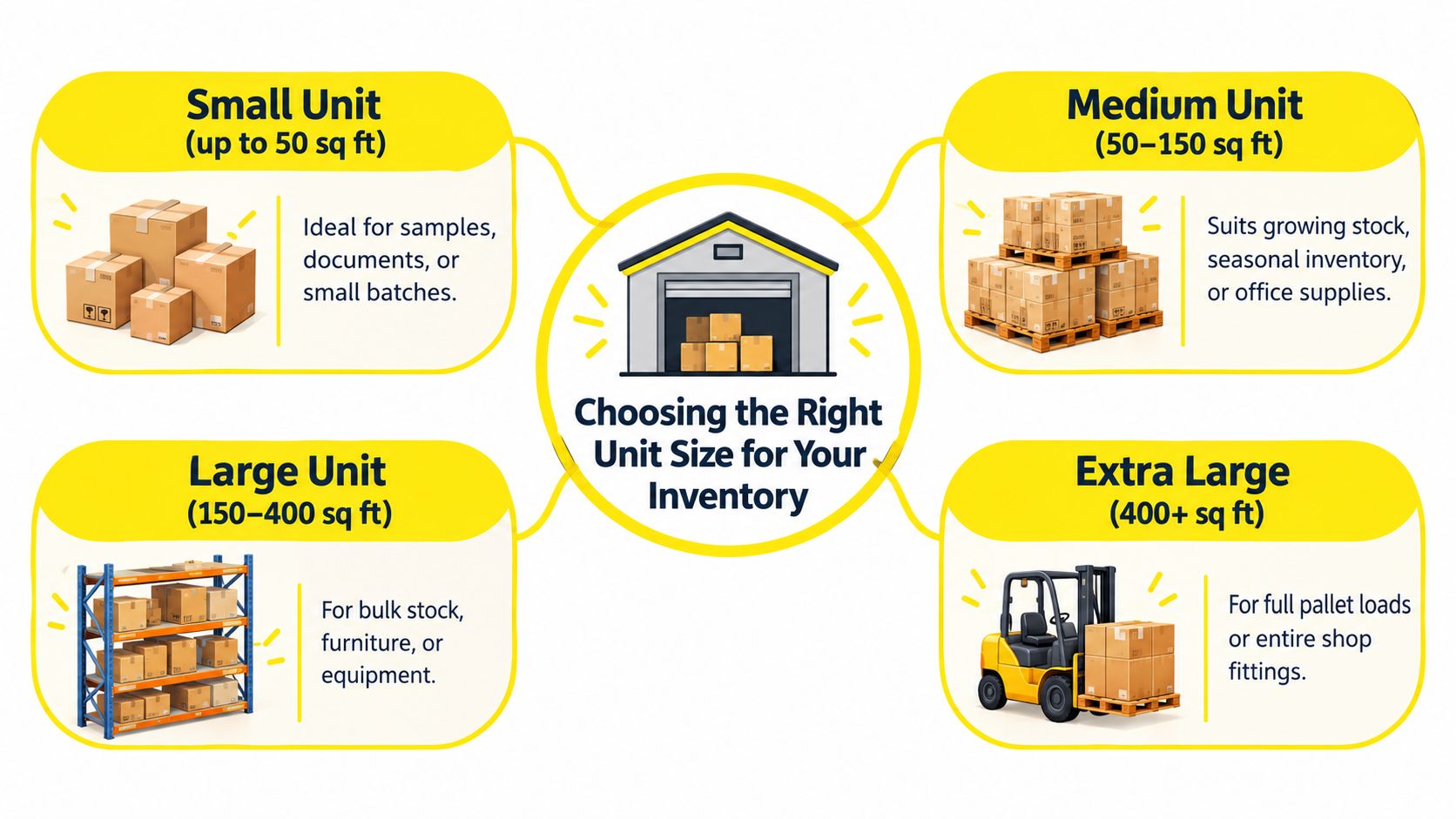
Start with an inventory list. Group goods by type, note how they're packed, and identify which items need frequent access. Estimate how many cartons, shelving bays or pallets you'll store, then allow for a route to reach them. A compact 9 sq ft locker may work for samples, small quantities or records, but it won't be suitable for routine access to bulky stock. A 100 sq ft room may suit a growing stock range with shelving and a clear route, while a 20 ft container can offer ground-level space for bulky cartons, tools or equipment. These are examples, not guarantees of fit. Carton dimensions, stacking limits and access needs all affect capacity.
The UK Government's fire-safety guidance for factories and warehouses recommends keeping at least 1 metre between stored goods and ceilings or lighting, at least 2.5 metres of aisle width, and 0.5 metres between goods and internal walls (fire-safety guidance for factories and warehouses). The exact site layout and applicable rules matter, so don't treat nominal floor area as permission to fill every gap.
Practical rule: Choose the smallest unit that lets you store safely, label clearly and retrieve your fastest-moving goods without shifting everything else.
Before booking, sketch your intended layout: shelves or pallets on one side, reserve stock in labelled zones, and a route from the entrance to the items you need. Compare that plan with the actual dimensions, not just a unit-size label. This guide to choosing a storage unit size can help you frame the questions to ask.
Understanding the True Cost of Storage in Nottingham
A low headline price per square foot doesn't automatically mean a lower-cost solution. A warehouse lease can bring business rates, utilities, insurance, a deposit, fit-out and ongoing responsibility for a space that may sit partly empty. A flexible unit can appear more expensive per square foot, yet cost less overall if you only need modest capacity and can avoid paying for unused premises.
The rates environment matters. Industrial property rateable values in England rose by an average of 21% in the 2026 rating list, while transitional rules limit the average rates-bill increase to 8.67%. For some distribution warehouses, the 2026 high-value multiplier raises the effective rate from 38p to 51p per pound of rateable value (Savills on business rates for warehouses). Those figures don't determine what any specific Nottingham business will pay, but they underline why rent alone is an incomplete comparison.
Consider a retailer or trades business looking for 100–300 sq ft of space. With a flexible drive-up unit, the business should price the unit, insurance, transport to and from the site, and the time spent retrieving goods. With a warehouse lease, add rent, rates, utilities, insurance, deposit, fit-out and the cost of space the business doesn't fill. If the warehouse also needs shelving, handling equipment or a dedicated member of staff, include those costs rather than treating them as free.
The decision changes as volume and operations change. A warehouse may become financially sensible when stock is consistently high, deliveries need managed receiving, orders require frequent picking, or the business needs a dedicated logistics setup. For a smaller operation, paying for unused capacity can erase the apparent benefit of a lower square-foot rate.
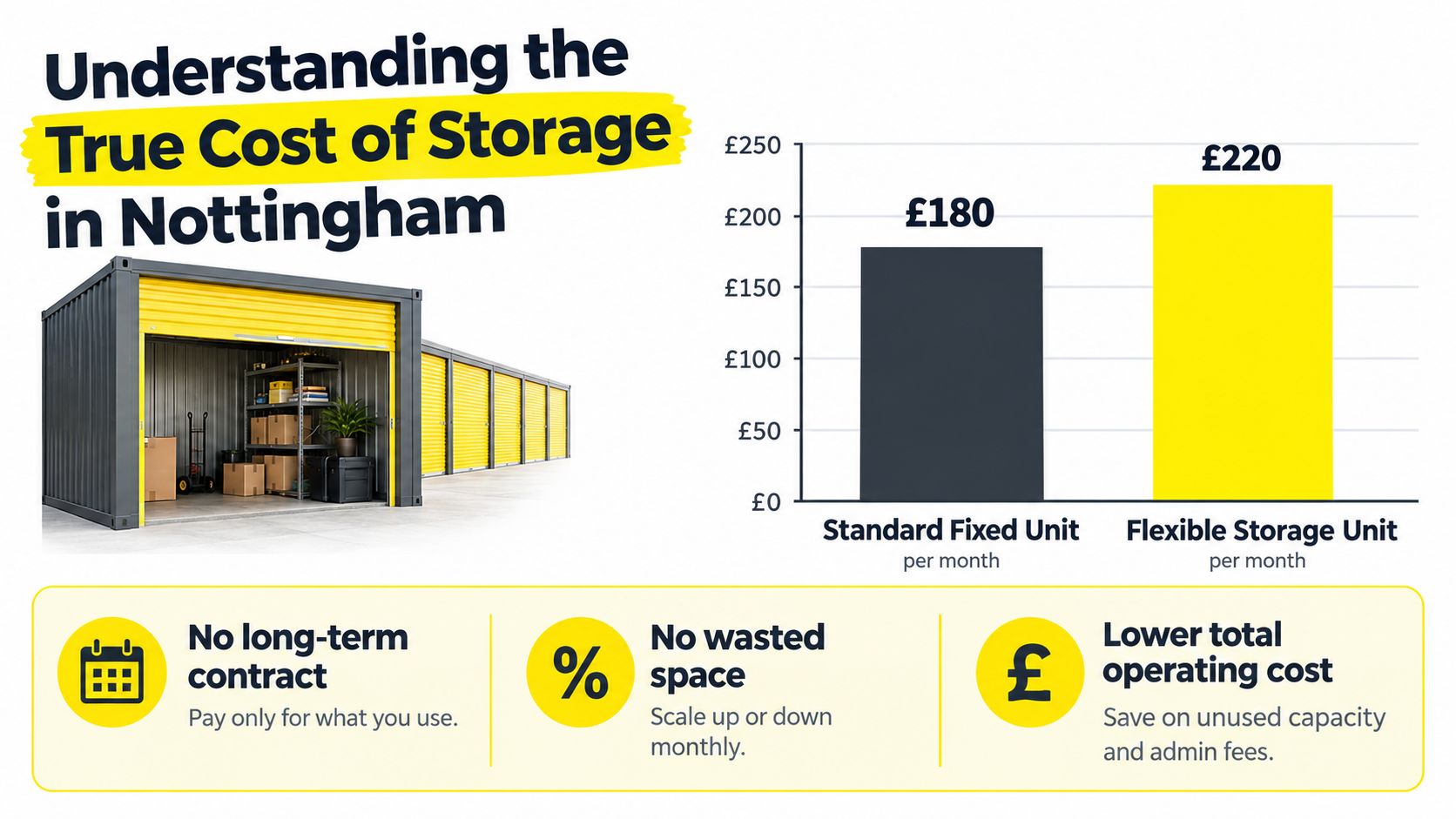
The graphic presents sample prices, not a verified Nottingham quote or universal comparison. Build your own like-for-like calculation using actual written prices and your expected occupancy. If you sell through different channels, include how you value goods as well as where they sit; this guide to inventory valuation methods for resellers offers a useful starting point for thinking about stock records and accounting treatment.
How to Manage Inventory Stored Off-Site
External storage works only if your records tell you what's there and where to find it. A simple system can be enough for a small retailer or tradesperson, provided it's updated whenever stock moves. Use a spreadsheet or inventory tool and give every product a unique SKU, then assign a location code such as a shelf, rack or labelled zone.
A practical workflow looks like this:
- Label each product or carton. Put the SKU and a brief description where you can see them without opening the box.
- Record the location. Log the unit, zone and shelf position, not just the fact that the stock is off-site.
- Place fast movers near access. Keep frequently picked products within easy reach; put reserve cartons and slow-moving goods further back.
- Log every movement. Update quantities when stock arrives, leaves, is returned or is damaged.
- Check and reconcile. Carry out regular cycle counts and investigate differences before they become emergency reorders or write-offs.
Your ledger should record SKU, quantity, location, batch and reorder threshold. For e-commerce stock, separate saleable goods from returns, damaged items and packing supplies. A weekly stock check may be practical for fast-moving lines, while slower stock can be checked on a less frequent schedule that fits your operation. The right rhythm is the one your team can maintain consistently.
Records also need to meet accounting requirements. UK limited companies must keep records showing the stock they own at the end of each financial year, generally retaining accounting records for six years from the end of the relevant company financial year (Companies House guidance on company and accounting records). Keep stock information linked to purchase, sales and dispatch evidence so a physical count can be reconciled with your accounts and insurance records.
The cheapest storage arrangement can become costly if staff repeatedly make trips for misplaced cartons or reorder stock that's already on a shelf.
For a broader approach to processes and controls, inventory management best practices for 2026 is a useful companion. For a small business-specific overview, see inventory management for small businesses.
Security, Access, and Logistics Near the M1 and A52
A cheap unit that's difficult to reach, awkward to load or unsuitable for your goods can cost more in working time than it saves in rent. Check the site in person if you can, and judge the route from the gate to the unit as carefully as the unit itself. For stock you collect often, loading convenience is part of the operating cost.
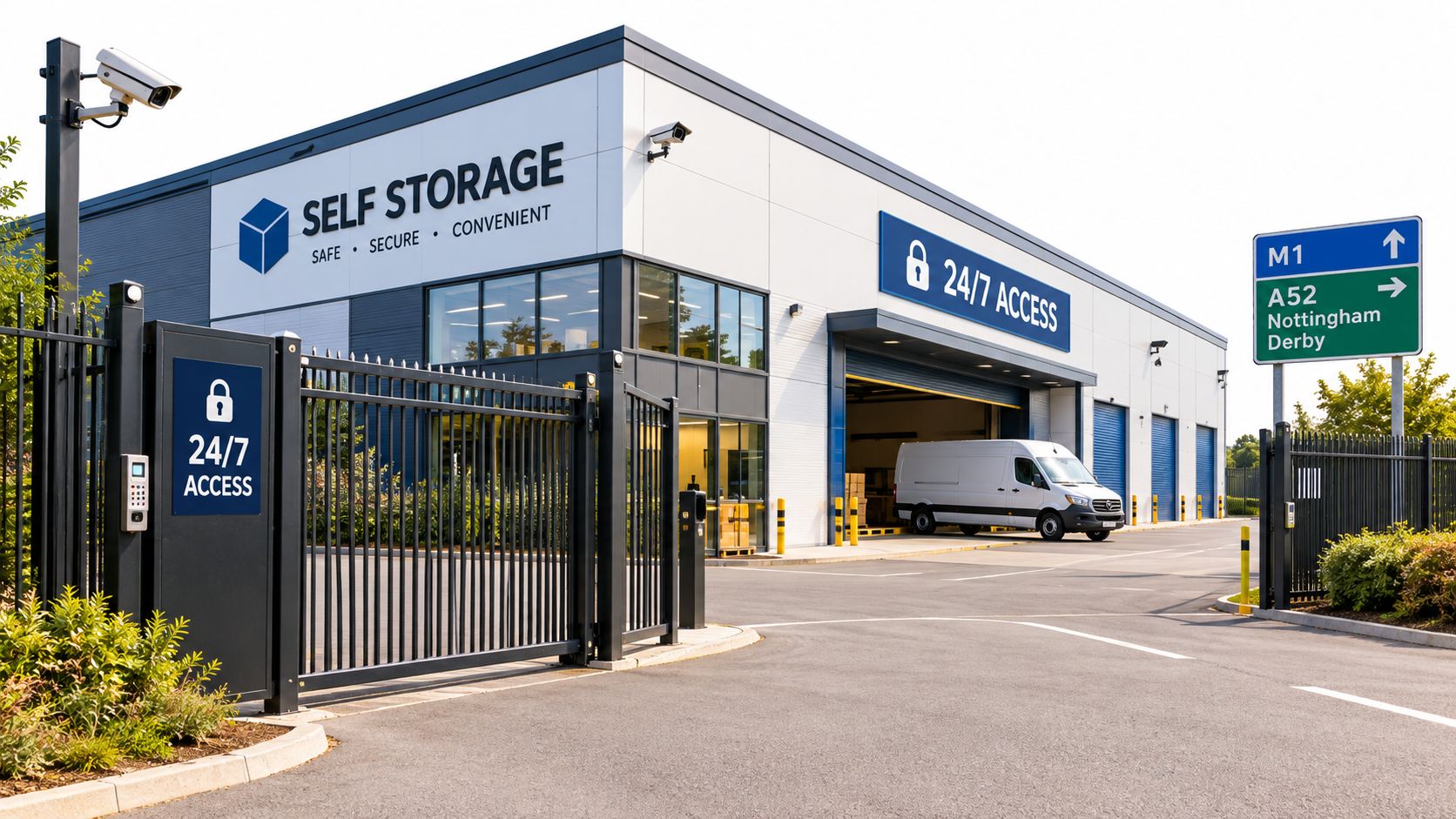
Ask how access is controlled and what security measures are in place. Gated entry, CCTV, on-site staff and clear procedures for authorised users are useful checks, but confirm what the provider offers rather than relying on general descriptions. Ask about access hours too. A unit that suits weekday visits may not work for a business that needs stock outside ordinary working hours.
For bulky items, look for ground-level access, a practical loading area and aisles that allow you to move goods safely. Drive-up access can make a difference when you're carrying tools, cartons or equipment between a van and the unit. Indoor rooms may be a better fit for smaller goods, paperwork or products that benefit from a more contained environment. In either case, check ventilation and the provider's rules on the goods you intend to store.
Nottingham's connection to the M1 and A52 can make a well-sited facility convenient for collecting supplies or serving customers across the area. The best choice depends on your routes: a unit close to your premises might be ideal for frequent picking, while a location near your regular jobs could suit a tradesperson better. Before committing, test the loading process with your actual vehicle and ask how deliveries are handled. Convenience is not a bonus if your stock depends on it; it's part of the facility's usefulness.
Real-World Use Cases for Tradespeople and E-Commerce Sellers
A Nottingham tradesperson may need to keep tools, fixings and job materials close enough to collect before a call-out, without filling the van overnight. A drive-up container can suit bulky equipment and sealed stock, provided the goods are permitted and the layout leaves a clear route to frequently used items. Keep high-value tools recorded separately, label shelves by job type or trade, and return materials to the same location after each job.
An online seller has a different pattern. The unit may need to hold sellable stock, cartons and packing materials, with returned or damaged goods kept apart. A room with shelves can help organise small products by SKU, while a drive-up space may be more practical for bulky cartons or larger batches. As orders fluctuate, flexible capacity can help the seller handle a seasonal peak or a product launch without taking a warehouse sized for the busiest period.
Online retail is a substantial part of the market. The Office for National Statistics reported that online sales represented 28.3% of UK retail sales in December 2025, up from 28.0% in November, and that online sales values were 11.1% higher than in December 2024 (ONS retail sales bulletin for December 2025). For a small seller, that makes a tidy dispatch setup useful, but it doesn't mean every retailer needs a warehouse. The right arrangement depends on order patterns, stock volume and how much handling the owner wants to do.
Packaging choices can also affect storage space and dispatch routines. Sellers reviewing protective materials for parcels may find this resource on shrink films for ecommerce shipping helpful when deciding what packing supplies to keep on hand. Whatever the setup, separate incoming stock from ready-to-dispatch orders and make sure the ledger matches the physical layout.
Frequently Asked Questions About Business Storage
What goods can I store?
It depends on the facility's terms and permitted-goods policy. Before moving stock in, ask specifically about aerosols, batteries, fuels, chemicals and other hazardous or restricted items. Don't assume that a product permitted in your workplace is automatically permitted in a storage unit.
Can I visit the unit outside normal business hours?
Access hours vary by provider and site. Confirm the actual arrangements before booking, including whether access is available on the days and at the times your business needs. If you expect regular early or late collections, make that a deciding factor rather than an afterthought.
What should I check before signing?
Read the contract for fees, notice requirements, payment terms, insurance responsibilities and rules on access or deliveries. Ask whether the quoted space is suitable for your stock, whether you can change unit size as needs shift, and how the provider handles security and prohibited goods. Get the terms in writing.
Is flexible storage better than a small warehouse?
Not in every case. Flexible storage can suit a business with modest or changing stock that doesn't need managed receiving or daily fulfilment. A warehouse may suit larger, predictable volumes and established logistics operations. Compare the total costs and workload, including business rates, utilities, insurance, fit-out, transport and the value of any space you'd leave unused.
How do I choose a unit?
List what you'll store, measure bulky items, identify what you'll retrieve most often and plan the route through the unit. Then confirm the internal dimensions, access arrangements and storage rules with the provider before booking. Keep enough room to reach goods and maintain a safe, organised layout.
Container Self Store provides indoor rooms and drive-up container storage for business stock, tools, equipment and records, with flexible terms and access at its Nottingham site. Compare unit options and request a quote through Container Self Store, or visit to assess which layout suits your inventory and collection routine.