The spare room has stopped being a room. There's a dismantled bed frame against one wall, six boxes marked "kitchen, maybe", and a bike you can't squeeze past. The fitters arrive on Monday, the flooring has to come up first, and you're standing in the middle of it wondering where the contents of a three-bedroom house are supposed to live for the next eight weeks.
This is the moment many individuals search for indoor storage. It's also where the first decision usually goes wrong. People rent too much space, or the wrong kind of space, because nobody explained what the options are or how the pricing maps onto a real inventory.
Storage works when you treat it as three decisions rather than one: how much floor you need, what conditions the contents require, and how long they'll be there. Get those right and a unit is a tool. Get them wrong and it's a monthly bill for a problem you've relocated rather than solved.
What an Indoor Storage Unit Is and Who Uses One
An indoor storage unit is a lockable, enclosed room or locker inside a secured building. Your possessions sit behind four walls and a door you lock yourself, reached along a corridor rather than across a yard. That's the practical difference from drive-up container storage, where a steel container stands outdoors and you load it directly from a vehicle. Both are self-storage. Only one keeps your belongings out of the weather as a matter of design.
The sector behind those doors is bigger than many assume. The UK self-storage annual report from Cushman & Wakefield counted approximately 2,915 self-storage stores across the UK in the 2024 calendar year, of which around 1,780 offered internal storage in purpose-built or converted buildings. Internal solutions accounted for 61% of UK storage, against 39% that were primarily container-based, run by roughly 1,480 operators ranging from single-site independents to national chains.
Three kinds of customer sit behind those figures:
- The homeowner mid-move. A family clearing a three-bedroom house so viewers can see the rooms, with a fortnight between exchange and completion.
- The student between contracts. Belongings that need a home between one tenancy ending and the next starting. The University of Nottingham alone reported 34,549 students based in Nottingham in 2019–20, according to its student statistics table, which is a lot of suitcases needing somewhere to sit for six weeks.
- The tradesperson or small retailer. Tools, materials, stock and boxes of paperwork that have outgrown a van and a back bedroom.
Whoever you are in that list, the same three questions follow: how big, what conditions, how long. The rest of this guide is those three questions answered in order.
Estimating Unit Size From Your Belongings
The fastest way to size an indoor storage unit is to stop guessing and match a written list against a floor area. Many people overestimate because they picture a houseful of furniture as one solid mass. In reality, boxes stack five high, sofas stand on end, and there's unused air above almost everything. Use the table as your first filter, then adjust for the route you need through the middle.
| Unit type | Typical size | Best for | Access |
|---|---|---|---|
| Indoor locker | 9 sq ft | Archive boxes, suitcases, seasonal clothing | Indoor access route |
| Compact indoor room | 25 sq ft | Student belongings, a small desk and filing | Indoor access route |
| Mid-size indoor room | 50 sq ft | Contents of a one-bedroom flat, office archive | Indoor access route |
| Large indoor room | 100 sq ft | Larger household contents, bulk trade stock | Indoor access route |
| Largest indoor room | 200 sq ft | Full household contents, large stock volumes | Indoor access route |
| 10 ft container | About 80 sq ft floor | Bulky furniture, tools, equipment | Drive-up |
| 20 ft container | About 160 sq ft floor | Stock, machinery, trade equipment | Drive-up |
Two things worth knowing about those rows. A 100 sq ft room is the same footprint that American guides call a 10 by 10, so if you've been reading size advice written in feet, what fits in a 10×10 unit gives you a direct comparison against your own list. The container rows, meanwhile, measure usable floor inside a steel box, both loaded straight from the vehicle.
Turn your inventory into a number
Work room by room and write down what's leaving the house, not what's in it. Group by destination: kitchen, bedroom, paperwork, tools. Count boxes and large pieces, because those are what consume floor.
A standard removal box measures roughly 45 cm by 35 cm, so its footprint is about 1.7 sq ft. Stack five high and ten boxes occupy under 4 sq ft of floor, provided the stack is stable and you can lift the top box down safely. Eight dining chairs nest into the space of two. A three-seater sofa stood on end takes roughly 10 sq ft. Total it, then add a retrieval route about one box wide, so 45 to 60 cm, down the centre.
That arithmetic turns a vague worry into a number. A three-bedroom house clearance, with beds, wardrobes, a sofa, white goods and sixty or seventy boxes, usually lands at the 200 sq ft end. A student with two suitcases and a box of books fits a 9 sq ft locker with room to spare.
What UK storage users actually rent
The SSA UK 2023 annual report, drawing on 1,827 responses from more than 80 UK storage facilities, found that units of 11 to 50 sq ft were the most popular category, chosen by 35% of respondents. It also found that business customers were more likely than domestic customers to take larger units.
That split is useful when you plan. Lockers and compact rooms are efficient for students, decluttering and boxed archives. A growing e-commerce seller or a trade user needs capacity that absorbs a stock increase without forcing a move to a warehouse, which usually means starting one row up and expanding within the same site rather than signing for space you'll only need in December.
Layout rules that decide the size
- Separate storage from access. Dense stacks belong at the back and sides; reserve the front third for anything you'll touch monthly.
- Stack to one box size. Mixed footprints waste height and make stacks lean. Heavy boxes at the bottom, nothing above shoulder height.
- Label every face. A box labelled on one side only is a box you'll end up opening twice.
- Keep a clear centre line. A route from door to back wall means you can reach any box without unloading the room.
If reaching a box you use often means moving more than one stack, the unit is too small. Step up a row rather than reorganising every fortnight.
Total your items, allow the route, then choose the row that fits. Five minutes of counting decides the next twelve months of rent.
Keeping Belongings Dry and Stable in an Indoor Unit
A leather sofa that spends a winter in a damp garage comes out smelling of mildew. The same sofa in a well-kept indoor unit comes out as it went in, because the building removes the three things that do the damage: rain, condensation and rapid temperature swings. That protection is why indoor rooms suit paperwork, furniture, electronics and anything with fabric or veneer. The building does only half the job, though. The rest comes down to how you load the space.
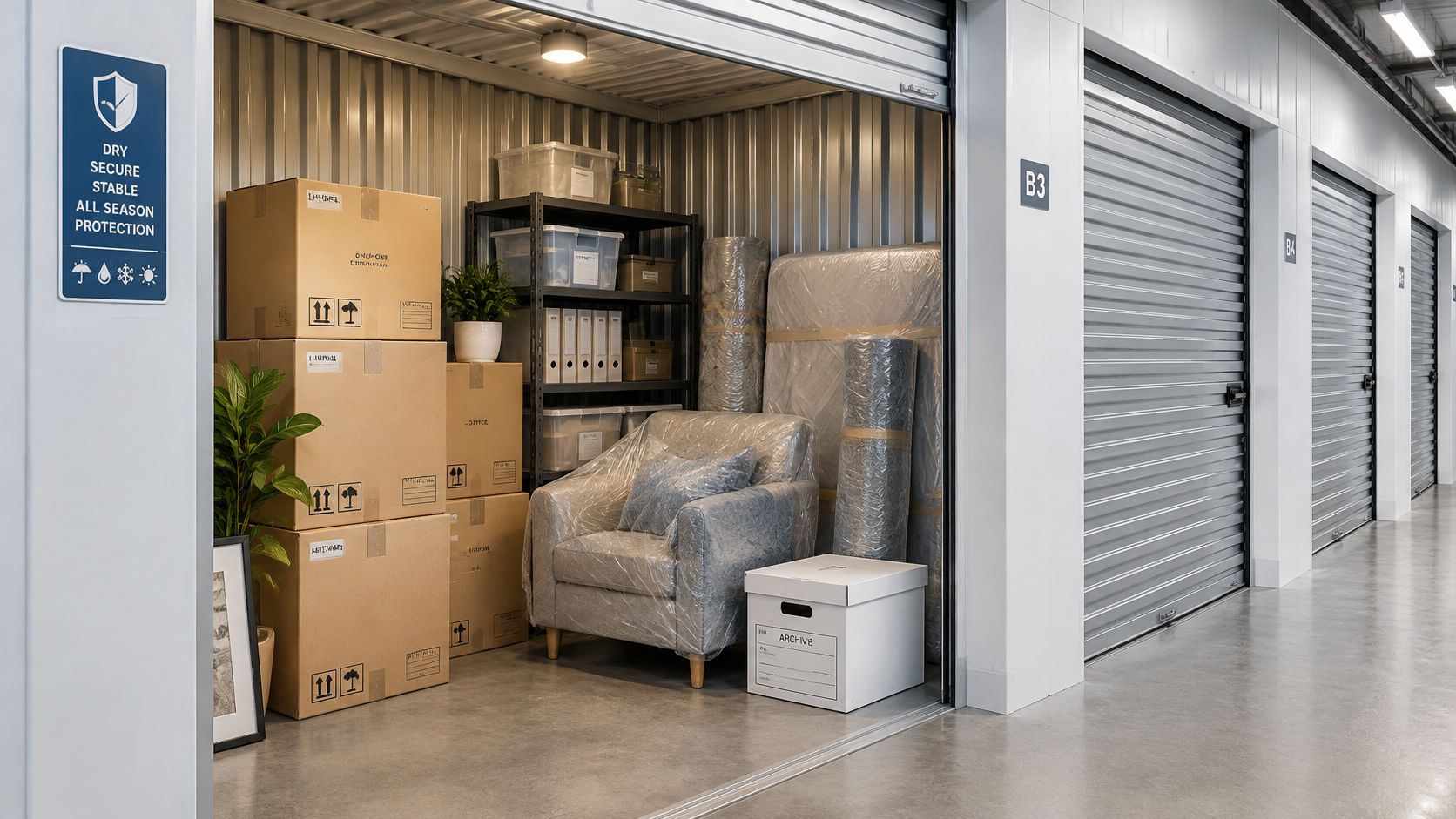
A well-loaded room looks like the one below, with air moving around the stacks and nothing pressed flat against a wall.
For anything on paper, the air inside the room matters as much as the floor area, so the useful benchmarks come from archival practice. The Archives and Records Association's guidance on environmental management advises 35% to 60% relative humidity alongside consistently cool conditions, while Norfolk Record Office gives a narrower practical archive target of 45% to 60% RH at 13°C to 19°C.
| Reference | Relative humidity | Temperature | What it means for a unit |
|---|---|---|---|
| UK Archives and Records Association | 35–60% RH | Consistently cool | Cool, stable air matters more than room size |
| Norfolk Record Office archive target | 45–60% RH | 13–19°C | Narrower practical target for archive storage |
| Ordinary household paperwork | Cool, dry, stable | No rapid swings | A standard indoor unit can suffice if conditions hold |
| Irreplaceable or highly valuable records | Tighter control than a general unit | Held constant year round | Consider monitored archival accommodation |
The reasoning is mechanical. Damp air feeds mould and microbiological activity, and paper spotted with it cannot be rescued by drying later. Air that is too dry embrittles paper fibres until pages crack at the fold. Temperature and humidity also move together: warm a room and its relative humidity falls, cool it sharply and water appears on cold surfaces. Condensation in a unit works like the mist on a car windscreen overnight, which is why concrete slabs and metal shelving are the first places moisture shows.
Handling rules that hold conditions steady
- Raise cartons off the floor. Pallets or shelving, even 10 cm of clearance, breaks contact with a cold slab.
- Leave air gaps. A hand's width between boxes and walls keeps circulation going.
- Never load damp items. Anything that has lived in a shed or garage needs to be dry before it goes in.
- Keep documents away from doors and heaters. Conditions change fastest in those two spots.
A standard indoor unit suits ordinary paperwork as long as the facility stays cool, dry and stable. Highly valuable or irreplaceable records sit in a different category and may need monitored archival accommodation. Where boxes are staying put for a year or more, Container Self Store's long-term indoor storage options offer clean, secure, weather-protected rooms suited to that kind of extended stay.
Ask before you book: how does the facility keep humidity stable through winter, and is your unit on an outside wall?
Business Records and How Long to Keep Them
For a business, storage is a records question before it is a space question. A box of invoices only earns its place in a unit if it can survive an inspection and still be found when someone asks for it several years from now. Two decisions shape everything else. The retention period sets how long the box stays, and the label decides whether you can retrieve it.
The HMRC rule that sets the outer limit
HMRC's compliance handbook states that companies filing a company tax return must normally keep records and supporting documents until the latest of three points: six years after the end of the accounting period, completion of a relevant enquiry, or the date the enquiry window closes. The "latest of" wording carries the weight here, because the clock runs until every one of those points has passed. The guidance's own example makes it concrete. Records for an accounting period ending 31 March 2010 had to be kept until 31 March 2016.
Company law places a separate duty on private companies to keep accounting records, generally for six years from the end of the financial year they cover, so the two clocks usually run side by side. Where the periods differ, the longer one governs.
Retention periods by record type
VAT paperwork splits by category, and HMRC's list of retention periods sets them out:
| Record type | Retention period |
|---|---|
| VAT account records | Six years |
| Bank statements and annual accounts | Five years |
| Purchase invoices, copy sales invoices, credit notes and debit notes | Four years |
| Import, export and warehouse-delivery documents | Three years |
| Production records, stock records, job cards and business letters | One year |
Where a document falls into more than one category, HMRC says the longest applicable period applies. An invoice that also forms part of your annual accounts is kept to the accounts period, not the invoice period.
Building a records archive in a unit
An archive works like a conveyor belt. Boxes enter at one end, move steadily toward their disposal date, and leave on schedule.
- Split by disposal date rather than topic. Six-year boxes at the back, one-year boxes by the door, so annual disposal is a walk rather than a dig.
- Date every box. Write record type, year and disposal date on two faces, because labels fade and marker smudges.
- Index the contents. A single page kept at home or in the cloud turns a search into a glance.
- Control access. Whoever holds the key should know what leaves the room and when.
Electronic records follow the same retention rules as paper, so a scanned invoice doesn't shorten the clock. Moving files off-site doesn't transfer the duty either: the obligation to preserve them stays with the business, and a tidy room of dated boxes is what makes compliance quick to prove. Business customers who need a working archive rather than a spare cupboard can see how our business storage units are laid out.
Using Storage During Renovations, Not Just Moves
A kitchen refit empties one room for six weeks. A loft conversion does the same job floor by floor. Storage marketed around house moves doesn't explain that pattern, but the figures do. The 2025 UK self-storage report records home redecoration at 24.4% of storage use, up from 13% in 2014, an increase of roughly 88%. Domestic customers form a large share of UK self-storage users, and renovation work is a growing source of that demand.
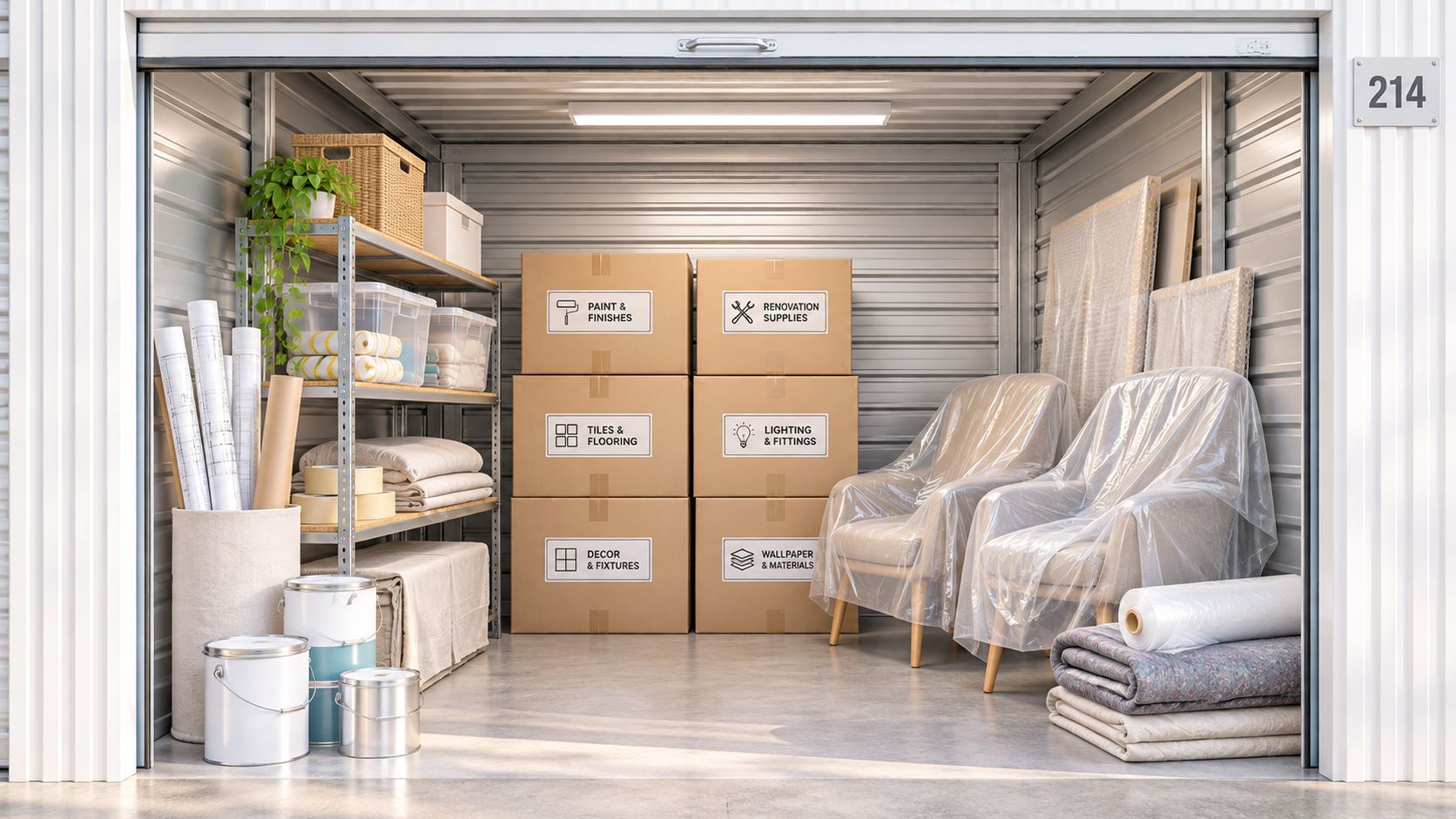
The behaviour has changed even where the advertising hasn't. Homeowners are improving the house they already have rather than trading up, and a phased project needs a dry, enclosed room where a lifetime of furniture can sit undisturbed. An indoor unit works like a spare room the house borrows for exactly as long as the work takes, then hands back.
Store and improve, or move
Two paths, and the comparison rarely gets done properly. Moving to a larger property carries agent fees, legal costs, removals, stamp duty and the working hours lost to viewings, and it resets your mortgage arrangements in the process. Storing carries a monthly fee for the length of the project and nothing else. For a single kitchen, bathroom or flooring job the storage total usually lands far below the cost of a move, so the budget goes into the improvement instead of the logistics of leaving.
Packing a room for a phased project
- Clear the room in one pass. Everything out, floor to ceiling, so trades aren't working around a sofa under a dust sheet.
- Wrap upholstered and veneered pieces. Dust settles into fabric and grits into hinges and runners; stretch wrap and old sheets do the job.
- Label by room and by the week it's needed back. "Kitchen, needed week 3" sorts your load into door boxes and back boxes before it leaves the house.
- Keep a home kit. Kettle, crockery for four, bedding, chargers and the tools you use weekly stay in the house, not in the unit.
Access beats distance on a short project. A room ten minutes away, or a container you can drive right up to, suits frequent visits, and our short-term self storage is set up for projects with a defined end date and no long-term commitment. A loft conversion that releases its contents in batches can sit deeper in the room, since each visit costs you nothing but a longer walk.
Test it this afternoon: stand in the room being done, list everything that has to leave it, and mark which items you would want back within a month. That split tells you how deep the unit gets packed and how close it needs to be.
Choose Your Unit Before You Book
Everything above comes down to three questions asked in order. What's going in? What conditions does it need? How long is it staying? Answer those and the choice usually makes itself.
Here's the kind of room that answers the first question at a glance, with floor space, headroom and a clear route from the door.
The decision path
- Match contents to type. If the load needs weather protection and fits one of the indoor rows in the size table, take an enclosed room. If it's bulky, heavy and wants loading from a van, take a drive-up container. Our indoor storage rooms run from 9 sq ft lockers to 200 sq ft rooms, and our 10 ft and 20 ft containers are ventilated, secure and accessible 7 days a week.
- Treat irreplaceable paper as its own case. Wills, deeds, original certificates, work you couldn't reconstruct. That's monitored archival accommodation, not a general-purpose unit.
- Cost the renovation before committing. Monthly fee multiplied by project length, set against the price of moving. If storage wins, choose access that matches how often you'll visit.
- Ask for a quote, then check the fit. Give the size row, your written list and your access needs. Book once the numbers agree with the inventory rather than with your nerves.
One practical cushion: there's no long-term commitment on our rooms, containers or business units, so the cost of picking a size that turns out slightly wrong is a month's rent, not a year's contract. When you're torn between two rows, start smaller and step up if the route through the unit disappears.
Container Self Store runs two sites in Nottingham and Northampton, with clean, secure, weather-protected indoor storage rooms, ventilated drive-up containers and business units behind gated entry, 24/7 CCTV and on-site staff. Tell us what you're storing, what conditions it needs and how long it's staying, and we'll match the unit to your list rather than to the biggest space on the price sheet. Visit Container Self Store for a quote and a size guide, and book the room or container that fits the inventory you've counted.