
Boxes are stacked in the hallway. The sofa is in the way of the painter. Your tenancy ends on Friday, but the new place isn't ready until Monday. Or your son's back from university and the spare room has gradually turned into a holding area for bikes, books, and bags. That's usually the point when short term self storage stops sounding optional and starts sounding sensible.
In Nottingham and Nottingham, short term storage is often less about “extra space” and more about getting through a busy patch without wrecking the house, the move, or your week. It gives you breathing room while you sort keys, decorators, removals, handovers, stock deliveries, or family logistics. You move the awkward bits out of the way, keep what matters accessible, and deal with the rest in the right order.
It's also a normal service now, not a specialist one. The UK self-storage market has expanded to 4,546 facilities by 2025, with occupancy sitting in the 83% to 87% range according to StorTrack's 2025 industry statistics. That matters because it tells you two things. First, there's broad availability. Second, people are still actively using it, even in a mature market.
If you're comparing options and want another practical overview of temporary storage scenarios, this short term storage guide is a useful companion read.
An Introduction to Short Term Self Storage
Short term self storage means renting storage space for a temporary need rather than a fixed long haul plan. In real life, that might be a couple of weeks during a house move, a summer break between student lets, or a short spell while your business clears room for incoming stock.
The main advantage is flexibility. You're not trying to force your whole life into a rigid timetable when the rest of your plans are moving around. Completion dates shift. Renovations overrun. Student accommodation contracts rarely line up neatly. A short term unit gives you a buffer.
What it usually looks like
There are two primary types of space commonly used:
- Indoor rooms for household contents, boxes, clothing, paperwork, and anything you'd rather keep in a more enclosed environment.
- Drive-up containers for furniture, tools, stock, equipment, and heavier items you want to load straight from a van.
The right choice comes down to access and what you're storing. If you'll be in and out often with bulky gear, ground-level drive-up access makes life easier. If you're storing packed household items and visiting less often, an indoor room often suits better.
Practical rule: Choose storage to remove stress from the job you're doing now, not to cover every possible future use.
Why people book it at the last minute
They don't plan to need storage. They hit a pinch point and need space quickly.
Common triggers include:
- House moves when dates don't quite meet
- Decluttering before viewings or building work
- Student moves between term-time and home
- Business overflow during seasonal rushes
- Trades and contractors needing secure, simple access to kit
The best short term setup is the one that feels easy from day one. Clear quote. Clear access. Clear contract. No mystery.
Common Uses for Flexible Storage Space
The most useful way to think about short term storage is by problem, not by unit type. People don't wake up wanting a storage room. They want a calmer house move, a tidier sale, a practical summer break, or a place to keep work gear without tripping over it at home.
Moving house without living in a maze of boxes
A lot of local families use storage before they've even exchanged. They want the house to look bigger in photos, easier in viewings, and less chaotic once offers start coming in. Spare chairs, bikes, toys, stacks of books, and the contents of the loft all go off-site so the house feels simpler.
That approach also helps on moving week. Instead of shifting everything in one frantic day, you can move non-essential items out early, keep only what you need at home, and deal with the final load more cleanly.
Students between halls, houses, and home
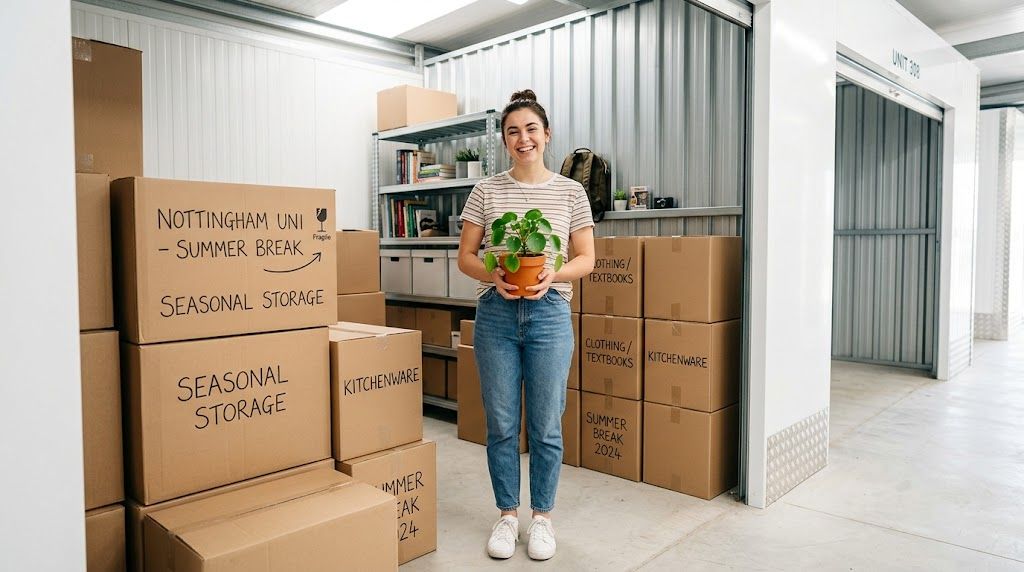
In Nottingham especially, students often need somewhere for a short gap between one tenancy ending and the next one starting. Taking everything home isn't always worth the trouble, especially if you've built up more than clothes and bedding. Kitchen kit, desk chairs, duvets, sports gear, and course materials soon fill a car.
Short term storage works well here because it keeps the in-between period manageable. You store your things locally, travel lighter, and collect them when the new room is ready.
A student unit usually works best when the contents are packed in stackable boxes with one clearly marked bag for the first day back.
Tradespeople who need quick access
A self-employed plumber, electrician, flooring fitter, or gardener doesn't need polished warehouse space. They need secure, reliable access and enough room to store tools, consumables, and bulky materials without turning the driveway into a work yard.
For that kind of use, drive-up storage tends to be the practical choice. You can back up, load fast, and get on with the job. That matters when your first call is early and you don't want to spend half an hour digging through a garage.
Small businesses with stock that won't stay put
Online sellers and smaller firms in Nottingham often use storage as a pressure valve. One month it's packaging and spare shelving. The next it's seasonal stock, event equipment, or archived paperwork that's taking over the office.
What works well is keeping the unit organised by use. Daily pick items near the front. Slower stock at the back. Tape, labels, and packing supplies in one crate. That way the space supports the business instead of creating another layer of mess.
Finding Your Perfect Storage Unit Size
People usually overestimate the size they need when they think in square feet alone. The better method is to think in categories. Are you storing boxes only, the contents of one room, or the contents of a whole flat? Do you need to walk into the unit often, or are you loading it once and leaving it until move-out?
Start with what you're actually storing
If you're storing only boxes, suitcases, and small household items, you can use space more tightly. If you're storing sofas, wardrobes, white goods, or trade equipment, you need room for awkward shapes and safe stacking.
A simple rule helps:
- Box-heavy loads can fit into smaller units than generally assumed
- Furniture-heavy loads need more breathing room
- Frequent access means leave space for an aisle
- One-off storage can be packed more densely if done properly
Here's a practical guide.
Self Storage Unit Size Guide
| Unit Size (sq ft) | Roughly Equivalent To | What It Typically Holds | Ideal For |
|---|---|---|---|
| 9 sq ft | A tall cupboard | A few boxes, bags, and small personal items | Students, document overflow, seasonal items |
| 16 sq ft | A small cloakroom | Boxes, suitcases, a bike, small furniture pieces | Short student stays, light decluttering |
| 25 sq ft | A small garden shed | Several boxes, bedside units, chairs, a small desk | Studio contents, spare room clear-outs |
| 35 sq ft | A large garden shed | Boxes plus a sofa, mattress, and occasional furniture | One-room contents, moving buffers |
| 50 sq ft | Half a single garage | Furniture and boxes from a one-bedroom flat | Moves, renovations, compact business stock |
| 75 sq ft | A full single garage feel | Contents from a one to two-bedroom home | Family moves, larger student house groups |
| 100 sq ft | A generous garage | Bulky furniture, appliances, and many boxes | Two-bedroom home contents, business overflow |
| 150 sq ft | A small commercial space feel | Larger household loads, stock, equipment | House moves with access space needed |
| 200 sq ft | A sizeable lock-up | Full household contents or substantial business storage | Larger moves, SMEs, archive and stock mix |
Indoor room or drive-up container
This choice matters as much as size.
Indoor rooms suit people storing packed household contents, archived paperwork, and items they want in a more enclosed setting. Drive-up containers suit bulky furniture, tools, materials, and stock when quick loading matters. If you're likely to reverse a van up to the door and unload straight in, a drive-up option is usually the easier call.
For a more detailed comparison of common sizes, this guide on what size storage unit do I need is handy.
If you're between two sizes, don't ask “Can I squeeze it in?” Ask “Can I load it safely and still find anything later?”
What usually goes wrong
The common mistake isn't renting too big. It's renting too small, stacking badly, and then needing a second unit or a stressful reshuffle. People also forget vertical space. Shelving units, stacked boxes, and dismantled furniture can save a lot of room if they're packed sensibly.
When in doubt, make a list before you book. Count the large pieces first. Beds, sofas, tables, wardrobes, white goods, tool chests. Then estimate the boxes. That gets you close enough to avoid paying for the wrong fit.
What to Expect from Storage Pricing and Contracts
Short term storage pricing is usually straightforward at first glance and slightly less straightforward once the extras appear. The monthly rent is only one part of the actual cost. You also need to check the minimum stay, the notice required to leave, whether insurance is mandatory, and whether any one-off charges apply.
What you're usually paying for
In most cases, the base price covers the unit itself and use of the site during the facility's access terms. Beyond that, there may be separate charges depending on the operator and the unit type.
Look out for these points when you ask for a quote:
- The unit rental. This is the main monthly charge.
- Insurance. Some providers require contents cover as part of the agreement.
- Padlock or security device. You may need to buy one if you don't already have a suitable lock.
- Access expectations. Check whether extended or frequent access is included as standard.
- Move-in offers. Introductory deals can help, but ask what the price becomes after the offer period.
The question people should ask first
If you only need storage for a short spell, ask this before anything else. Do I have to pay for a full month if I only need part of one?
That matters because, as noted in this overview of short-stay contract issues, many UK providers advertise flexible terms but still price storage monthly, which raises the question of whether unused days are prorated or refunded. In practice, “flexible” doesn't always mean “pay only for the exact days used”.
So don't stop at “Is it flexible?” Ask the detail behind it.
Contract points worth checking
These are the bits that separate a smooth short stay from an annoying one:
Minimum rental period
If the tariff is monthly, find out whether a shorter stay still triggers the full monthly charge.Notice to leave
Some operators are easy on this. Others want notice before your final day. Miss that and you may roll into another billing period.Move-out timing
Ask when the unit must be empty, clean, and locked off by.Insurance requirements
If cover is compulsory, include it in your budget from the start.
Short term storage is only cheap when the contract matches the job. A low headline price can lose its shine if the exit terms don't fit your timescale.
A good storage quote should answer your practical questions without you having to drag the details out. If the contract wording feels slippery, keep asking until it doesn't.
Why Local Access in Nottingham and Nottingham Matters
Convenience sounds like a soft extra until moving day arrives. Then it becomes the whole game. A storage site that adds awkward turns, town-centre traffic, or long detours can turn a simple drop-off into a drawn-out chore.
Industry analysis on self-storage site selection shows that short-term demand is highly sensitive to local convenience, and that the best-performing sites have short drive times and strong motorway access because that reduces customer friction during a move or clear-out, as explained by Inside Self-Storage's mini demand study guidance.
Why that matters on a real day
If you live in Nottingham, routes around the M1 and A52 can make the difference between a straightforward run and a stop-start slog with a loaded van. The same applies in Nottingham around the A45, especially if you're trying to fit a storage stop around work, school pickup, or a removals booking.
For different kinds of customers, access solves different problems:
- Home movers need a direct route that doesn't waste van hire time.
- Students want a location that's easy for family cars and borrowed vans.
- Tradespeople need quick in, quick out access before the day's jobs start.
- Small firms benefit from ground-level loading that doesn't slow dispatch and stock handling.
A well-located facility isn't just easier to reach once. It's easier every time you forget something, need one box back, or have to do the move in two stages.
What to check before booking
Use a map, but don't stop there. Test the route in your head.
- Look at the roads you'll use, not just the postcode pin
- Think about van access, not car access
- Check whether the site suits repeat visits
- Consider rush-hour reality if you'll visit before or after work
If you're weighing up East Midlands options, this page on self storage units in Nottingham gives a useful view of what a well-connected local setup looks like.
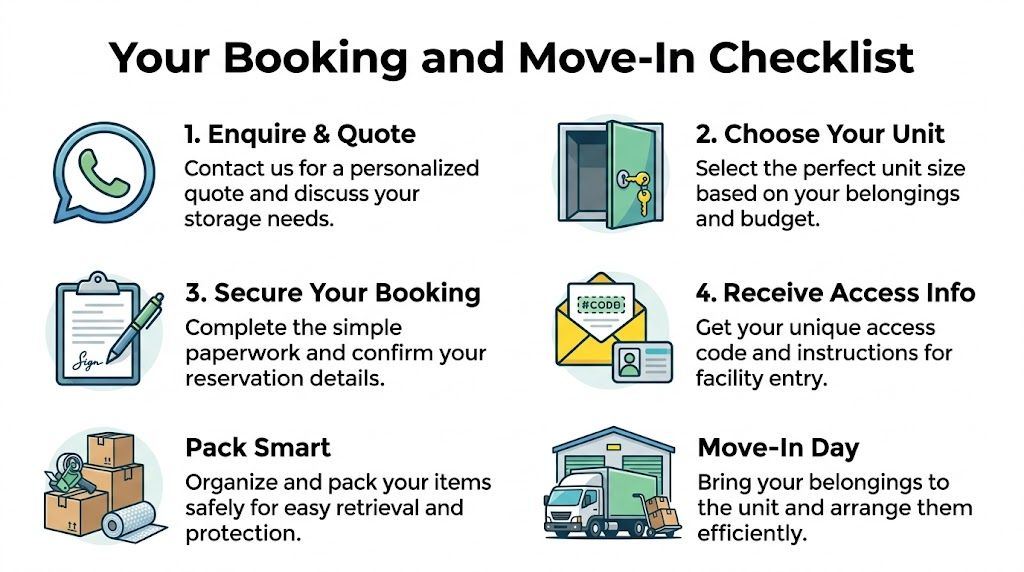
Your Booking and Move-In Checklist
A lot of first-time renters worry that storage involves loads of paperwork, awkward rules, or a long wait before they can use the unit. Most of the time, it's simpler than they expect if they prepare properly.
Before you book
Start with the basics. Know roughly what you're storing, when you need the unit, and whether you want an indoor room or drive-up access. If your dates are still shifting, be honest about that when you enquire. It helps staff guide you towards the right contract and unit type.
Have these details ready:
- Your move-in date or best estimate
- A simple item list with the bulky pieces included
- Your access needs, especially if you'll visit often
- Vehicle details, if you're bringing a van or trailer
- Any questions on notice and insurance before you commit
What you'll usually need for sign-up
Storage operators normally ask for identification and basic contact details. The exact list varies, but it often includes photo ID and proof of address. If a business is taking the unit, there may also be company details to confirm.
This part goes much faster if you bring everything first time. The delay usually isn't the storage. It's the customer turning up ready to move in but missing one key document.
Bring your ID, proof of address, payment method, lock, and booking confirmation on day one. That small bit of preparation saves a surprising amount of faff.
Move-in day
Keep move-in day boring. That's the aim.
Arrive with a plan
Don't fill the van randomly. Keep heavy furniture loaded first if it's going to the back of the unit, and keep the items you'll need soonest near the doors.Check access instructions before you set off
Make sure you know the gate procedure, unit number, and any arrival guidance.Walk the route once
If it's your first visit, take a minute to find the easiest unloading line rather than improvising with a trolley in one hand and a mattress in the other.Load by priority
Put long-stay items at the back. Keep essentials near the front.Lock up properly before leaving
Don't assume the door is secure just because it's shut.
A smooth move-in rarely comes down to strength. It comes down to sequence.
Smart Packing and Security for Your Belongings
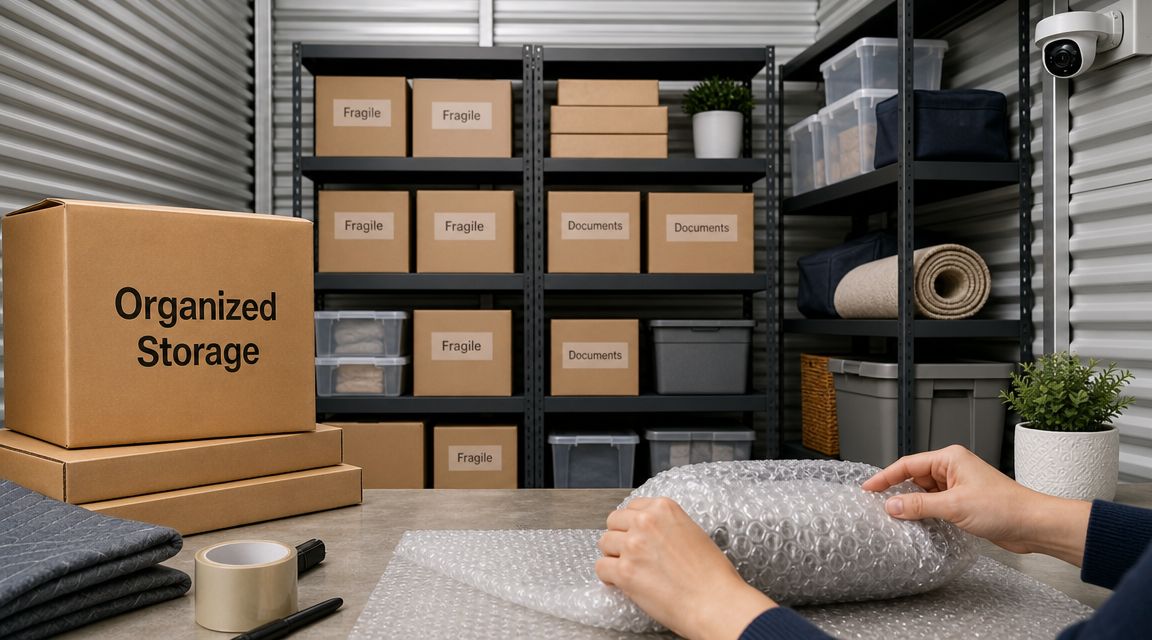
Good packing saves space, protects your things, and makes the unit cheaper in practice because you're using it properly. Bad packing does the opposite. It wastes room, increases the chance of damage, and turns every visit into a rummage.
Pack for stacking, not just transport
People often pack as if the job ends when the boxes leave the house. It doesn't. The boxes then need to stack safely in a unit, sometimes for weeks, without collapsing or hiding everything important.
Use sturdy boxes of similar size where you can. Label more clearly than you think necessary. “Bedroom” isn't enough. “Bedroom, lampshades, extension leads, winter bedding” is much more useful when you need one thing back in a hurry.
A few habits make a big difference:
- Keep heavy items in smaller boxes so they can still be lifted safely
- Use bubble wrap and covers for breakables and furniture edges
- Leave a centre or side aisle if you'll need regular access
- Stand mattresses and sofas carefully only if they're stable and protected
- Break down tables and bed frames to free up floor space
Security starts with your own setup
The site's security features are often a focus, which matters. But your part matters as well. A poor-quality padlock, no inventory, and loose packing near the door all make storage less secure than it should be.
Keep a simple item list on your phone. Photograph valuable pieces before move-in. Use a proper lock. Don't leave small expensive items in obvious, easy-grab containers near the front.
For a plain-English overview of cover options, this guide on how to protect your self storage assets is worth a read. If you're checking whether cover is required for your unit, this page on contents insurance for storage units is also useful.
Pack the unit as if you'll need one specific box in bad weather, in a rush, with poor memory. If you can still find it easily, you've packed well.
What peace of mind usually looks like
A well-run facility should make you feel that your belongings are being stored in a controlled environment, not dumped in a yard and forgotten. Customers usually look for gated access, CCTV, clear procedures, and staff presence on site. Combined with sensible packing and a decent lock, that gives most short term users exactly what they need. Confidence that their items will be there, in the same condition, when they come back for them.
Short Term Storage FAQs in Nottingham and Nottingham
Do I need my own insurance
Sometimes yes, sometimes the facility requires or offers cover as part of the agreement. Don't assume it's included in the headline price. Ask whether insurance is compulsory, what it covers, and whether you can arrange your own if the provider allows it.
What can't I store
As a rule, don't store anything dangerous, perishable, illegal, or likely to leak, rot, or attract pests. That usually means no flammable liquids, explosives, gas bottles, live items, or food. If you're unsure about a specific item, ask before move-in rather than on the day with the van loaded.
How does 7-day access usually work
It usually means you can access your unit every day of the week during the site's stated access hours. It doesn't always mean round-the-clock entry. Check the actual hours, how gate access works, and whether there are any differences on weekends or bank holidays.
Can I change to a bigger or smaller unit later
Often yes, if suitable space is available. That's useful when a short term booking changes shape. A house move may need more room than expected, while a student stay might shrink once a few items go home. Ask how transfers work and whether you'll need to sign a fresh agreement.
If you're putting soft furnishings into storage after a move or clear-out, it's worth cleaning obvious marks before packing them away. This guide on how to clean furniture stains can help with upholstery prep.
If you need secure, flexible storage in the East Midlands, Container Self Store offers indoor rooms and drive-up units in Nottingham and Nottingham, with straightforward access, clear terms, and space for home moves, student storage, tools, stock, and business use.