
Putting your belongings into storage can feel like a huge weight off your mind. You've found a secure spot, locked it up tight, and now you can get on with things. But a sturdy padlock and CCTV only tell half the story.
The simple truth is that contents insurance for storage units is your financial safety net. It’s what protects the actual value of your items from the kind of risks a lock can't stop: things like fire, flood, or even vermin damage. It’s not an optional extra; it's a vital part of storing your things responsibly.
Why Your Storage Unit Needs More Than a Lock
It's natural to think that once your stuff is behind a locked door in a secure facility, it's completely safe. And while modern storage sites have fantastic physical security, those measures are all about stopping unauthorised access. They can't do much against a burst pipe, an electrical fire, or a freak storm.
This is exactly where contents insurance for your storage unit comes in.
Think of it like this: your secure storage facility is like a bank vault. It has thick walls, complex locks, and round-the-clock surveillance to stop thieves. But the vault itself doesn't guarantee the value of the cash inside if the building burns down. That guarantee comes from insurance.
Physical Security and Financial Protection Work Together
A top-notch padlock and a good insurance policy aren't an either/or choice. They’re two sides of the same coin, working in tandem to give you total protection.
- Physical Security: This is your first line of defence. It’s the facility’s gated access, the CCTV cameras, and the strength of your own lock. A good lock makes your unit a much harder target for opportunistic thieves.
- Financial Security: This is your back-up plan for when the unexpected happens. It covers the cost of replacing your items if they’re damaged or destroyed by events that are completely out of anyone's control.
While insurance is your financial backstop, never underestimate the power of a good lock. It's always worth learning about the best padlocks for storage units to make sure you’re starting with the best possible physical security.
Your padlock protects your items from being stolen. Your insurance protects your investment from being lost. You need both for complete peace of mind.
Replacement Value vs. Current Value
Here’s a crucial detail you need to understand: the difference between 'replacement value' and 'current value'. Most good insurance policies cover the replacement value of your goods. This means the policy pays out enough for you to buy a brand new, equivalent item at today's prices.
This is far better than 'current value' cover (sometimes called 'actual cash value'), which only pays what the item was worth at the moment it was lost, after factoring in all the wear and tear.
For example, your five-year-old sofa might only have a current secondhand value of £100. But to buy a similar one new today could easily cost over £1,000. Proper insurance ensures you have the funds to actually replace what you've lost, not just get a fraction of its original cost back.
If you’re currently looking for a secure unit, our guides on storage container rental near me can help you find the right space in Nottingham or Nottingham.
Choosing the Right Insurance for Your Stored Goods
Figuring out insurance for your storage unit can feel like a bit of a minefield, but it really just comes down to three main options. Getting to grips with the real-world pros and cons of each is the key to protecting your stuff properly without paying over the odds. You can either extend your home insurance, go with a specialist provider, or take the policy offered by the storage facility itself.
Let’s walk through each path, so you can decide what makes the most sense for you at Container Self Store.
This handy decision tree shows the basic choice: are you relying just on a padlock, or do you want the financial safety net of an insurance policy?
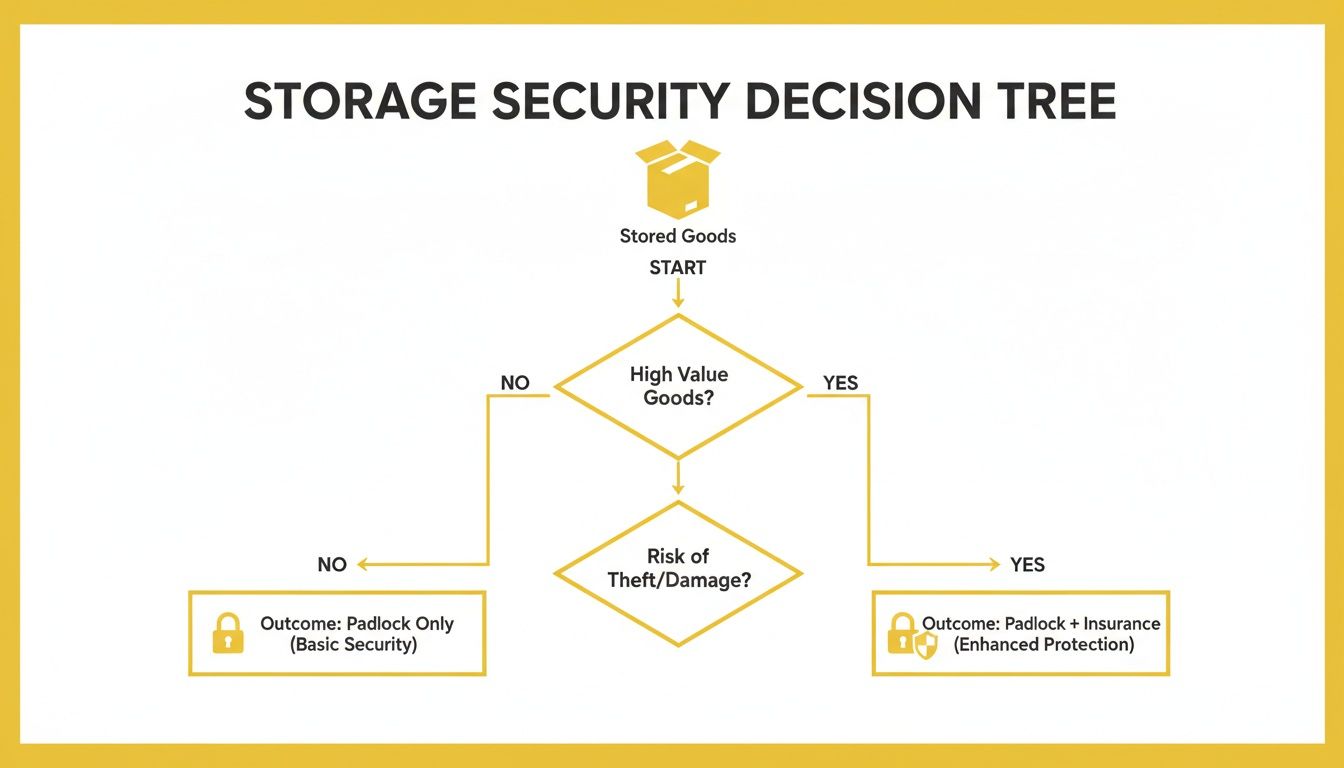
As you can see, a good padlock is your first line of physical defence, but a solid insurance policy is what really protects you financially if the unexpected happens.
Option 1, Using Your Home Contents Insurance
On the surface, just adding your stored items to your existing home or tenant’s insurance policy sounds like the easiest thing to do. You already have a relationship with the provider, and it feels neat to keep everything in one place. The reality, though, is often riddled with nasty surprises.
Many standard home insurance policies provide very little, if any, real cover for belongings stored elsewhere. It's common to find that:
- The total amount you can claim for items in storage is incredibly low – sometimes as little as £1,000 or £2,000, which likely won't even scratch the surface of what you've stored.
- Specific risks like flood or pest damage are often completely excluded for items not kept at your registered home address.
- There might be a time limit, meaning your belongings are only covered for the first 30 or 60 days they’re in the unit.
Expert Tip: Always ring your provider and ask them for written confirmation of cover for 'goods in a self-storage facility'. Never just assume your standard policy will stretch to cover everything properly.
Option 2, Buying from a Specialist Insurance Provider
A much safer bet is to buy a policy from a company that specialises in self-storage insurance. These providers build their policies from the ground up, specifically for the kind of risks your belongings face in a storage unit.
Going with a specialist has some clear advantages:
- Purpose-Built Cover: The policies are designed to protect against the most common storage risks like theft, fire, flood, and malicious damage.
- Competitive Prices: Because they operate in a crowded market, specialist insurers usually offer far better value for money than the in-house options.
- Flexibility: It’s easy to change your cover level up or down if you add or remove items from your unit, so you’re only ever paying for the protection you actually need.
A dedicated policy gives you genuine peace of mind, knowing your cover is fit-for-purpose and not just a flimsy add-on to a different insurance product.
Option 3, Taking the Storage Facility's Insurance
Most storage facilities, our Nottingham and Nottingham sites included, will need to see proof of insurance before you sign the rental agreement. To make life easy, many offer their own in-house insurance policy that you can sort out right there and then.
This is undoubtedly the most straightforward option. There’s no shopping around, and all the paperwork is done at the same time as the storage rental. The cost is simply rolled into your monthly payment.
But this convenience often comes with a hefty price tag. An eye-opening investigation for Telegraph Money (commissioned by Surewise) found that in a staggering 99% of cases, customers were quoted insurance prices up to three times higher when buying directly from a facility versus a specialist provider. The mark-up on in-house policies can be huge, which really shows why it pays to shop around. You can read more about these findings on how storage prices compare.
To help you weigh it all up, here’s a straightforward comparison.
A Practical Comparison of Storage Insurance Options
This table breaks down the key features, typical advantages, and common drawbacks of the three main insurance options, giving you an at-a-glance view to help you decide.
| Insurance Type | Pros | Cons |
|---|---|---|
| Home Contents Extension | Convenient single policy and provider. | Often has very low cover limits (£1,000-£2,000), multiple exclusions, and strict time limits. May increase your home premium. |
| Specialist Provider | Purpose-built, comprehensive cover. Competitive pricing and flexible terms. | Requires a few minutes of research to find and compare quotes. A separate policy to manage. |
| Facility-Provided Cover | Extremely convenient, set up on-site. The premium is added to your monthly storage bill. | Often significantly more expensive (up to 3x higher). Can have less flexible terms and higher excesses. |
Ultimately, while the facility’s insurance is a perfectly valid and simple choice, taking ten minutes to get a quote from a specialist could save you a serious amount of money over the time you’re renting. It puts you in control, allowing you to find the right balance between convenience and cost.
What Your Storage Insurance Policy Actually Covers
An insurance policy is only as good as the protection it actually offers. When it comes to insuring items in a storage unit, getting into the nitty-gritty of the policy wording is non-negotiable. It’s the fine print that determines whether you get a payout when things go wrong. So, let’s lift the lid on what’s typically covered and, just as importantly, what’s not.
Think of your insurance policy as a specific list of promises from the insurer. If a disastrous event is on that list, you’re covered. If it’s not, you’re on your own to cover the loss.
What Is Usually Protected
Most specialist storage insurance policies are built to handle the big, common disasters you might worry about. While the exact language will differ from one provider to the next, you can generally expect your belongings to be protected against loss or damage from a list of specific events, often called ‘named perils’.
Here’s a look at what’s almost always on that list:
- Fire and Explosion: This covers damage from a fire, whether it starts inside or outside your unit, as well as from explosions.
- Theft: This kicks in if your unit is forcibly broken into. It’s a great reminder of why a high-quality padlock is essential and why you should report any incident to the police immediately.
- Flood and Water Damage: This typically covers damage from things like burst pipes, a leaky roof, or external flooding from heavy rain or a nearby river.
- Vermin Damage: Provides protection against destruction caused by rats, mice, or other pests that might find their way into the facility.
- Malicious Damage and Vandalism: This covers intentional damage to your belongings by another person.
- Impact from Vehicles: If a car or lorry accidentally hits your storage unit, the damage to your goods should be covered.
Let’s put that into a real-world context. Imagine a tradesperson storing £5,000 worth of power tools in one of our drive-up units at Container Self Store. If a thief cuts the lock and makes off with the tools, a solid policy would cover the cost of replacing them. In the same way, if a pipe bursts in the unit next door and soaks your stored family furniture, your insurance should pay out for its replacement value.
What Is Often Excluded
Knowing what isn’t covered is just as critical as knowing what is. Exclusions are the specific situations or types of items the insurance company won’t pay for. Ignoring them can lead to a very nasty surprise if you ever need to make a claim.
Here are some of the most common exclusions to watch out for:
- Mould and Mildew: Damage that happens slowly over time due to dampness or humidity is almost never covered. Insurers see this as a maintenance issue, not a sudden, unforeseen event.
- Gradual Deterioration and Wear and Tear: Policies are designed for unexpected accidents, not for the natural ageing or breakdown of items over time.
- Certain High-Value or Prohibited Items: Things like cash, jewellery, fine art, and perishable goods are usually excluded. You’d need a special, high-value policy endorsement to cover them.
- Undeclared Items: If you haven’t listed an item on your inventory or included it in your total valuation, it simply won’t be covered. This is a common pitfall for people storing expensive electronics or business stock.
- Damage During Transit: Your standard storage insurance only protects items once they are safely inside the unit. You’ll need a separate ‘goods in transit’ policy to cover the move itself.
Your policy is a contract for a specific amount of cover. It’s crucial to ensure your total declared value matches the ‘new for old’ replacement cost of your items. If you’re underinsured, the insurer may only pay a percentage of your claim, even for a partial loss.
Beyond what’s covered, you also need to get your head around your policy’s financial limits to know the maximum amount you could ever receive in a payout. For a bit more background, understanding insurance policy limits is a great way to familiarise yourself with the concept. This knowledge is key to choosing a level of cover that gives you real peace of mind.
Getting to Grips with the Real Cost of Storage Insurance
When you’re sorting out a storage unit, it’s easy to focus on the weekly or monthly rental price and see insurance as just a minor add-on. But to really understand what you’ll be paying and to avoid any nasty surprises down the line, you need to look closer at how your insurance premium is calculated. The cost isn’t just plucked out of thin air; it’s directly linked to the value of what you’re asking the insurer to protect.
The single biggest factor that decides your premium is the ‘new-for-old’ replacement value of your items. Put simply, this is what it would cost to buy everything you’ve stored again, brand new, at today’s prices. It’s not what you’d get for them on Facebook Marketplace. Insurers use this figure to weigh up their risk, and your price tag will reflect that.
How to Calculate Your Cover Value
To get this number right, you’ll need to roll up your sleeves and create a detailed inventory. It takes a bit of time, but it’s crucial. For each item, think about what it would cost to replace it after a total disaster, like a fire.
Let’s walk through a real-world example. Say you’re putting the contents of a standard two-bedroom house into storage. Your list might look something like this:
- Living Room: Sofa (£1,200), TV (£500), bookcase and books (£400)
- Bedrooms: Two double beds with mattresses (£1,000), wardrobes and chests of drawers (£800)
- Kitchen: Small appliances, pots, pans, and crockery (£600)
- Miscellaneous: Boxes of clothes, personal effects, and electronics (£1,500)
Add that all up, and you get a total replacement value of £6,000. This is the figure you need to declare when you ask for a quote. Underinsuring your stuff is a classic mistake and can leave you seriously out of pocket, so it’s always better to round up than to sell yourself short.
The most common pitfall is valuing goods at their current second-hand price. You must always calculate the cost to replace them as new. An insurer will only ever pay out up to the value you’ve declared, so getting this figure right from the start is absolutely essential.
What You Can Expect to Pay
Once you have your total replacement value, you can get a much clearer picture of the actual cost. Storage insurance prices in the UK do vary, but they can be a noticeable addition to your rental fee. Based on what we see across the industry, typical premiums range from £2 to £8 per week, depending on the total value of your goods. While a 100 sq ft unit for a three-bed house might cost around £190 per month to rent, the mandatory insurance adds another layer to this expense. You can find out more about how these insurance costs compare on Surewise.com.
Don’t Forget the Policy Excess
The other key number to pay attention to is the policy excess. This is simply the amount you have to pay out of your own pocket towards any claim you make. It’s your contribution to the repair or replacement.
For instance, if your policy has a £100 excess and you make a successful claim for £1,000 worth of damage, the insurance company will pay you £900. You cover the first £100.
The excess is there for two main reasons: it stops people from making lots of small, trivial claims and it means you share a tiny piece of the risk. Some policies might let you choose a higher excess in exchange for a lower premium. This can be a good way to save a bit of money each month, but just make sure it’s an amount you could comfortably find if you ever needed to make a claim.
Your Step-by-Step Checklist to Getting Insured
Getting the right insurance for your storage unit doesn’t need to be a headache. If you follow a few simple steps, you can sort out a solid policy that properly protects your things without costing a fortune.
Think of it like this: you wouldn’t head off on a long road trip without checking the map first. It’s the same logic for storage – you need a clear plan to protect your belongings before you lock them away. Let’s walk through it.
Step 1: Create a Detailed Inventory
First things first, you need to know exactly what you’re insuring. The best way to do this is to go through your stuff, room by room, and list everything destined for the storage unit. Don’t just think about the big things like sofas and beds; get the smaller bits down too, like boxes of books or kitchenware.
A detailed inventory is your best friend if you ever have to make a claim. Be specific. Instead of just writing “TV,” note down “Sony 55-inch television, model X.” It feels like a chore now, but you’ll thank yourself later.
Step 2: Calculate the True Replacement Value
This part is crucial. For every item on your list, you need to figure out its ‘new-for-old’ replacement value. This isn’t what you could sell it for on eBay; it’s what it would cost to walk into a shop and buy a brand-new equivalent today.
- For furniture and electronics: A quick search online for similar models will give you current retail prices.
- For clothes and personal bits: Be realistic about what it would cost to replace them.
- For valuable collections or antiques: It’s often worth getting a professional valuation to make sure you’re not under-insuring them.
Add it all up, and that final figure is the total replacement value you’ll need to give the insurance provider.
Step 3: Check Your Existing Policies and the Facility’s Rules
Before you start hunting for quotes, there are two quick checks to make. First, give your home contents insurer a call. Ask them directly if your policy covers items held in a self-storage facility. As we’ve covered, any protection they offer is usually quite limited, but it’s essential to know where you stand.
Second, dig out the rental agreement for your storage unit. This is really important. Most facilities, including us here at Container Self Store, will state in the contract that insurance is mandatory. Look for their minimum cover requirements and any other specific rules they have.
Understanding the storage facility’s contractual requirements is non-negotiable. It ensures the policy you choose will be accepted, avoiding any last-minute issues when you arrive to move your items in.
Step 4: Compare Quotes from Specialist Insurers
Okay, now you’re ready to get some quotes. With your total replacement value in hand, contact at least three different specialist storage insurers. When the quotes come back, don’t just fixate on the price.
Look closely at the details:
- The policy excess (the amount you’d have to pay towards any claim).
- The list of insured perils (exactly what events, like fire or theft, you’re covered for).
- The list of exclusions (the things that are specifically not covered).
A cheaper policy might have a sky-high excess or exclude common risks, making it poor value in the long run.
Step 5: Read the Fine Print and Finalise Your Cover
Once you’ve picked a policy that looks right, take the time to read the full policy document before you pay. This is your final check to make sure it ticks all the boxes for both you and the storage facility. When you’re happy, go ahead and buy the policy, then send the proof of insurance over to the site manager.
Taking the time to get this right is a smart move. The UK’s self-storage market is huge, with an annual turnover now at £1.2 billion. In the East Midlands, average storage costs hover around £21.73 per square foot, according to data on UK storage costs at Checkatrade.com. A little bit of effort upfront to protect your goods could save you thousands of pounds and a world of stress down the line, especially if you’re considering long-term storage solutions.
How to Navigate the Claims Process Successfully
Let’s be honest, nobody wants to have to make an insurance claim. But if the worst happens, knowing the right steps can turn a nightmare scenario into a manageable process. A successful claim isn’t about luck; it’s about good preparation. In fact, the most important work happens before you’ve even locked your unit.
Thinking ahead is your secret weapon here. Before you load a single box, take the time to photograph your more valuable items. A quick snap on your phone is all it takes to create a visual record of what you’re storing and what condition it’s in. This simple step can head off so many arguments down the line.
An up-to-date inventory list is just as crucial. Your insurer will need to know exactly what’s missing or damaged, and what it would cost to replace it. Having this list ready to go not only gets the ball rolling faster but also shows you’re organised and on top of things.
Acting Fast When an Incident Occurs
The moment you discover something’s wrong, whether it’s a break-in, a leak, or fire damage, you need to act quickly. Your first priority, if it’s safe, is to stop any further damage from happening. This is what insurers call ‘mitigating your loss’.
After that, follow these steps methodically:
- Contact the Facility Manager: Let the team at Container Self Store know immediately. They need to log the incident, and their report will be a key part of your official claim.
- Report to the Police: For any theft or malicious damage, you must report it to the police to get a crime reference number. No insurer will even look at a theft claim without one.
- Notify Your Insurer: Get on the phone with your insurance provider as soon as you can. Most policies have strict time limits for reporting a claim, so don’t put it off.
It’s a good idea to jot down who you spoke to and when. It really helps keep everything straight during a stressful time. For more tips on managing your belongings, have a look at our guide on how to organise your storage unit effectively.
What to Expect During the Claims Process
Once your claim is filed, the insurer will assign someone, usually a claims handler or loss adjuster, to your case. Their job is to review all the evidence you’ve provided: your inventory, photos, the police report, and anything else.
Be prepared to provide receipts or other proofs of ownership for high-value items if you have them. The more documentation you can supply, the faster and more straightforward the process will be.
The handler will then assess the value of your loss based on your policy’s terms. Don’t be afraid to keep in touch with them and ask for updates. Good communication is vital. Ultimately, a well-documented claim that’s been reported promptly has the very best chance of a fair and successful outcome, helping you get back what you’ve lost and move on.
Your Storage Insurance Questions, Answered
Even when you think you’ve got it all figured out, a few last-minute questions about storage insurance always seem to crop up. Let’s tackle some of the most common ones so you can get your cover sorted and have complete peace of mind.
Do I Really Have to Get Insurance for My Storage Unit?
In a word, yes. Almost every self-storage facility in the UK will require you to show proof of insurance before they hand over the keys. It’s a standard part of the rental agreement, designed to make sure your stuff is protected from day one.
While the facility will likely offer their own insurance plan, you’re not usually tied to it. You’re free to shop around and find your own policy from a specialist provider, just as long as it meets the facility’s minimum cover requirements.
How Do I Figure Out How Much My Stuff is Actually Worth?
Getting the value right is crucial. The key is to calculate the ‘new for old’ replacement cost – what it would cost to buy everything again today, not what you’d get for it on Facebook Marketplace. The easiest way to do this is to make a simple inventory, room by room, of everything going into the unit.
For things like furniture or electronics, a quick search online for similar new models will give you a good idea of their current price. If you’re storing antiques, art, or valuable collections, it’s probably worth getting a professional valuation. A good rule of thumb? It’s always better to aim slightly high than to get caught short if you need to make a claim for a total loss.
Can I Insure My Business Stock or Work Tools?
You certainly can. Plenty of specialist insurance policies are built specifically for commercial goods. Just make sure you declare that you’re storing business items when you get your quote, whether it’s e-commerce inventory, power tools, or company archives.
Be aware that a standard household policy might not cover business use, or it might have very low limits for commercial items. Always double-check the policy details to ensure you’re getting proper commercial cover that actually protects your business.
For tradespeople and small business owners, this isn’t just a tick-box exercise. Getting the right business cover is about protecting your livelihood. It’s what ensures a fire or theft doesn’t put you out of action for long.
What Happens If I Add More Stuff to My Unit Later On?
If you move more items into your unit after your policy has started, you need to let your insurer know. Your premium is based on the total value of your goods, so adding more means you’ll need to increase your sum insured.
Forgetting to do this could leave you underinsured. If you had to make a claim, the insurer might only pay out a fraction of your loss, even if only a few items were affected. It’s usually a quick fix – just a phone call or a simple update in your online account.
At Container Self Store, our priority is making sure your belongings are safe and properly protected. Our friendly teams in Nottingham and Nottingham are always here to help with any questions about our units or insurance. To find your perfect secure space, pop over to containerselfstore.com.