You've outgrown the kitchen table, but a 3,000 sq ft lease in Chilwell still feels reckless. That's the trap I see all the time, owners trying to choose between a noisy home office and a long commercial commitment that eats cash before the business has earned it.
Shared workspace in Chilwell sits in the middle for a reason. It gives you a professional base without forcing you into a warehouse-style overhead, and the right setup can suit a lone consultant, a two-person office team, or a trades business that needs somewhere secure to work from between jobs.
Finding Your Ideal Work Space in Chilwell
A Chilwell electrician once told me he was running his quoting, ordering, and invoicing from the passenger seat of his van because his home office had become a dumping ground for family life. He didn't need a fancy corporate suite. He needed a place where he could keep paperwork clean, charge tools, and stop wasting half his day moving gear around.
That's the choice in shared workspace in Chilwell. Not between “work from home” and “sign a huge lease”, but between a setup that slows you down and one that fits the way small businesses function. Nottingham's market proves the wider demand is already there, with 39 coworking spaces recorded in the city and Nottingham ranked the 7th largest coworking market in the UK (CoworkingCafe UK and Ireland report).

Why the middle ground works
Remote workers usually want quiet, decent Wi-Fi, and a door that closes. Tradespeople and e-commerce sellers want that too, but they also need somewhere practical to keep equipment, stock, packaging, or samples without paying warehouse money for empty air. That's where flexible space beats the old model of one-size-fits-all offices.
The best sites near Chilwell are the ones that understand this split. A desk-only model works for a consultant on a laptop. It fails a business that turns over physical goods, carries tools, or needs ground-level access every day. If you're comparing options in Nottingham, office space in Nottingham is worth viewing as a benchmark because it shows how local flexible stock is being packaged for different business types.
Practical rule: if your day involves carrying boxes, tools, or samples, don't buy a workspace based on images of hot desks and plants. Buy on access, security, and how much time you'll waste if the setup is wrong.
The common mistake is choosing a space that looks polished but slows down the business. The smart move is picking a place that keeps the admin, storage, and day-to-day work under one roof.
Types of Flexible Workspace Available
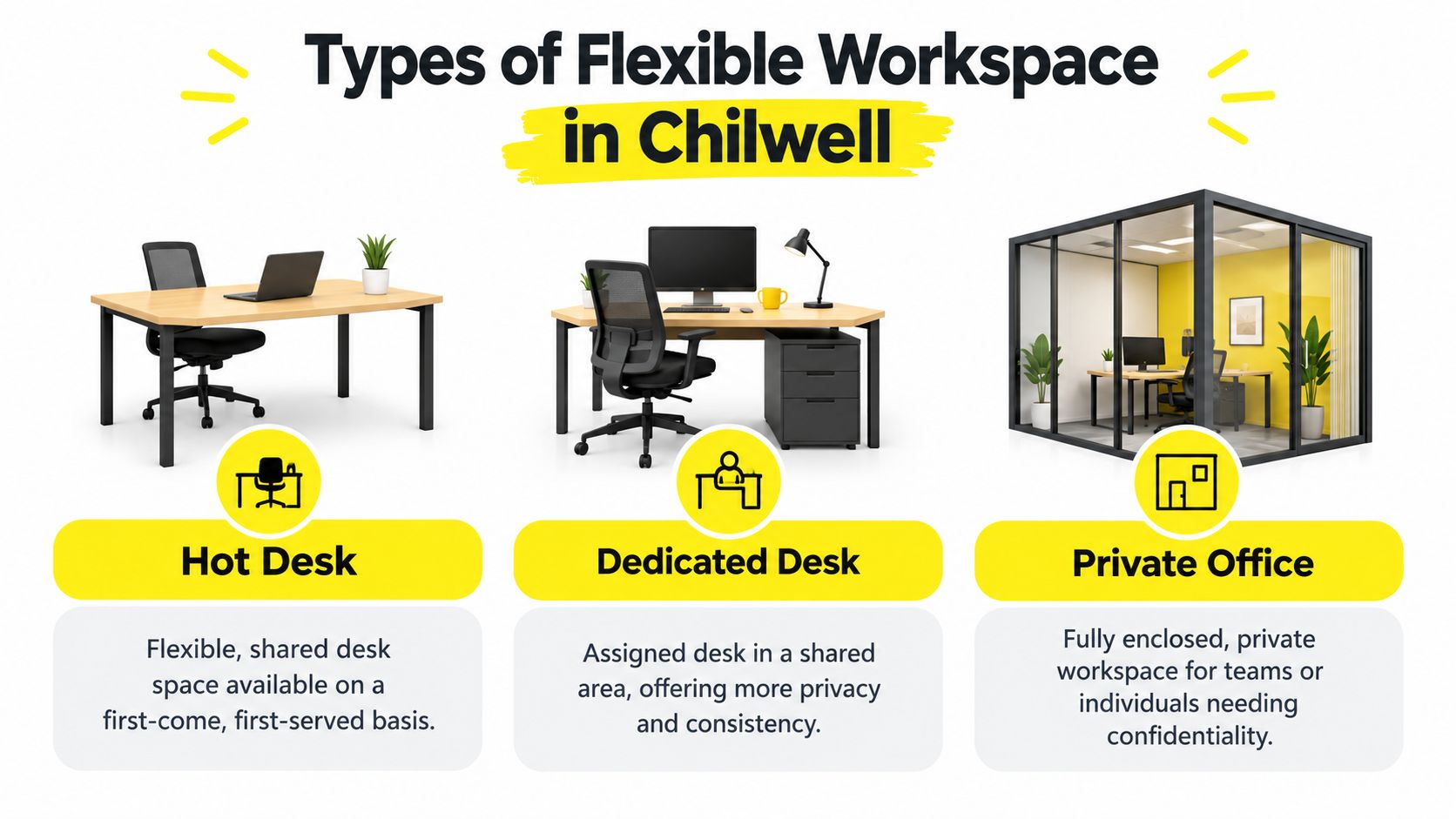
The market usually splits into three clear categories, and each one solves a different problem. Hot desks suit people who only need occasional access. Dedicated desks and private offices suit people who need consistency, privacy, or both.
A hot desk is the lightest option. You turn up, claim a seat, log in, and leave. For freelancers and hybrid workers, that can be enough, especially when the appeal is routine, a professional address, and a break from home distractions. In Nottingham, coworking prices give a useful benchmark, with median monthly rates reported at £158 for open workspaces, £211 for dedicated desks, £49 for virtual offices, and £18 per hour for meeting rooms (CoworkingCafe Nottingham market snapshot).
Private space versus business pods
Private offices change the equation. You still sit inside a shared building, but you get a closed room, better privacy, and a stronger sense of control. That matters for client calls, sensitive paperwork, or any small team that can't afford the noise and interruptions of open-plan space.
For trades and sellers, the more interesting option is a business or trade pod. Think of it as a mobile office that doesn't move, a lockable unit with power, Wi‑Fi, and room for tools or stock. If you need guidance on connectivity in that kind of setting, the practical standards around guest Wi‑Fi for co-working spaces are a useful reference point because stable access and simple login flows matter more than glossy branding.
| Type | Best for | Main strength | Main weakness |
|---|---|---|---|
| Hot Desk | Solo remote workers | Low commitment | No personal storage |
| Dedicated Desk | Regular desk users | Consistency | Limited privacy |
| Private Office | Small teams | Confidentiality | Higher commitment |
| Trade Pod | Trades, e-commerce, micro-SMEs | Work and storage together | Less suited to casual drop-in use |
The right choice comes down to what your business does every day. If you only need a screen, a chair, and decent internet, keep it simple. If you're carrying stock or tools, ignore the café-style noise and look for something built for real work.
Why Flexible Workspace Matters in Nottinghamshire
In Nottinghamshire, businesses are still making moves. A 2026 market review reported 315,000 sq ft of total occupier take-up across the county in 2025, with city-centre take-up at 173,631 sq ft, 30% ahead of 2023 and 5% above 2024 (Nottinghamshire market review). In Chilwell, that matters. It shows occupiers are actively reshaping space to fit how they work.
The flexible sector points in the same direction. Independent UK coworking data put the market at 4,415 flexible workspaces in the UK in Q2 2026, with occupancy often above 80% (Innes England market insight). That level of demand is not a passing trend. It shows businesses want shorter commitments, better use of floor space, and fewer idle costs sitting in half-empty rooms.
Benchmarks that make the local picture clearer
Many Chilwell searches are really comparisons with Nottingham. That is sensible, because the city market is established and gives a realistic pricing reference. A market snapshot placed Nottingham as the 7th largest coworking market in the UK, with clear price benchmarks already in circulation for desks, open space, virtual offices, and meeting rooms (CoworkingCafe report).
That points to two things. Flexible workspace has moved well past novelty in this part of the East Midlands. Buyers are also sharper now. They know what a desk costs, and they are asking a better question, does the space help the business trade better?
A space that only saves rent falls short when it wastes collection time, storage time, or quiet working time, that is a false economy.
The operators that win here do it on practicality, not polish. Trades, micro-SMEs, and sellers around Chilwell need space that cuts friction. The market already rewards that kind of setup.
How to Evaluate and Choose the Right Space
A Chilwell unit can look perfect on a tour and still fail a working business. Start with how the space will function on a normal day. If you are loading tools, moving stock, or taking deliveries, ground-level access saves time and reduces damage. If every visit turns into a carry-and-climb routine, keep looking.
Security comes next. Ask who controls access, how CCTV is monitored, what the locks cover, and whether anyone else can get in after hours. For a tradesperson holding tools or an e-commerce seller storing stock, weak security is a business risk, not a small inconvenience.
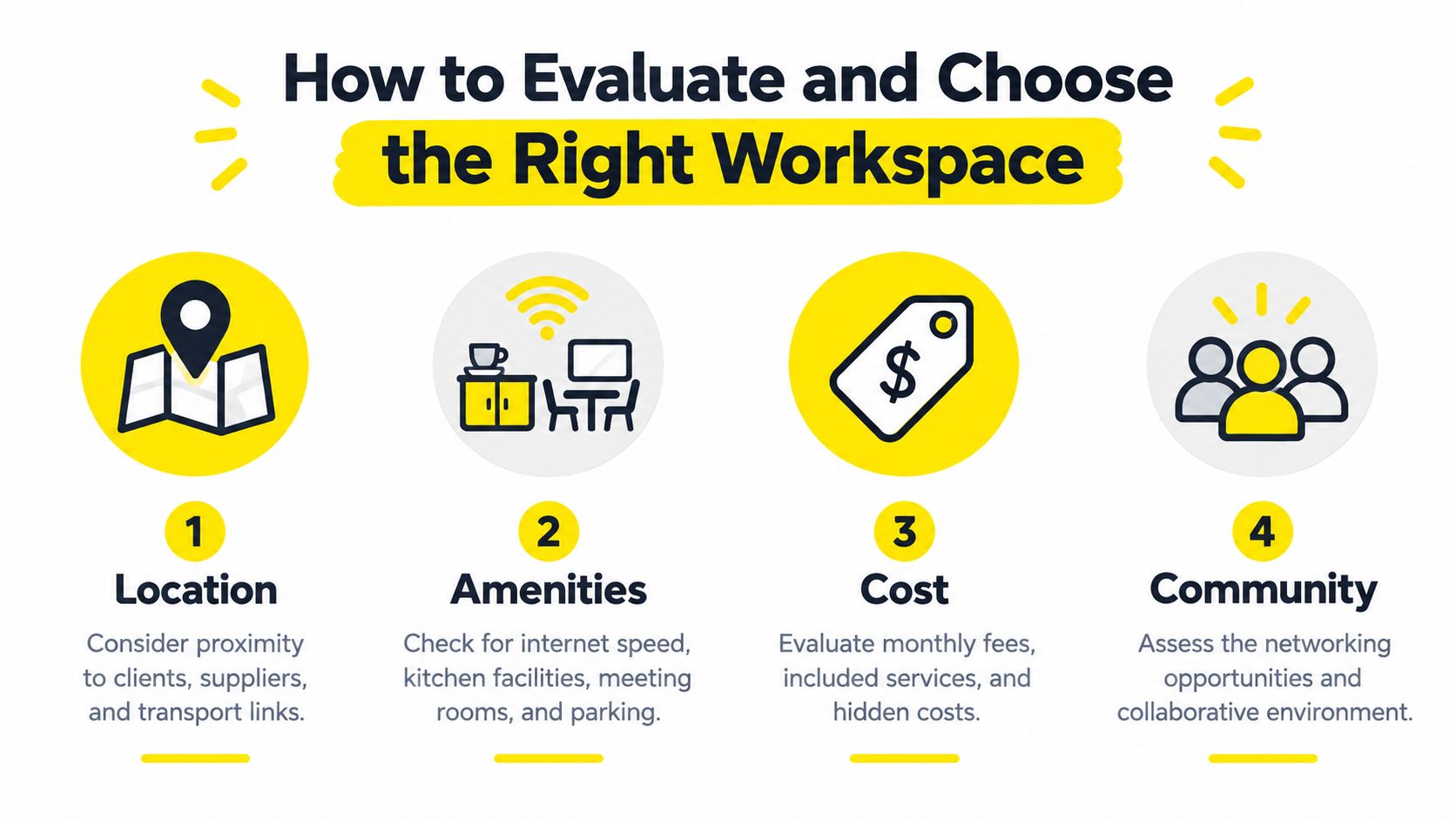
Ask the right questions before you sign
- Location: Can clients, suppliers, and staff reach it easily, and is parking or delivery access realistic for the way you work?
- Amenities: Does it have reliable internet, enough power points, meeting space, and basic facilities that match your operation?
- Cost: Are the monthly charges clear, and what is included before extras start creeping in?
- Community: Does the building create real business value, or is it just shared space with polite neighbours?
Those are simple questions because they are the right ones. Most mistakes happen when someone tours a site, likes the fit-out, and forgets to ask how the business will run inside it. F1Group workplace consulting insights makes the same point, workspace decisions should follow business strategy, not showroom appeal.
Hard rule: if the space does not save time, protect assets, or support revenue, do not sign.
Check the hidden costs as well. Business rates are paid by occupiers of business premises, and Nottingham City Council's guidance explains the basics clearly (Nottingham City Council business rates guidance). If rates, service charges, or access rules are unclear, walk away. A cheap-looking deal turns expensive fast when the fine print is driving the costs.
The Advantage of Integrated Storage and Workspace
A coworking desk works beautifully for a consultant. It is the wrong answer for a plumber, a locksmith, a decorator, or a seller who moves cartons every week. If your work depends on equipment, inventory, or packaging, splitting your day between a desk and a separate unit just creates waste.
The daily pain is obvious. You leave the office, drive to storage, pick up materials, then drive to site. Or you sit down to invoice and realise the stock you need is three miles away. That's time, fuel, and attention leaking out of the business.
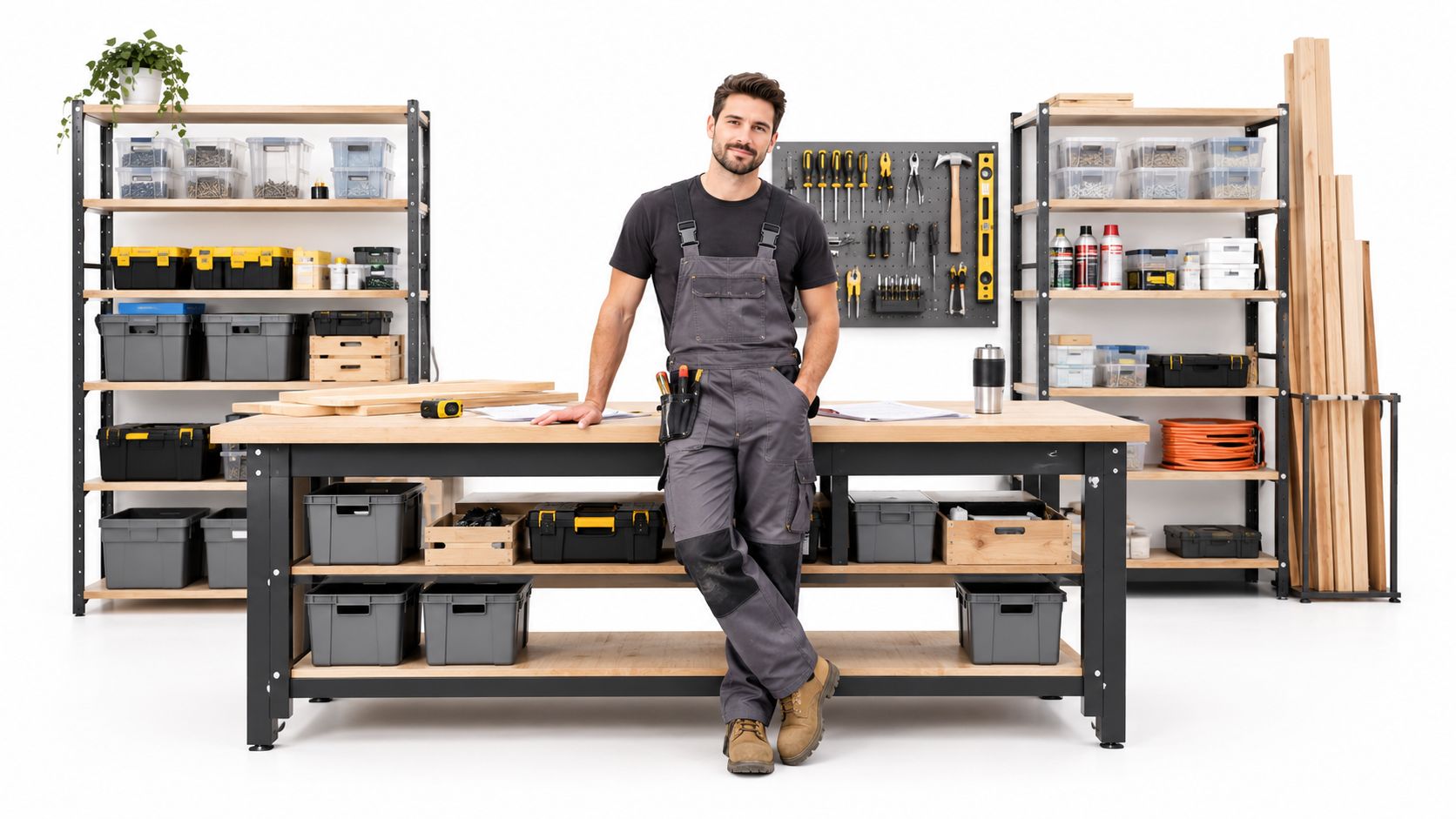
One space does the job of two
That's why integrated units matter. A secure pod with power, Wi‑Fi, and lockable storage changes the working pattern completely. You can quote, order, pack, and store from the same base without shuttling between a desk and a shed. For many small operators, that isn't a luxury, it's the difference between a smooth week and a messy one.
A modern Chilwell listing for Chetwynd Business Park shows how specific workspaces are assessed locally, with a modern office building at 16 Regan Way, a total net internal floor area of 8,392 sq ft, a 2017 rateable value of £88,500, and business rates payable of £45,312 for 2020/2021 (Savills Chetwynd Business Park brochure). That kind of detail matters because it reminds you space is not abstract. It has tax, utility, and operational consequences.
If you want a simple option that combines office space and storage, office space with storage for rent is the sort of model worth comparing against a standard desk rental. I'd take that seriously for any business that handles tools, stock, or bulky equipment.
The point is simple. Don't rent two separate problems if one integrated unit solves them both.
Comparing Workspace Options for Your Business
| Option | Ideal user | Security | Storage | Access | Budget logic |
|---|---|---|---|---|---|
| Coworking desk | Freelancers, remote workers | Shared environment | Minimal | Easy, drop-in friendly | Lowest commitment |
| Private office | Small teams, client-facing firms | Better privacy | Limited or internal | Controlled, enclosed | Higher than a desk, still flexible |
| Trade or business pod | Trades, e-commerce sellers, micro-SMEs | Stronger control | Built in | Ground-level, practical | Pays back in time saved |
The table tells the truth quickly. A coworking desk is fine if your work lives on a laptop. It becomes clumsy the moment you need to secure gear, stack boxes, or keep materials on hand. Private offices add privacy, but they don't always solve the storage problem.
Trade and business pods are different because they treat workspace as an operating tool rather than a nice backdrop. That is why they suit businesses that need to move, store, and work in the same place. They reduce clutter, cut repeat trips, and keep assets closer to the people who use them.
A lot of local businesses don't need more prestige. They need less friction. The right choice is the one that matches your actual workflow, not the one that looks best on a brochure.
Final Checklist and Common Questions
Before you sign anything, check access hours, security, noise levels, internet reliability, and whether the contract lets you scale without drama. Ask who pays the rates, what happens if you grow, and whether the space still works when the business gets busier.
People also ask whether temporary spaces trigger business rates, and whether virtual office services can sit alongside a physical base. They can, but only if the provider spells it out clearly. The smarter move is to choose a setup that fits your next twelve months, not just your next week.
If you're weighing up storage, workspace, or a mix of both, Container Self Store gives you a practical place to compare options without the baggage of a full warehouse lease. Visit Container Self Store and look at the spaces that suit trades, sellers, and small teams who need secure ground-level access and a cleaner way to work.