You know the point where the spare bedroom stops being a home office and starts looking like a dispatch bay. Stock on the floor. Packaging under the desk. Tools left in the van because there's nowhere safer to put them. Client calls taken between deliveries, returns, and the constant hassle of moving things from one place to another.
That setup works for a while. Then it starts costing you money.
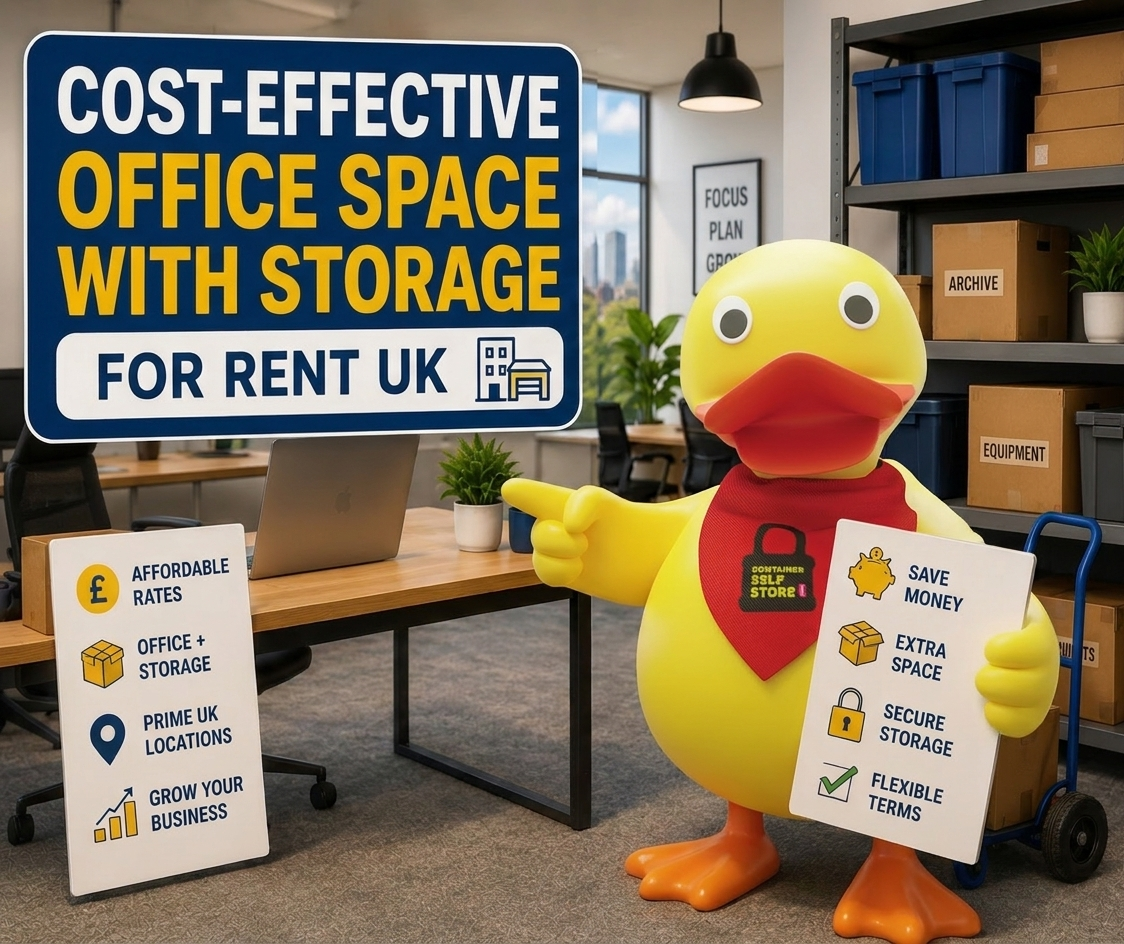
If you're searching for office space with storage for rent, the primary issue usually isn't space alone. It's wasted movement, split locations, poor access, and paying for premises that don't suit how your business operates. For tradespeople, online sellers, small teams, and self-employed operators outside major city centres, the smartest move is often a hybrid unit that gives you workspace and storage in one place.
That's not a niche requirement anymore. UK self-storage demand surged 15% in 2025, with SMEs comprising 28% of users seeking combined workspace-storage to cut costs by 40-60% versus traditional leases, according to the British Self Storage Association annual report. The same source notes that areas off the M1 and A45 in the Midlands show 22% higher SME vacancy rates for flexible units, which matters if you want practical space without city-centre costs.
Is Your Business Outgrowing Your Space?
A lot of businesses reach the same stage in roughly the same way. The e-commerce seller starts from home, takes a small lock-up for overflow, then realises they're driving between the two every day. The electrician keeps materials in one place, paperwork in another, and loses half an hour each morning loading the van. The small service business rents an office that looks professional but still needs separate storage elsewhere.
That's bad property strategy.
When your stock, equipment, desk work, and admin are split across different locations, you pay in time first and rent second. You also make growth harder than it needs to be. Staff can't find things quickly. Deliveries become awkward. You end up renting based on habit rather than workflow.
The warning signs are usually obvious
You're probably outgrowing your current setup if any of this sounds familiar:
- Your home no longer functions as a home. Inventory, samples, tools, or archive boxes have spread into living space.
- Your vehicle is acting as a storeroom. That creates security risk and slows every job down.
- You're renting two imperfect spaces. One unit for stock, one office for admin, neither designed to work together.
- You avoid taking deliveries because access is awkward, restricted, or too far from where you work.
- You're turning down work because there's no room to store extra materials, packaging, or seasonal stock.
Practical rule: If your business relies on regular access to physical items, your property should reduce handling, not create more of it.
Why hybrid space makes more sense
For most SMEs and tradespeople, a combined office and storage unit solves a basic operational problem. It puts your desk, stock, tools, paperwork, and loading area in one workable footprint. That means fewer journeys, quicker dispatch, better control of stock, and a cleaner separation between home life and business activity.
It also gives you a more professional base without forcing you into a long warehouse lease or a polished office you don't need.
The strongest demand for this kind of space isn't just in city centres. It's in practical regional locations where people can drive in, load easily, and get back on the road without wasting half the day in traffic or paying premium rent for the privilege.
Analysing Your True Space and Workflow Needs
Most tenants start by asking, “How much space do I need?” Wrong question. Ask, “How does my business move through the space in a normal week?”
That changes everything.
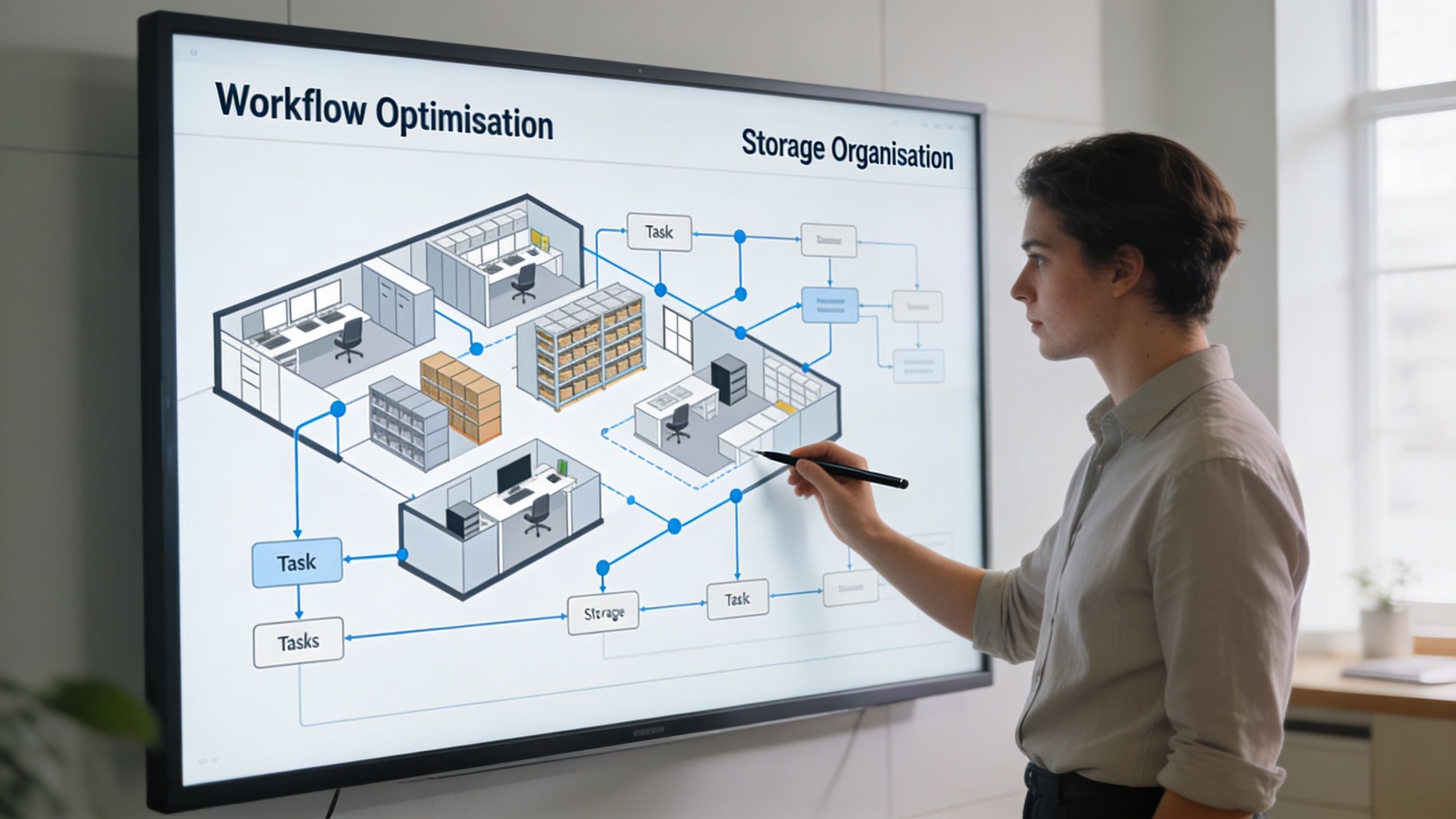
A proper brief should cover stock volume, access frequency, loading style, desk requirements, power needs, internet, and how quickly you expect the business to change. Skip that work and you'll either over-rent or choose a unit that looks fine on day one but creates friction every day after that.
Start with use, not square footage
Break your operation into three zones:
- Working zone. Desk space, admin, quoting, customer calls, laptop work, and any room needed for one or more people.
- Active storage zone. Items you touch often. Daily picks, packaging, tools, consumables, returns, or materials for current jobs.
- Passive storage zone. Archive files, slower-moving stock, seasonal items, spare equipment, or overflow.
Once you divide the business this way, you can judge what must stay immediately accessible and what can sit further back. That's how you stop paying premium space rates for items you rarely touch.
Use utilisation as your discipline
This is the number too many occupiers ignore. UK-specific benchmarks for office-storage hybrids target a 60-70% utilisation rate, and a pre-lease audit often reveals 28% average over-allocation. Optimising that can save 18-25% on rent, while vertical racking can increase storage space utilisation by over 45%, according to Tango Analytics on office space utilisation metrics.
That tells you something important. Many businesses don't need more space. They need better layout.
Don't rent empty air. Rent usable workflow.
If your boxes are stacked badly, your shelving is shallow, or your team keeps a “just in case” area that never moves, you're paying rent on inefficiency. Before you sign anything, map what you hold, how often it moves, and who needs access to it.
Build a short brief before viewing units
Write this down before you visit any site:
- Access pattern. Daily, weekly, or occasional.
- Loading method. Hand-carry, trolley, pallet, van side-door, rear-door, or mixed.
- Working requirement. One desk, shared hot-desk space, meeting area, or private pod.
- Utilities. Lighting, sockets, Wi-Fi, heating tolerance, charging for tools or devices.
- Growth tolerance. Whether you need a unit that can scale without a disruptive move.
For layout ideas, it's worth reviewing specialist examples such as Gibbsonn acoustic pod storage options, especially if you're trying to separate quiet work from active storage in a compact footprint. If stock control is the bigger issue, tighten your process before taking more room. A clear stock system beats a bigger unit every time, and this guide to inventory management for small businesses is a sensible place to start.
Matching a Unit to Your Business Model
Not every hybrid unit suits every operator. A builder, an online retailer, and a consultant with archive storage don't need the same thing. The mistake is choosing on size alone.
Choose on handling, access, and how the space earns its keep.
What usually fits best
A drive-up container works well when you need sturdy, simple storage with direct loading. A business pod suits operators who need a proper place to work, with power and connectivity, while keeping stock or equipment close by. Indoor rooms are better for paperwork, lighter items, and businesses that don't need van-to-door access every day.
Here's the simplest way to think about it.
| Container Self Store Unit Comparison | |||
|---|---|---|---|
| Unit Type | Typical Size | Best For | Example Use Case |
| Indoor storage room | Compact to larger internal rooms | Archive files, boxed stock, student items, household overflow | A small firm storing records, stationery, and occasional event kit |
| Drive-up container | 10 ft or 20 ft | Trades, tools, materials, bulky stock, furniture | A plumber loading parts and equipment directly from a van |
| Business Pod | Flexible workspace with storage function nearby | E-commerce, admin-led businesses, dispatch, small teams | An online retailer managing stock, packing orders, and handling customer service |
| Trade Pod | Practical workspace for operators handling equipment and stock | Mobile trades, service businesses, regional SMEs | A contractor combining quoting, scheduling, and secure kit storage |
Match by workflow, not aspiration
Some tenants over-specify because they like the idea of an office. Others under-specify because they're trying to save money. Both choices backfire.
- If you're van-based, prioritise ground-level access and fast loading.
- If you dispatch orders, prioritise packing flow, shelving, and somewhere to handle admin without interruption.
- If clients visit, choose a space that supports conversation and presentation without exposing your stock mess.
- If your need is temporary, keep flexibility ahead of polish.
The right unit should remove a daily irritation. If it doesn't, keep looking.
If your move involves a house relocation as well as business storage, it helps to understand the crossover between moving logistics and temporary storage planning. This guide on planning your London move is useful for thinking through timing, access, and how much handling you want to avoid.
Essential Security, Access and Location Factors
A cheap unit in the wrong place is expensive. So is a large unit with poor security. People focus on rent first because it's visible. They should focus on risk and access because those costs show up later.
Security needs to be practical
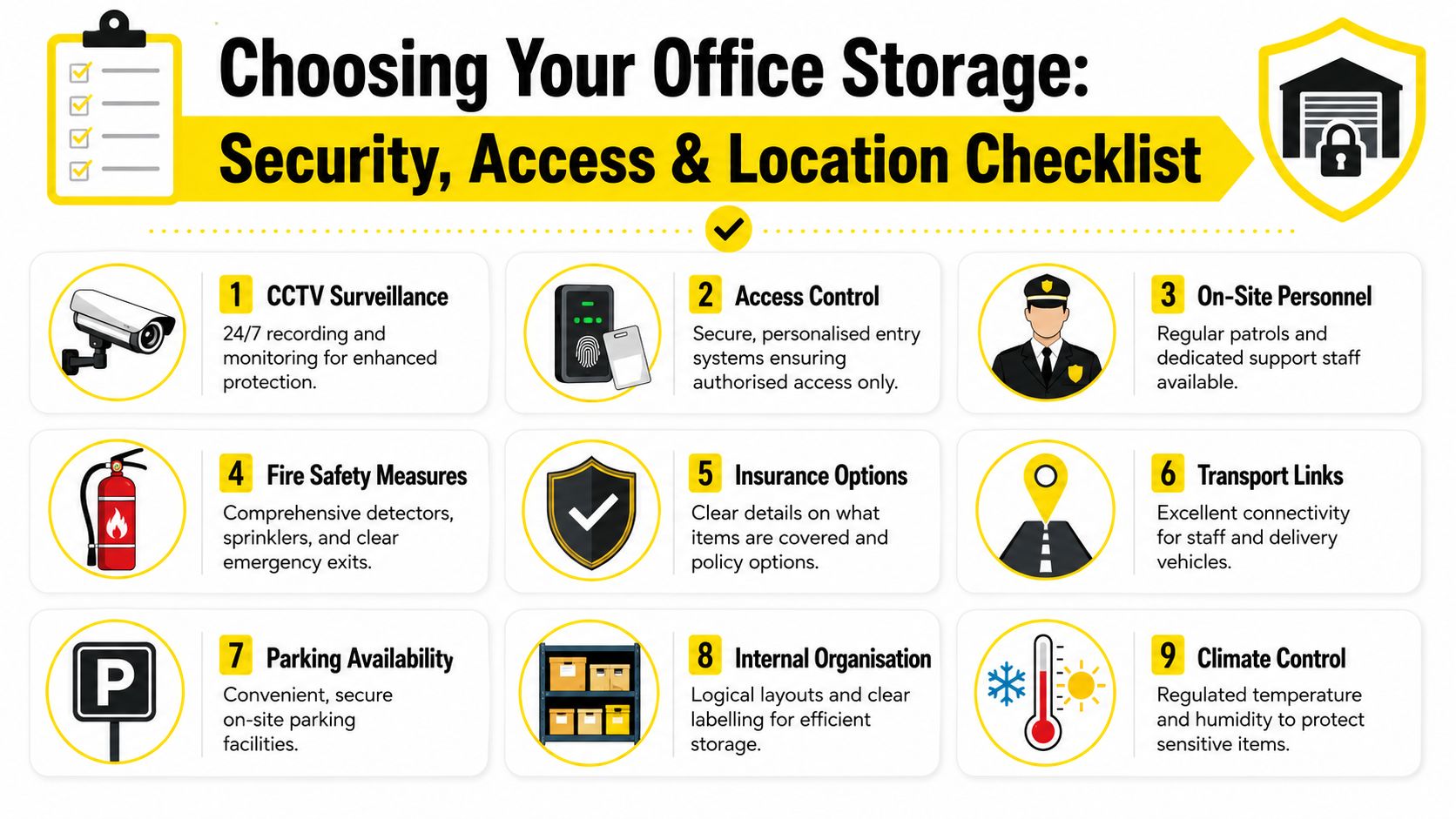
For tradespeople and SMEs, security isn't a brochure feature. It's business continuity. If your tools disappear, jobs stop. If your stock is compromised, customer service becomes a clean-up exercise.
Look for:
- Controlled entry that limits who gets into the compound
- CCTV coverage across access routes, not just at the gate
- On-site staff who can spot problems before they escalate
- Clear insurance terms so you know what's covered and what isn't
- Well-kept common areas because neglected sites usually signal weak management
If you want a stronger sense of what joined-up protection looks like across access control, monitoring, and site systems, this guide to integrated security is worth reading.
Access rules matter more than glossy marketing
You need access that matches how your business works. If you start early, finish late, or work weekends, restrictive opening hours are a liability. The same goes for awkward turning circles, poor parking, or loading bays that look fine on paper but fail the moment two vans arrive together.
A proper viewing should answer these questions fast:
- Can I park where I need to load?
- Can I move bulky items without stairs or long corridors?
- Will I lose time waiting for access?
- Could a staff member or driver use the site without confusion?
One good checkpoint is to compare any site against a dedicated secure self storage checklist, especially if you're storing tools, equipment, records, or saleable stock.
Location should support routes, not ego
A prestigious postcode is useless if it adds mileage, congestion, and delivery delays. For most SMEs outside central London, the better strategy is simple. Stay close to arterial roads, keep loading easy, and avoid city-centre constraints unless customer footfall pays for them.
The best locations for office space with storage for rent are usually the ones that cut dead travel. Near major roads, close to your jobs, suppliers, or delivery patch, and easy enough for staff or couriers to find without a running commentary over the phone.
A Smart Guide to Costs and Contracts
The headline rent is never the full story. If you compare properties on that figure alone, you'll make bad decisions.
A smart occupier looks at total occupancy cost, how the space is measured, what's included, and how painful the contract becomes if the business changes. Flexibility has value. So does not paying for square footage you can't use.

Understand RSF before you sign
In the UK, hybrid office-storage rentals are commonly priced on Rentable Square Footage (RSF), not just the area you physically occupy. RSF includes a load factor, typically 12-18%, for shared areas. Ignore that and your costs can be inflated by 12% or more compared with Usable Square Footage (USF), according to the Essensys workspace metrics reference.
That sounds technical, but the practical point is simple. Ask the landlord or operator exactly what you're paying for.
Ask this directly: “What is the usable space, what is the rentable space, and what shared area is included in that difference?”
If they can't answer clearly, slow down.
Compare total cost, not just base rent
The same source notes that regional hybrids can average £12-18 per sq ft annually, offering up to 35% savings over separate urban leases when compared properly. That matters because many businesses still compare a single hybrid quote against only the office rent, while forgetting the second storage rent, extra travel, utility duplication, and lost time.
Here's what to review before saying yes:
- Base rent. What are you paying each month or term?
- Included services. Power, lighting, Wi-Fi, shared facilities, or maintenance.
- Access terms. Seven-day access, restricted hours, or extra charges tied to extended use.
- Insurance obligations. Whether you arrange your own or must buy through the operator.
- Notice periods. Flexible space stops being flexible if the exit terms are punitive.
- Price review wording. Understand when and how charges can change.
If your business is weighing a larger footprint, a comparison with warehouse self storage options can help you decide whether you need warehouse-style space or a better hybrid setup.
Read contracts like an operator, not a hopeful tenant
The right contract leaves room for your business to change. That means scaling up, scaling down, or exiting without legal drama. Don't get distracted by a nice reception area or a discounted opening month if the rest of the agreement is rigid.
Check these points carefully:
Notice and renewal
Make sure the notice period suits your sales cycle. Seasonal businesses need room to adapt.Permitted use
Your intended activity must be clear. Stock holding, admin, packing, and light business use shouldn't be left vague.Access and keys
Confirm who can enter, when, and under what conditions.Damage and alterations
If you want shelving, benches, or internal layout changes, get the rules in writing.Insurance and liability
Know where their responsibility ends and yours begins.
Some businesses chase the lowest monthly figure and end up stuck in space that no longer fits. Others choose flexibility and save themselves an expensive move six months later. In most SME cases, the second group makes the better decision.
How to Book Your Space in Three Simple Steps
Delayed action is common because individuals often assume the process will be awkward. It usually isn't, provided you've already worked out what the business requires.
Step one
Get a quote for the type of space that matches your workflow, not just your rough guess on size. If you need drive-up access, say so. If you need power and Wi-Fi, say that too. Specific enquiries get better options.
Step two
Visit the site in person. Don't skip this. Walk the access route, check turning space, test the loading convenience, and look at how secure the place feels when you arrive. A unit can sound ideal online and still be wrong in practice.
If you'd hesitate to send a staff member there alone with stock or tools, don't take it.
Step three
Read the paperwork properly, confirm the notice terms, insurance position, and what's included, then complete the booking. Digital admin is fine. Blind agreement isn't. The best flexible spaces make sign-up straightforward and the terms easy to understand.
If you've done the earlier homework, booking becomes a simple operational decision rather than a gamble.
Frequently Asked Questions
Can I start small and move to a larger unit later?
In flexible storage environments, that's usually the sensible way to do it. Start with the space your workflow justifies now, not the space your ego thinks you might need. If the provider offers straightforward transfers, scaling later is far less painful than paying for underused room from day one.
Is office space with storage for rent only useful for established businesses?
No. It often suits early-stage businesses better than a conventional lease. If you need somewhere to work, store stock, charge devices, keep paperwork organised, and take deliveries without turning your home into a depot, hybrid space is often the cleaner answer.
What should tradespeople prioritise first?
Access and security. A polished office means very little if loading is awkward and your tools aren't properly protected. For most trades, ground-level convenience beats appearance every time.
What should e-commerce sellers prioritise first?
Picking and packing flow. If you can't receive stock, shelve it logically, process orders, and handle admin without walking in circles, the unit is wrong. Good internet and power matter, but layout matters first.
Are all items allowed in these spaces?
No. Restrictions vary by operator and insurance terms. Hazardous materials, illegal goods, perishables, and certain high-risk items are commonly restricted. Check the permitted use before you sign, especially if you store chemicals, fuel-related items, or specialist equipment.
Is insurance included?
Sometimes, sometimes not. Don't assume. Ask whether insurance is bundled, optional, or entirely your responsibility. Also ask what evidence of value or stock records you may need if you ever have to make a claim.
Should I choose city-centre space for convenience?
Only if your business depends on that location. Most SMEs and tradespeople are better served by practical regional sites with easier access, simpler loading, and less wasted time.
If your business needs secure, flexible space without warehouse overheads, Container Self Store is a strong place to start. Their Nottingham and Nottingham sites give you practical storage and business space near key road links, with straightforward contracts, seven-day access, drive-up container units, indoor rooms, and workspace options for growing SMEs and tradespeople.