
You've found a promising office in Nottingham, but the decision quickly becomes less straightforward. The room may be available, yet the lease could be too rigid, the fit-out could take months, or the building might not offer the access, parking, storage or energy performance your business needs. A growing online seller, a consultant meeting clients in town and a tradesperson storing tools all need something different from “an office”.
The practical question isn't how much office space is listed. It's which quality band is usable now, which location supports your people and clients, and which agreement matches your plans. This guide explains the main office models, Nottingham's key areas, the costs that sit behind quoted rent, and the checks that matter before you sign.
Introduction to Finding Office Space in Nottingham
A small Nottingham business might start with one desk at home, then reach the point where stock, paperwork and client meetings are taking over the spare room. The owner searches for office space in Nottingham and sees plenty of listings. Some appear ready to occupy, while others need refurbishment, new lighting, upgraded heating or a complete internal reconfiguration.
That difference explains why the market can feel tight despite a sizeable amount of advertised space. In 2024, total occupier take-up reached 279,931 sq ft, around 11% below the previous 12 months, while supply increased to 1.2 million sq ft and Grade A availability rose to 269,735 sq ft, according to Nottingham's 2025 market overview. Much of the activity remained in smaller transactions, with 230,918 sq ft acquired in deals of 10,000 sq ft and below, pointing to strong demand for flexible suites rather than large, single-tenant floors.
The headline total therefore needs careful interpretation. A vacant building that needs substantial work isn't equivalent to a furnished, connected workspace that can open its doors quickly. The right search starts with your operational requirements, not with a property portal filter.
Practical rule: Treat available space like stock in a shop. The quantity on the shelves matters less than whether the product is the right size, specification and condition for your immediate need.
You'll find a plain-English comparison of traditional leases, serviced offices, coworking and business pods, followed by a location guide covering the city centre, Southside, Station Quarter and other useful business areas. The later sections deal with rent, rates, service charges, lease risk and viewing checks. Businesses wanting wider property and workplace insight can also browse our latest articles from JRG Property UK Ltd.
Use the guide progressively. First decide how much commitment you can carry, then shortlist areas, calculate the whole occupancy cost and only afterwards compare individual units. That order helps prevent a common mistake, choosing an attractive room before checking whether it works for your people, equipment and plans.
Understanding Your Office Options in Nottingham
Office occupation works a little like transport. A traditional lease resembles owning a season ticket for a fixed route. A coworking membership is closer to using a network when needed. A serviced office adds convenience, while a business pod can suit a small operation that needs a practical base without taking on a conventional commercial unit.
Traditional leased offices
A conventional lease gives you control over a defined space. You'll normally have more freedom to arrange desks, meeting areas, branding and storage, but you'll also need to understand the full repairing obligations, insurance position, rent reviews, service charges and exit provisions.
This model can work well for an established team with predictable space requirements. It's less comfortable for a young business whose headcount, cash flow or working pattern may change quickly. A larger suite can look economical on a rent-per-square-foot basis but still create unnecessary exposure if half the space sits unused.
Serviced offices
A serviced office usually packages more of the practical infrastructure into one arrangement. Furniture, reception services, meeting rooms, broadband, utilities and cleaning may be included, although the exact package differs between providers.
You pay for simplicity and speed. That can be useful when you're moving quickly, testing a Nottingham location or avoiding a large fit-out bill. Check what the quoted price includes, particularly meeting-room use, printing, broadband support, access hours and additional occupants.
Coworking memberships
Coworking is designed around shared space. You might have a hot desk, a dedicated desk or access to communal facilities, with meeting rooms available separately.
It suits freelancers, remote workers and businesses that value a professional setting without needing a private office every day. Privacy, noise and storage deserve close attention. A team handling confidential client work may outgrow open seating even if the membership looks attractive initially.
Business pods
A business pod is a compact, self-contained workspace that can combine office use with practical access and storage. That makes it relevant to tradespeople, online retailers and small firms that need somewhere secure for tools, stock, equipment or paperwork as well as somewhere to work.
For furniture planning, businesses comparing flexible workspaces can also explore circular purchase desk solutions, particularly where re-use and adaptable fit-out matter. If your requirement is small office space with storage rather than a conventional suite, small office space to rent in Nottingham may provide a useful comparison point.
The best choice depends on the work, not just the brand of workspace. Ask whether you need client-facing presentation, secure ground-level access, quiet individual work, room for stock or the ability to add space without relocating.
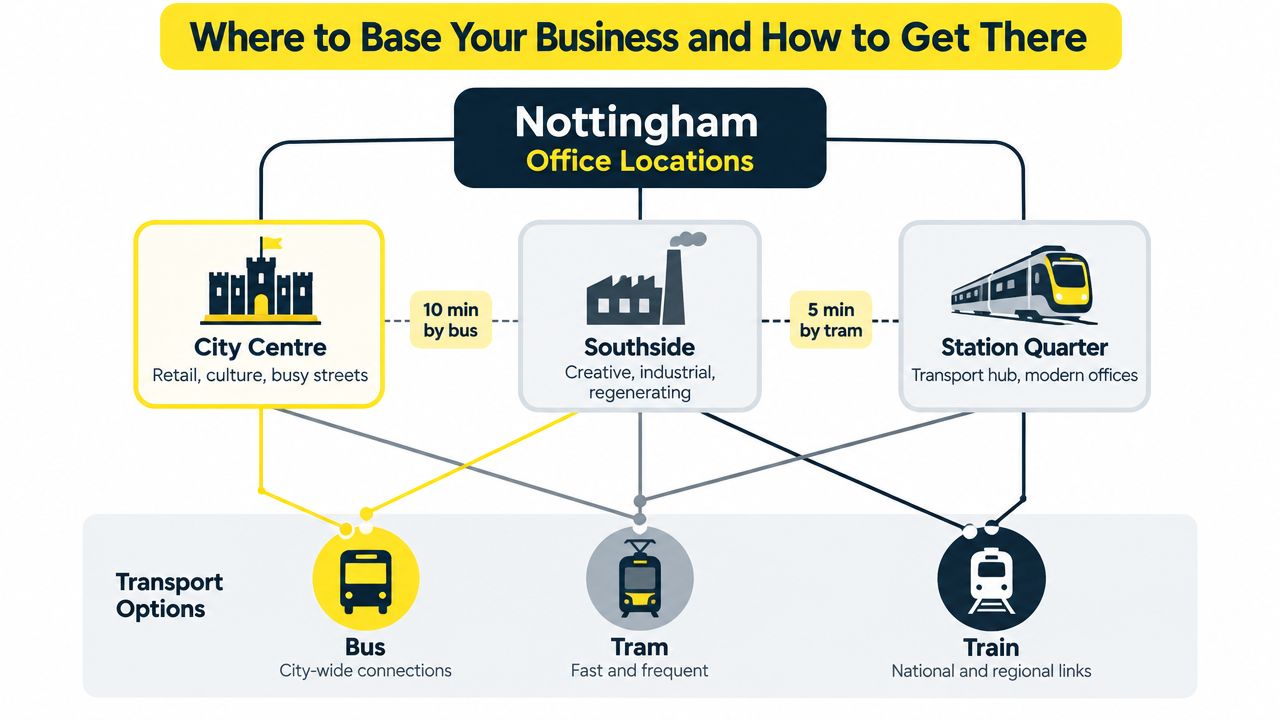
Where to Base Your Business and How to Get There
Location affects more than appearances. It changes how easily staff commute, whether clients can find you, how deliveries work and whether the building supports the way your business operates.
City centre and nearby quarters
The city centre offers strong access to shops, cafés, services and public transport. It can suit professional firms, recruitment businesses, advisers and teams that want a central meeting point. The trade-off may be limited parking, higher costs for prime accommodation and greater competition for well-specified space.
Lace Market and the Creative Quarter have a different feel, with character buildings and a mix of creative, cultural and independent businesses. Period features can support a distinctive brand, but listed or older buildings may bring restrictions around alterations, heating, accessibility and energy upgrades. Examine the actual workspace rather than assuming character means operational suitability.
The Station Quarter is a natural option for businesses whose clients or employees travel by rail. Modern offices and a transport-led setting can strengthen convenience, although you should still test the walking route, visitor arrival experience and availability of parking for those carrying equipment.
Southside and employment locations
Southside can appeal to firms seeking a more practical or regenerating environment, especially where deliveries, equipment and cost control matter. Its proximity to central Nottingham can preserve client access without requiring a fully central address. Check pedestrian routes, evening activity, loading arrangements and the immediate surroundings at the times your team will use the premises.
Nottingham Science Park and business parks close to the M1 and A52 suit firms that prioritise road access, parking, larger floorplates or a quieter setting. They may work particularly well for technology, engineering, distribution-linked operations and businesses with staff travelling from outside the city.
Make the shortlist operational
Nottinghamshire's office demand shifted towards larger average transactions in 2025. Total take-up reached 315,000 sq ft, with 173,631 sq ft in the city centre, 30% ahead of 2023 and 5% above 2024. Average deal size reached 4,200 sq ft across Nottinghamshire and 5,262 sq ft in the city centre, increases of 20% and 28% respectively on 2024, as reported in the 2025 Nottingham office market review.
Those figures don't mean every business needs a large office. They do show why a small occupier should compare neighbourhood, specification and timing carefully rather than relying on a broad city-wide availability figure.
Shortlist areas by asking:
- Commute: Can staff reach the building without difficult changes or unreliable parking?
- Client access: Is the entrance easy to find and suitable for visitors?
- Deliveries: Can suppliers load and unload without disrupting the team?
- Daily services: Are food, banking, printing and meeting options nearby?
- Future needs: Could the business add desks, storage or a meeting room without moving?
What Office Space Costs and How Leases Work
The quoted rent is only one part of the budget. A useful comparison adds rent, business rates, service charge, utilities, insurance, furniture, fit-out and any storage or meeting-room costs.
Prime pricing is moving upwards. Market commentary expects prime rents in Nottingham to exceed £30 per sq ft in 2026, a projected milestone cited in the Nottingham office market outlook. That forecast applies to prime accommodation and shouldn't be treated as a universal rate for every building or location.
The cost beside the rent
Business rates can materially change the monthly figure, particularly for small occupiers. Nottingham had 24,556 rated business properties, with a median rateable value of £8,500. Around 62% were below the £12,000 Small Business Rate Relief threshold, meaning many may qualify for little or no business rates when the relevant relief is applied, according to Nottingham's business rates data.
Relief isn't automatic in every situation. Ask who is responsible for the application, whether the quoted figure assumes relief and what happens if your circumstances change. You can contact Nottingham City Council's Business Rates Team at Admail 4270, Nottingham, NG1 9YZ. Telephone opening hours are 9am to 5pm Monday, Tuesday, Thursday and Friday, and 9:30am to 5pm on Wednesday, as stated in the council's business rates guidance.
| Cost Element | What It Covers | Watch Out For |
|---|---|---|
| Rent | Use of the office itself | Confirm whether it's quoted annually or monthly, and whether VAT applies |
| Business rates | Local taxation linked to the property's rateable value | Check relief eligibility and who submits the application |
| Service charge | Shared areas, maintenance, cleaning or security | Ask for the current budget and what can be recharged |
| Utilities | Electricity, heating, water and sometimes broadband | Clarify whether usage is metered, capped or included |
| Insurance | Buildings cover and possibly occupier policies | Confirm the landlord's cover and your own required policies |
| Fit-out and furniture | Partitions, desks, chairs, signage and connectivity | Price the work and programme before committing |
| Storage and extras | Stock, tools, meeting rooms, parking or printing | Check charges for use beyond the basic package |
Lease, licence or flexible agreement
A traditional lease can offer stability but may require a longer commitment, a deposit, legal work and responsibility for repairs. A licence or serviced-office agreement may provide faster occupation and simpler management, but it can offer less control and different notice arrangements.
Read the break clause carefully. Check the notice period, the method of serving notice and any conditions attached to ending the agreement. Ask how rent reviews work, whether the deposit is refundable, who pays for reinstatement and whether you can assign or share the space.
For a business that needs office space with storage, compare the combined cost rather than paying for an office and a separate warehouse arrangement without checking the practical benefit of each. Office space with storage for rent can be a useful benchmark when assessing that combined requirement.
Budgeting test: Ask for one written figure covering every recurring and one-off cost. If two quotes describe inclusions differently, they aren't yet comparable.
Business Pods Serviced Offices and Coworking Compared
The shortage in Nottingham is often a shortage of suitable space rather than an absence of empty buildings. In 2024, Nottinghamshire had 735,904 sq ft of total office availability, but only 32,000 sq ft of Grade A space was readily occupiable immediately. The remainder required refurbishment or later completion, according to the Nottingham office market overview.
That distinction matters to an SME with a deadline. A refurbished Grade B or C building may offer more space on paper, but the occupier could face delays, capital expenditure and uncertainty about energy performance. A turnkey business pod can reduce those practical obstacles when the requirement is modest and immediate.
A focused comparison
| Requirement | Business pod | Serviced office | Coworking |
|---|---|---|---|
| Immediate usability | Often suited to a ready-to-use requirement | Usually ready to occupy | Ready to use, subject to membership availability |
| Privacy | More private and controlled | Private office options | Shared environment |
| Storage | Can suit businesses needing work and storage together | Often limited or charged separately | Usually limited |
| Ground-level access | Particularly useful for tools, stock and equipment | Depends on the building | Rarely designed for bulky items |
| EPC and condition | Verify the specific pod and site | Verify the specific building | Verify the host premises |
| Scaling | May require an adjacent unit or new pod | Often easier within the operator's network | Easy to add users, less suitable for physical operations |
| Cost structure | Can combine practical facilities in a simpler arrangement | Convenience is priced into the package | Lower commitment, but extras can accumulate |
A business pod won't suit every firm. A solicitor needing multiple confidential meeting rooms, a consultancy hosting frequent client sessions or a team seeking a prestigious reception may prefer a serviced office. A solo professional who works remotely and wants occasional desk access may find coworking more economical.
When the pod makes sense
Choose a pod when short lead time, secure access, practical storage and lower fit-out exposure matter more than a large corporate reception. This is especially relevant to tradespeople, e-commerce sellers and small teams that need a base close to the M1 or A52 but don't want warehouse overheads.
Container Self Store's Nottingham offering includes Trade Pods and Business Pods with lighting, power and Wi-Fi, alongside secure storage facilities with gated access, CCTV and 7-day access. For a broader serviced-office comparison, review serviced office space in Nottingham and ask each provider to separate included facilities from optional charges.
Your Step by Step Checklist for Viewing and Leasing
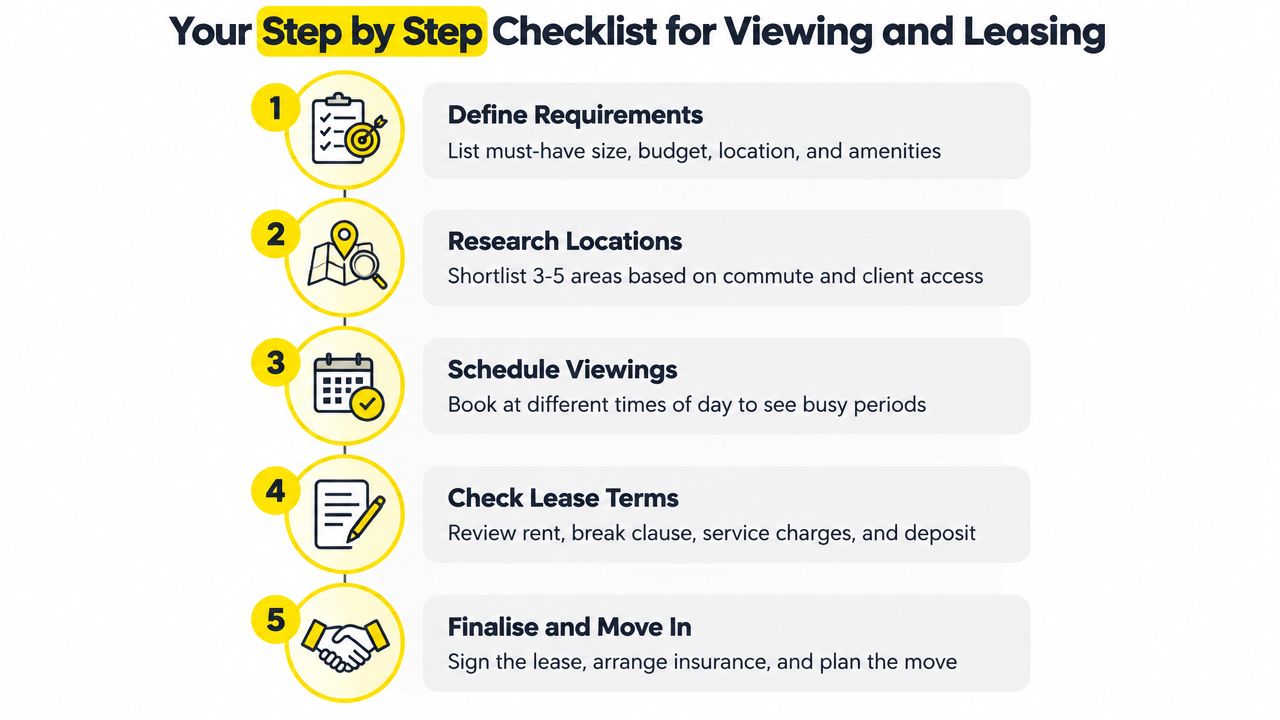
A viewing should test the office as a workplace, not just as an attractive room. Take your requirements with you and record answers while they're fresh.
1. Define the working brief
Write down the number of people, desk arrangement, meeting needs, storage, access hours, parking, budget and preferred areas. Separate essentials from preferences. A tradesperson may prioritise ground-level loading, while a client-facing consultancy may put reception and meeting space first.
2. Shortlist suitable quality bands
Ask whether each unit is Grade A, Grade B or Grade C, and what “ready to occupy” means in practice. Check the EPC rating, proposed improvement works and expected completion date. Don't treat a future refurbishment as equivalent to a finished office.
3. View at a useful time
Visit when staff will arrive and leave. Listen for traffic, check lighting and ventilation, test mobile reception and observe visitor access. If parking matters, assess whether spaces are reserved, shared, paid, time-limited or unavailable.
4. Test the infrastructure
Ask to see power sockets, internet arrangements, heating controls, toilets, kitchen facilities and any meeting rooms. Confirm who supports Wi-Fi and what happens if the service fails. Check whether the furniture shown is included or belongs to the previous occupier.
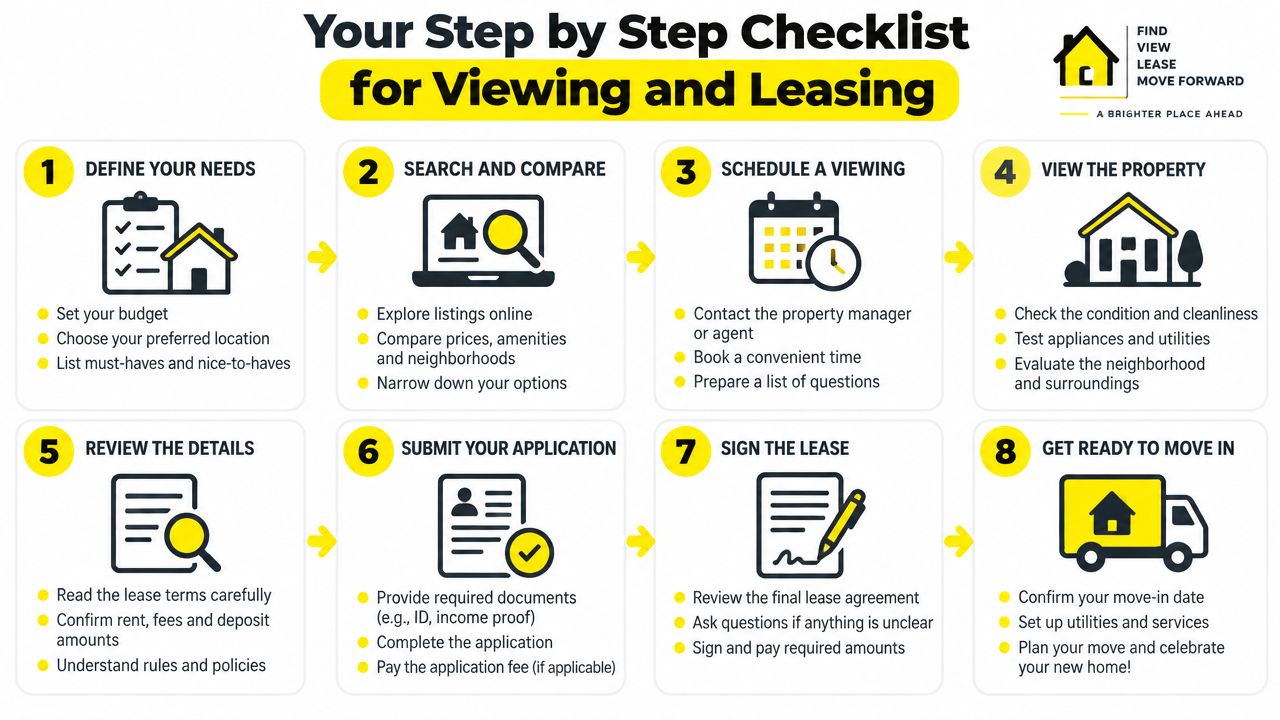
5. Question access and security
Clarify keyholder arrangements, alarm procedures, CCTV coverage, delivery access and out-of-hours entry. Businesses holding tools, stock or confidential files should ask where items can be kept and who can enter shared areas.
6. Read the commercial terms
Request the heads of terms before spending money on a survey or fit-out. Check rent, rates, service charge, utilities, insurance, deposit, notice period, break clause, rent review and reinstatement obligations. Ask whether you can add users, install equipment or take extra space later.
7. Complete due diligence
Take legal advice on a conventional lease. Confirm the landlord's authority, permitted use, planning position, repairing obligations and any restrictions affecting signage or alterations. Reference checks and insurance requirements should be identified early, not after you've committed to a move date.
8. Plan the move
Agree the handover condition, keys, broadband activation, furniture delivery, signage and waste arrangements. Keep a written schedule of agreed works and dates. If the space includes storage, plan stock flow and loading before desks arrive.
Ask one final question: “What will I pay, and what can change, during the full period I expect to occupy this space?” A clear answer often reveals more than a polished brochure.
Making the Right Choice for Your Nottingham Business
The most useful office search separates total availability from usable availability. A city-centre suite, Southside unit, business-park office, serviced room and business pod can all be described as office space, but they create different commitments and working conditions.
Choose a traditional lease when your team, budget and footprint are stable. Choose a serviced office when speed, presentation and managed facilities matter. Choose coworking when you need professional space without a permanent private office. Choose a business pod when your SME or trade operation needs a practical, secure base with lighting, power, Wi-Fi and access to storage, without taking on a larger conventional unit.
A separate operational system can also help property teams manage enquiries and follow-ups. Businesses comparing platforms may wish to find a CRM for international agencies, while keeping the office decision focused on actual workflow, location and cost.
Get written quotes, confirm what is ready now and test the building at working hours. Then compare the total commitment, not just the advertised rent.
Container Self Store provides flexible Nottingham storage and business space, including Trade Pods and Business Pods with lighting, power and Wi-Fi, plus secure access for tools, stock and equipment. Visit Container Self Store to review available options, use the online size guides and request a straightforward quote for a workspace that matches your operational needs.