
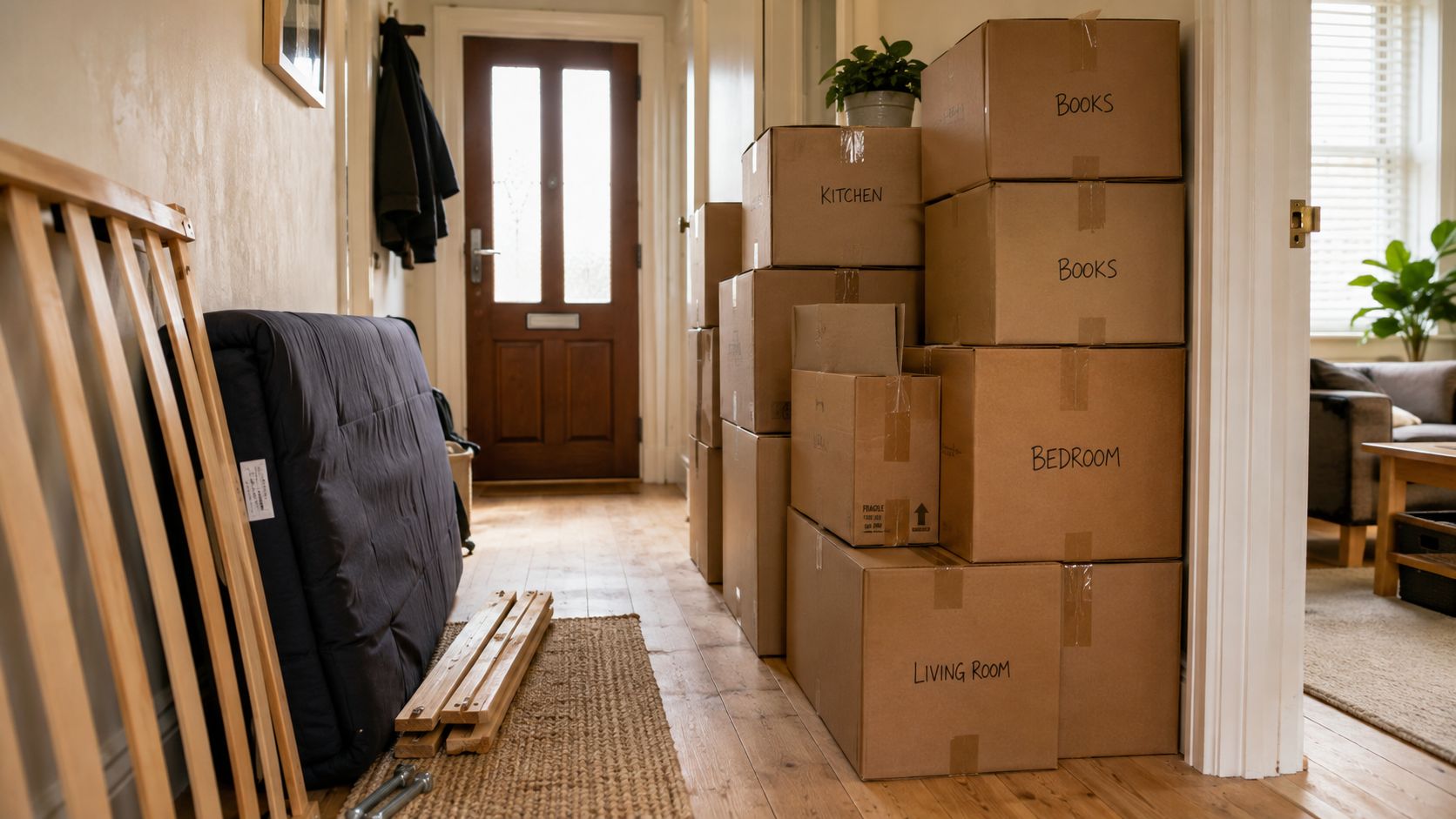
You've got boxes blocking the hallway, a removal date that doesn't quite match the completion date, or tools and stock taking over a room that was meant to be an office. That's when self storage near Derby stops being a luxury and becomes a practical bit of planning.
The right choice usually comes down to three things: how often you'll visit, how you'll load your belongings, and what the full price includes. A nearby indoor room may suit a flat move, while a drive-up container outside the city can make far more sense for furniture, tools, pallets or renovation materials.
Why Derby Residents Are Searching for Storage Right Now
A move in Derby rarely happens in one clean handover. One household may have packed a Chaddesden terrace but be waiting for keys to the next property. Another may have stripped out a Mickleover kitchen and need somewhere to keep furniture while the work continues. A student clearing a shared house near Lonsdale Square may only need a small space, but they still need it quickly and for a defined period.
Those situations reflect three practical pressures.
First, Derby's population reached 261,400 at the 2021 Census, compared with about 248,800 in 2011, an increase of 5.1% according to Derby's census information. More residents and households create more movement between rented homes, purchased properties and temporary accommodation. Storage gives people somewhere safe to place possessions when the property chain, tenancy dates or building work refuse to line up neatly.
Second, renovation work is turning spare rooms into active work zones. Victorian terraces around Allestree, Normanton and Spondon often need furniture moved before plastering, rewiring, flooring or kitchen installation can begin. Keeping everything in the garden or shifting it between rooms creates damage, clutter and delays. A unit removes that obstruction.
Storage is becoming working space
The third pressure comes from small businesses. Tradespeople in DE1, DE3 and DE23 may need a secure base for tools, fixings and materials. E-commerce sellers may need shelving for stock and packaging. Remote-working households may need to reclaim a bedroom from business equipment.
National usage supports this local pattern. The UK market report says 73% of storage space is used by domestic customers, while 40% of customers use storage when moving house, as reported in the UK Self Storage Annual Report. Storage isn't only for emergencies. It's a short-term buffer for movers and a practical back-office for businesses.
Local rule: If your belongings are obstructing work, a sale, a tenancy change or your daily operation, book storage before the pressure peaks. Waiting until the last day usually leaves you choosing on distance alone.
The Derby Storage Market in Numbers
Derby's storage market is large enough to give customers a real choice of format. The latest national industry report records 2,915 self-storage stores, approximately 64 million square feet of storage space and annual turnover just under £1.2 billion in 2024. It also records 1,135 container-based sites, making drive-up storage a serious option for movers, tradespeople and small businesses.
Demand is steady rather than occasional. The report records 75.1% occupancy in 2025, alongside 0.94 square feet of storage per person across the UK. Derby's population scale supports year-round demand from households, students, property transactions and local businesses.
The practical lesson is simple. The nearest unit is not automatically the best-value unit.
Why the format matters locally
Container and outdoor storage openings have been most prevalent across the Midlands and Northern regions, while the East Midlands remains one of the more affordable storage regions, according to UK industry data from the Self Storage Association UK. For customers searching around Derby, that makes a wider comparison worthwhile. A site a short drive beyond the city may offer easier loading, more usable access and better value than a city-centre room.
The customer mix reinforces that point. The national report says 73% of storage space is domestic, while another UK market source places domestic demand at around 76%, as outlined in Derbyshire self-storage market guidance. The figures come from different reporting contexts, but they agree on the main point: households lead demand, with a substantial business segment alongside them.
For a house move, indoor rooms suit boxed belongings and items needing a controlled environment. Drive-up containers work better for bulky furniture, tools, stock and repeated vehicle loading. A trade-off is involved. Indoor units may reduce exposure to outdoor conditions, while containers can save carrying time and make access simpler.
Compare the format, travel time, loading arrangements and contract flexibility before judging rent. A cheaper unit becomes poor value if every visit adds a long drive or difficult unloading.
Choosing the Right Unit Size for Your Move
People usually overestimate the space they need because they imagine possessions as a pile rather than a plan. Start with a room-by-room inventory. Write down furniture, appliances, box counts and awkward items such as bikes, tools or shelving. Then remove anything that's seasonal, soft furniture only or redundant before you reserve a larger unit “just in case”.
UK storage guides commonly associate 10 to 15 square feet with lockers and small items, 25 square feet with a studio flat or garden shed equivalent, 50 square feet with a one-bedroom flat, 75 square feet with a two-bedroom house, 100 square feet with a three-bedroom house and 200 square feet with much larger household or business storage needs, according to this UK storage unit size guide.
Match the unit to the user
10 to 15 sq ft: A student near Lonsdale Square, a Becket Street flat tenant storing boxes, or someone keeping documents and seasonal items may need no more than a locker. Providers commonly describe a 10 sq ft unit as similar to a double wardrobe and suitable for approximately 10 to 15 standard boxes, as explained by Attic Storage's calculator.
25 sq ft: This suits a studio move, a garden-shed clear-out or a small collection of furniture. It's useful when the contents are compact and you don't need to store a whole household.
50 sq ft: A one-bedroom flat mover, perhaps relocating from central Derby, can often work within this range if the inventory is controlled. This is also a sensible starting point for a plumber or electrician storing tools and boxed materials.
75 to 100 sq ft: A two-bedroom household shifting out of a Chaddesden property during renovation needs more room for furniture, appliances and packed boxes. The 100 sq ft guide is commonly linked with a three-bedroom house, but loading discipline still matters.
200 sq ft: A larger household, small retailer or trade business with bulky equipment may need this level. A typical UK ceiling is about 8 feet, so volume matters as well as floor area, according to Standby Self Storage's size guide.
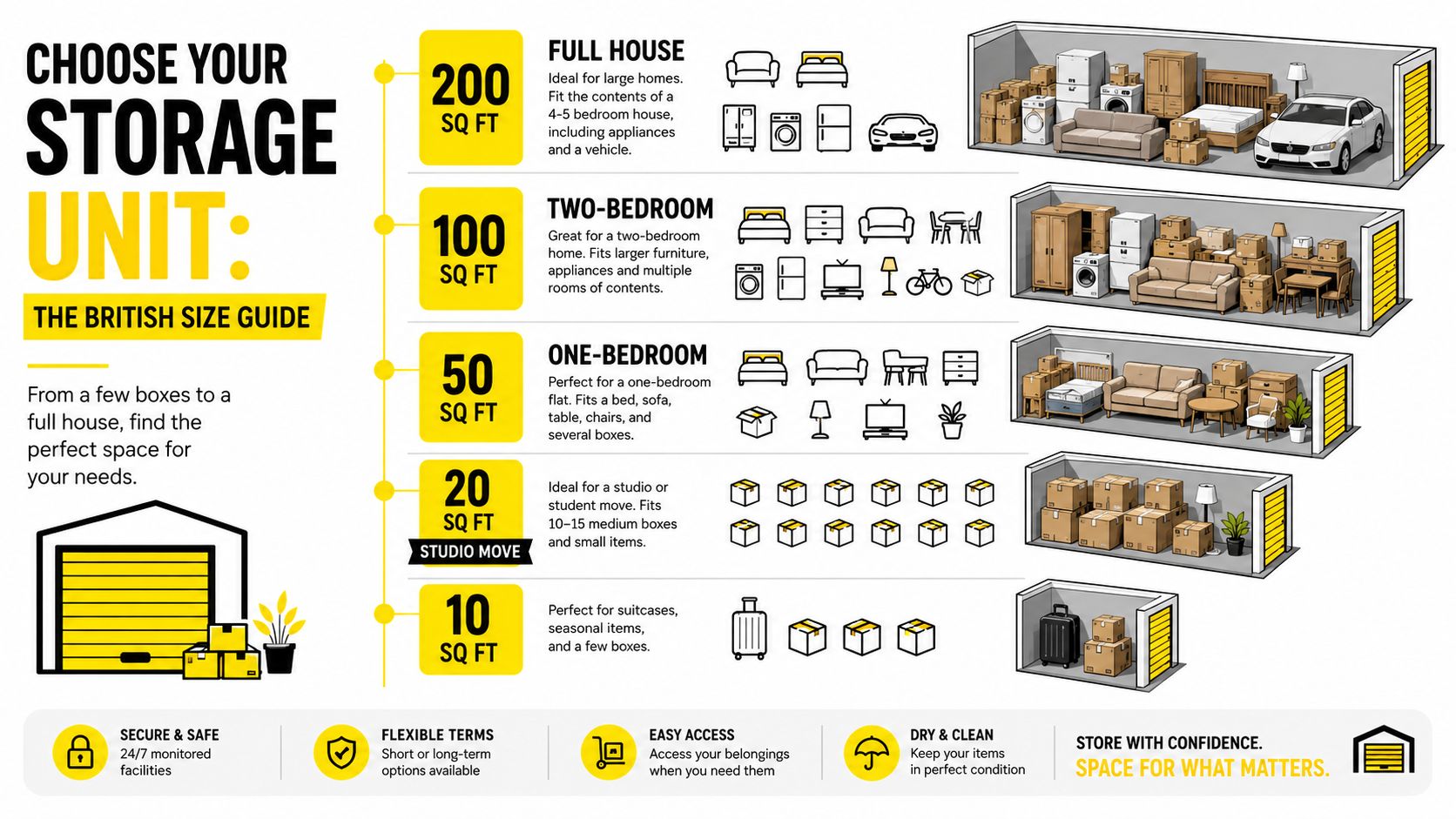
For a deeper sizing check, use this storage unit size guide and compare its examples with your own inventory.
Packing advice: Estimate generously, then drop one size band if a large part of the load is seasonal, soft furniture or items you no longer need.
The 10 to 50 sq ft band is especially relevant to smaller users. One UK guide reports that it represents the most popular size range, accounting for 43% of business customers and 33% of domestic customers, as shown in Henfield Storage's size guidance. Don't pay for a 100 sq ft room when a well-labelled, properly packed smaller unit will do.
Indoor Rooms or Drive-Up Containers
Derby shoppers normally face two distinct choices. Indoor rooms provide a building-based environment with units such as 25 sq ft, 50 sq ft, 100 sq ft, 150 sq ft and 200 sq ft. Drive-up yards offer container formats such as 10 ft, 15 ft, 20 ft and 25 ft, depending on the operator. Container Self Store is one concrete example of a provider offering 10 ft and 20 ft container units, alongside indoor rooms.
Indoor storage makes sense when the load is sensitive, frequently accessed in small quantities or carried from a flat without convenient parking. Books, paperwork, clothing and household goods may be easier to organise inside a room reached through a corridor or lift. A flat above a shop in Derby city centre can favour this arrangement if the customer is collecting a few boxes rather than moving heavy furniture repeatedly.
Drive-up storage wins when the load is heavy, bulky or handled with a van. A renovation driveway, a tradesperson's tool stock or a small retailer's boxed inventory is simpler when you can park at the container door. You avoid lifts, long corridors and repeated trolley journeys.
Compare the visit pattern, not just the rent
Use this working comparison:
| Requirement | Indoor room | Drive-up container |
|---|---|---|
| Frequent small visits | Better for boxes, files and personal items | Less efficient if each visit involves opening and reorganising a large load |
| Heavy furniture | Possible, but check lifts, corridors and loading bays | Strong choice because the vehicle reaches ground level |
| Books and clothing | Usually the more natural fit | Check ventilation and the operator's guidance |
| Tools and materials | Works for smaller inventories | Practical for bulky trade equipment and regular van loading |
| House move | Useful where access and building conditions suit | Better when the entire load arrives by van |
| Long-term archive | Often easier to catalogue by shelving | Useful for durable goods that don't need frequent handling |
A 20 ft container-style space is commonly described as around 150 sq ft, comparable to a standard parking bay, according to Attic Storage's storage calculator. That gives movers and businesses a useful mental picture, but always check internal dimensions and access rules.
Format rule: Visit often and remove small items, choose an indoor room. Load once, handle bulky goods or work from a van, choose ground-level drive-up storage.
Security, Access and Contract Features Worth Checking
A low price means little if the site is difficult to enter or poorly protected. Ask direct questions before booking, then write the answers beside the quoted price. The nearest facility is not always the best-value choice for a Derby move or trade business if awkward access creates extra loading time.
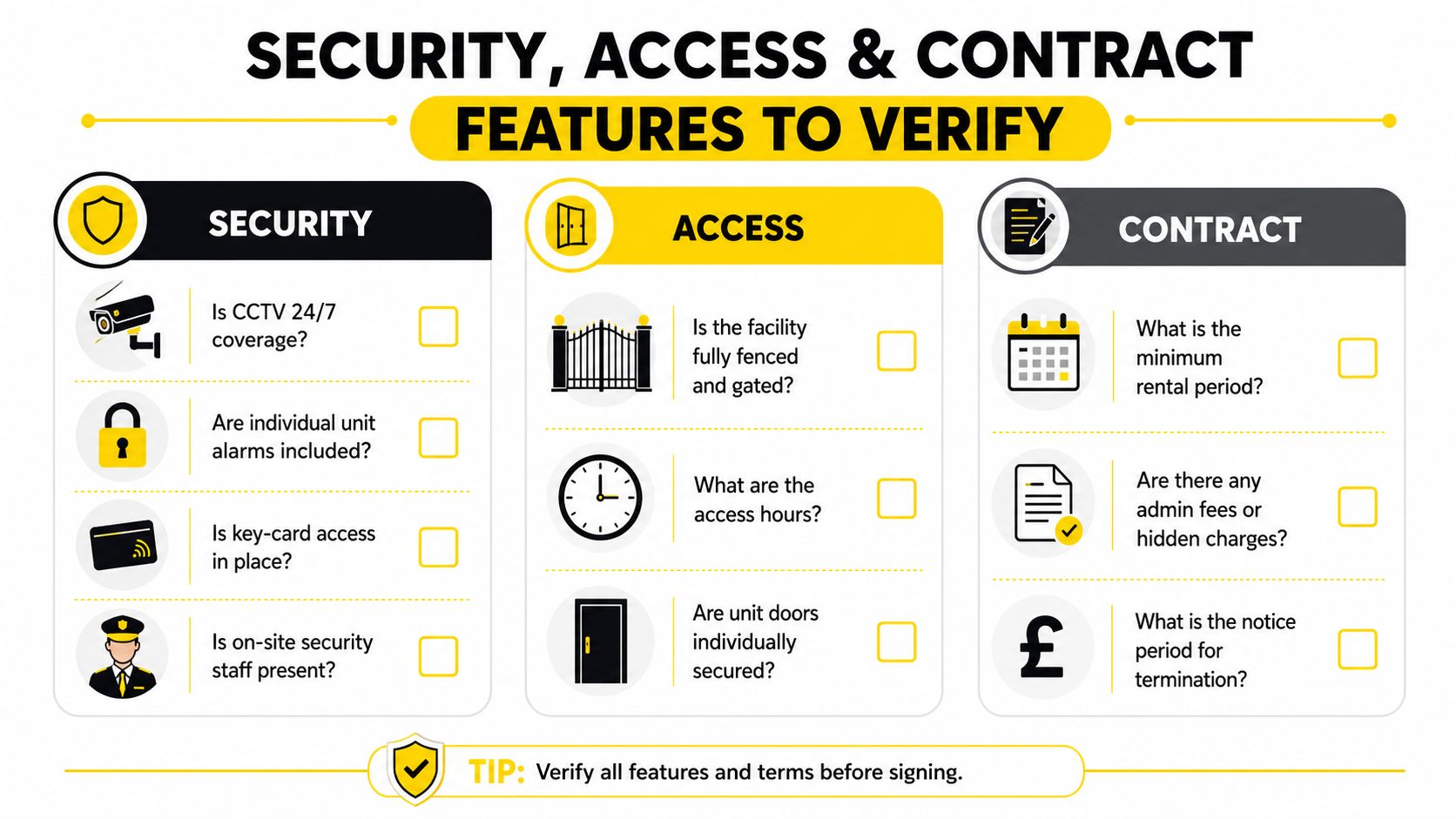
Security questions
- CCTV: Does coverage include entrances, loading areas, corridors and container rows? How long is footage kept, and who can review it?
- Unit protection: Does each room or container have an individual alarm? Who supplies and controls the lock?
- Site entry: Is the perimeter gated? Do customers receive a personal access code or key card?
- Staff presence: Are staff based on site, and during which hours?
- Industry standards: Does the operator follow a recognised code of practice, such as membership of the Self Storage Association UK?
A gate and cameras are only part of the answer. Ask how incidents are reported, whether lighting covers loading points and whether the operator provides clear guidance on protecting stored goods. Review the operator's secure self storage information before comparing facilities.
Access questions
Check access against your real routine, not the office timetable. Ask about 24-hour container access, seven-day opening, corridor access, lifts, trolleys, covered loading and turning space for a van. Confirm whether out-of-hours entry costs extra and whether you keep your own key or padlock.
Ground-level access matters when a tradesperson is moving tools or a household is unloading furniture. Indoor rooms may suit frequent box retrieval, while drive-up containers reduce carrying and trolley work. Compare the full visit pattern with the drive time before choosing the closest site.
Label boxes on two sides, keep an inventory on your phone and leave a route to items needed first. These InchBug storage labels provide a practical system for boxes, seasonal belongings and business stock.
Contract questions
Before paying, ask:
- Is there a minimum stay?
- How much notice is required to leave?
- Is the price fixed for a stated period?
- Is insurance included, optional or required?
- Is there a deposit, administration fee or mandatory direct debit?
- Are late-payment charges clear?
- Do students, tradespeople or businesses qualify for a discount?
Read the cancellation wording in full. A cheap opening offer can become poor value if leaving requires more notice than your move allows. Get every fee, access restriction and insurance requirement in writing before signing.
What Self Storage Near Derby Costs
Use the UK average rate of approximately £27.40 per square foot per year as a starting benchmark, not a guaranteed Derby quote. The East Midlands is described as one of the more affordable storage regions, but the nearest site is not automatically the best-value choice. A drive-up container farther from Derby may reduce loading time and transport effort, while an indoor room may suit frequent box access.
A simple calculation turns the benchmark into a rough monthly guide:
| Space | Annual benchmark calculation | Monthly equivalent |
|---|---|---|
| 25 sq ft | £27.40 × 25 = £685 | About £57.08 a month |
| 100 sq ft | £27.40 × 100 = £2,740 | About £228.33 a month |
| 10 ft container | Price depends on the operator's actual floor area and format | Request a like-for-like quote |
These are benchmark calculations, not advertised Derby prices. Do not compare a container with an indoor room by floor area alone. The formats differ in loading arrangements, vehicle access, site layout and operating costs.
What changes the quote
City-centre facilities may charge more than industrial or edge-of-town sites because land, parking and vehicle access differ. Industrial-estate locations can make van loading easier. Student moves and renovation work can also reduce availability during busier periods.
Ask for the complete monthly cost, not only the promotional rent. Check:
- Insurance: Is your own policy accepted, or must you buy the operator's cover?
- Administration: Is there a joining, booking or account fee?
- Deposit: Is money held upfront, and when is it returned?
- Payment terms: Is direct debit mandatory?
- Late payment: What penalty applies?
- Lock: Must you buy a particular padlock on site?
Run one final comparison before booking. Multiply the quoted monthly rent by the number of months you expect to store, then add compulsory fees and insurance costs. Compare three units with the same size and format, including the likely driving and loading effort. A lower headline rent can become poorer value when repeated trips, van time and extra charges are included.
Drive Times and Booking Tips for Derby-Area Sites
Distance should be measured in working time, not postcode miles. For a one-off move, the closest site normally wins because the van, removal team and household contents only need to make the journey once. For a tradesperson or online seller visiting repeatedly, ground-level loading and easier parking can outweigh a slightly longer drive.
A Derby customer widening the search may consider Nottingham sites around 35 to 45 minutes from Derby city centre via the A52 or A38, while Northampton can be roughly 75 to 90 minutes away using the M1. Out-of-town Derby facilities on the A52, A61 or A6 corridors can be reached in under 15 minutes from many parts of the city. Treat those figures as route-planning examples, not promises. Traffic, roadworks, the exact postcode and the time of day will change the result.
Use this same-day shortlist
- Filter by postcode: Start with your home, current property or business base, then list sites along the route you already use.
- Check the journey: Put each postcode into Google Maps at the hour you'll normally travel, especially if you'll visit before work or during school-run traffic.
- Compare identical formats: Request prices for the same indoor size or the same container size. Don't compare a small corridor room with a large drive-up unit.
- Ask about access: Confirm parking, loading, gate hours, lift arrangements and whether out-of-hours entry costs extra.
- Read the notice clause: A flexible 14-day notice contract can suit uncertain moves, but confirm the operator's exact terms before signing.
Advisor's view: A longer drive can pay for itself when you're collecting bulky stock, loading tools or using a lower-overhead container yard. It won't pay for itself when you're making frequent short visits for a box or two.
Container Self Store's Nottingham and Northampton yards are useful reference points when you're comparing container formats beyond Derby. You can widen the search through self storage units near me and then judge the result by total journey time and handling effort, not distance alone.
Common Questions Derby Storage Customers Ask
Can I leave a storage unit on a rolling contract?
Most East Midlands operators offer rolling monthly arrangements with a short notice period, often 14 days, rather than fixed long-term terms. Confirm the minimum stay, notice wording and price-change rules in writing. A rolling contract suits a property chain or renovation where the end date may move.
Can a Derby trader use storage for tools and stock?
Yes, traders and small businesses commonly use larger drive-up containers or 100 to 200 sq ft rooms for tools, stock, archived paperwork and seasonal inventory. Choose the format around your loading method. A van-based operation will usually benefit from ground-level access, while a business handling smaller parcels may prefer an indoor room with organised shelving.
What access hours should I expect?
Access windows vary. Some sites operate around 6am to 10pm, while container yards may offer 24/7 access. Ask whether the advertised hours apply to your unit type, whether staff are present outside office hours and whether out-of-hours access carries a charge.
Is Nottingham or Northampton worth the drive?
Yes, if you value drive-up loading, lower per-square-foot pricing or a specialist container format. No, if you need storage for a short stay or expect frequent visits, because a Derby city site may save more time than you'll save in rent.
Container Self Store offers indoor storage rooms and drive-up container units for household moves, trade equipment, stock and business storage, with flexible options across its Nottingham and Northampton sites. Compare the sizes and access arrangements, then visit Container Self Store to request a quote based on the space and format you need.