Most advice treats container storage units as the cheap option you choose when an indoor room costs too much. That's the wrong starting point. The better question is how you'll use the space. If you're loading tools, furniture, stock or equipment straight from a van, ground-level access can matter more than a polished corridor or a climate-controlled room.
The UK market shows how far container storage has moved beyond a niche format. By the end of 2025, it had reached an estimated 684 operators, 1,218 sites and 112,150 containers, providing more than 16.7 million square feet of capacity. More than 70 new sites opened during 2025, and the container fleet grew from 100,980 to 112,150 units, an 11% year-on-year increase. (Container Storage and Self Storage Association census)
That scale reflects a practical shift. Container storage isn't automatically inferior to indoor storage. It's a purpose-built format that works exceptionally well for certain items, access patterns and businesses, while indoor rooms remain the safer choice for some sensitive goods.
Why Container Storage Units Are More Than a Budget Option
The assumption that containers are a lower-cost substitute misses the main operational benefit: you can drive directly to the door. A UK self-storage provider describes its container compound as hardstanding with ground-level access, allowing customers to park beside their unit while loading and unloading. (Ground-level access at Glebe Self Storage)
That changes the job. A tradesperson can move tools from a van into storage without carrying them through a building. A home mover can unload wardrobes, sofas and boxed kitchen equipment without negotiating corridors, lifts or staircases. An online retailer can bring stock in by vehicle, organise it inside the unit and load outgoing orders from the same position.
Practical rule: Choose storage around the work you'll do at the unit, not just the monthly rent.
The format suits people who handle heavy or awkward goods repeatedly. Ground-level loading reduces unnecessary lifting and makes short visits more productive. If you're accessing stock every day, that convenience can be more valuable than a small difference in the advertised rental price.
The market's size reinforces the point. In 2025, 1,135 of the UK's 2,915 self-storage stores were predominately container-based, representing around 39% of all stores. The wider industry generated just under £1.2 billion in turnover in 2024, with 64 million square feet of storage space across all formats. (CSTA Census 2025)
Those figures don't mean containers suit everyone. They do show that container storage is now one of the main ways UK operators deliver storage, particularly where customers value vehicle access, flexible loading and practical business use.
Indoor rooms have their place. They're generally preferable for artwork, temperature-sensitive electronics, important paperwork and items that need a more stable environment. But for trade equipment, garden machinery, furniture, building materials and sturdy business stock, a drive-up container often solves the problem better.
Understanding Container Storage Unit Sizes and Capacity
Start with the volume of your belongings, then check how you'll pack and access them. A standard 20-foot container commonly used for storage has external dimensions of about 6.06 metres by 2.44 metres by 2.59 metres. Its internal dimensions are around 5.90 metres by 2.35 metres by 2.39 metres, giving roughly 33 cubic metres of internal storage space. (20-foot shipping storage container dimensions)
That's a useful benchmark, but cubic capacity alone isn't enough. A container packed tightly from floor to ceiling may hold a great deal, yet become frustrating if you need to reach items at the back. Leave a workable route to regularly used goods, and keep heavier items low.
| Unit Size | Internal Dimensions | Cubic Capacity | Best For |
|---|---|---|---|
| 10-foot container | Confirm the operator's internal measurements before booking | Confirm with the facility | Tools, equipment, smaller stock and selected household contents |
| 20-foot container | About 5.90 m × 2.35 m × 2.39 m | Roughly 33 m³ | Bulky furniture, substantial household contents, trade stock and larger business inventory |
A 10-foot unit is usually the sensible starting point for a tradesperson with tools, a small retailer with rotating stock or a household storing selected furniture during decorating. A 20-foot unit gives you considerably more room for sofas, wardrobes, appliances, boxed possessions and business equipment, but don't rent it because it's available. Unused space is still space you're paying to maintain.
Measure the awkward items first
Measure wardrobes, shelving, machinery and palletised goods before requesting a quote. Think about door clearance, stacking height and whether you'll need to remove items without unloading the whole container.
For a more detailed sizing process, use this guide to choose the right storage unit size. It helps translate household contents and business stock into a practical unit choice rather than relying on guesswork.
The site itself matters, too. A level, durable base supports safe loading and keeps the container stable. If you're researching the engineering behind a suitable base, this example of concrete container pads by Firm Foundations provides useful context, even though a self-storage facility should already have its units installed on an appropriate surface.
Pack for access, not just capacity
Put rarely needed possessions at the rear, leave frequently used stock near the doors and label every box on more than one side. Use shelving where the facility permits it, but don't block vents or overload the walls. A carefully organised smaller unit can be more useful than a larger unit packed without a retrieval plan.
Indoor Storage Rooms Versus Drive-Up Container Units
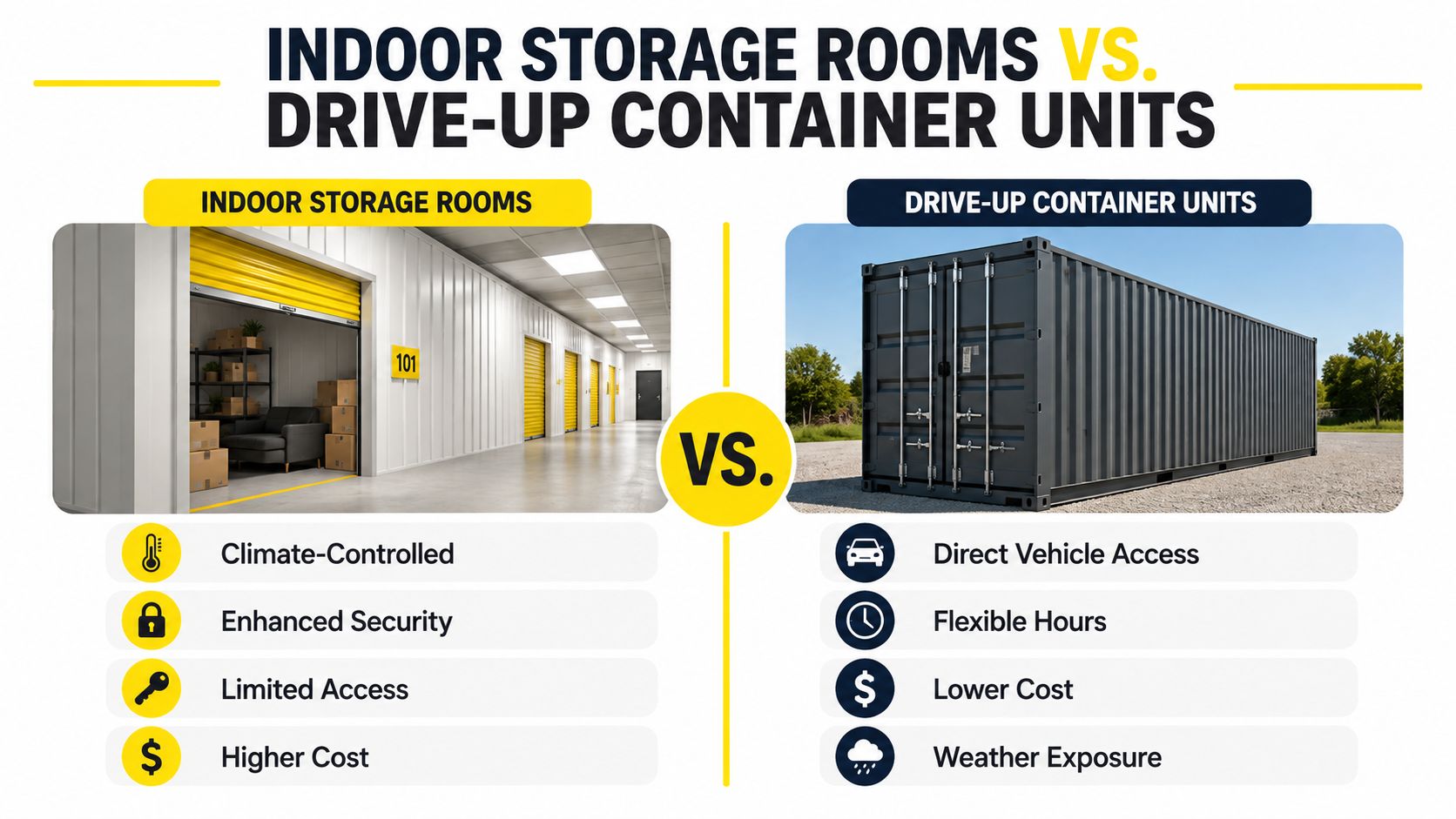
Indoor rooms win on environmental control and building comfort. Container units win on loading efficiency and direct vehicle access. The right choice depends on the goods and the frequency of access, not on the assumption that one format is universally better.
| Consideration | Indoor storage rooms | Drive-up container units |
|---|---|---|
| Loading | May involve corridors, trolleys, lifts or stair access | Vehicle can usually be parked directly beside the unit |
| Suitable goods | Documents, electronics, artwork and temperature-sensitive possessions | Furniture, tools, equipment, materials and robust stock |
| Environment | More controlled indoor setting | Ventilated steel space with greater exposure to temperature changes |
| Access pattern | Suitable for occasional retrieval | Particularly efficient for frequent loading and unloading |
| Security | Building controls may include monitored entry and internal surveillance | Compound security combines controlled entry, CCTV and individual unit security |
| Cost efficiency | You pay for the indoor environment and building infrastructure | You pay for practical space and vehicle-level access |
The difference becomes obvious during a move. Carrying a sofa through an internal facility can involve manoeuvring around doors and shared spaces. With a drive-up container, the vehicle is beside the unit and the loading route is short. That's why containers are often the stronger operational choice for tradespeople, home movers and sellers handling physical stock.
Indoor rooms remain the responsible choice for items that may react badly to moisture or temperature fluctuations. Paper records, delicate electronics, artworks and some household valuables deserve a more stable environment. Don't force these items into a container merely because the floor area looks attractive.
Compare the whole job
Compare more than the rental figure. Include vehicle hire, fuel, labour, loading time and the inconvenience of repeated handling. A container may be the better value when it removes extra transfers and makes regular access quicker.
Container storage also isn't automatically unprotected. A UK facility combines 24-hour digital video surveillance, automated entry using a unique personal token and drive-up access, illustrating how security and convenience can operate together. (Additional Self Storage security and access)
Managing Condensation and Protecting Sensitive Items
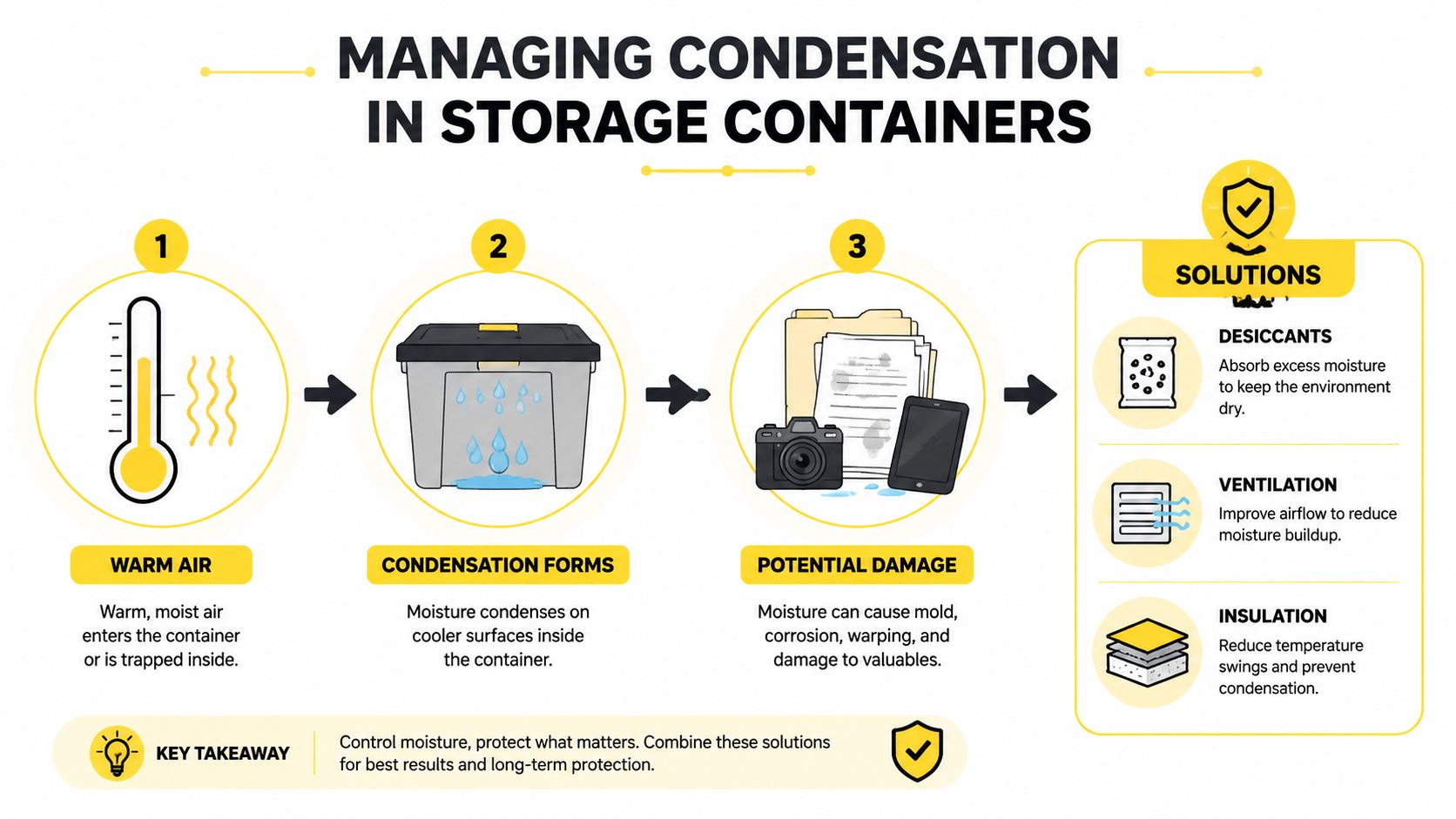
Steel containers need sensible moisture management. Condensation forms when warm, moist air meets a cold steel surface. If the steel falls below the air's dew point, water can collect on the roof and upper sidewalls. That moisture can affect paper, textiles, timber, stock packaging and metal tools.
The solution isn't to seal the container airtight. Trapped moisture has nowhere to go. UK guidance identifies natural ventilation as the most effective low-cost control, using vents positioned to maintain a steady air flow. Mechanical extraction or insulation becomes more appropriate when moisture loads and temperature swings are higher. (BSI guidance on condensation control)
Use a layered specification
Passive vents help, but stronger protection comes from combining insulation, vapour control and targeted airflow. A UK container-accessories guide cites 50 to 100 mm of polyisocyanurate insulation with mechanical ventilation at 0.3 to 0.5 air changes per hour, saying this can reduce peak dew-point temperatures by 2 to 3°C. (Container ventilation and condensation solutions)
That specification is more relevant to a converted or specially fitted container than a basic storage unit. Ask the operator what ventilation is installed, where vents are positioned and whether the unit is insulated. Don't assume every steel container has the same internal environment.
Prepare your goods properly
Dry items before storage. Avoid putting damp garden furniture, wet tools, freshly washed textiles or moist cardboard into the unit. Keep boxes on pallets or raised supports where possible, leave air space around walls and roof areas, and avoid pushing goods tightly against vents.
Desiccants can help with enclosed loads, but size them for the container and the shipment rather than scattering a few packets around. This practical guide to desiccant sizing for container shipments offers a useful starting point.
Tools and garden equipment can usually work with ventilation and sensible packing. Documents, electronics, textiles and valuable timber furniture deserve more caution. If the contents are irreplaceable or highly sensitive, choose an indoor room with a more controlled environment.
Real-World Use Cases for Container Storage Units
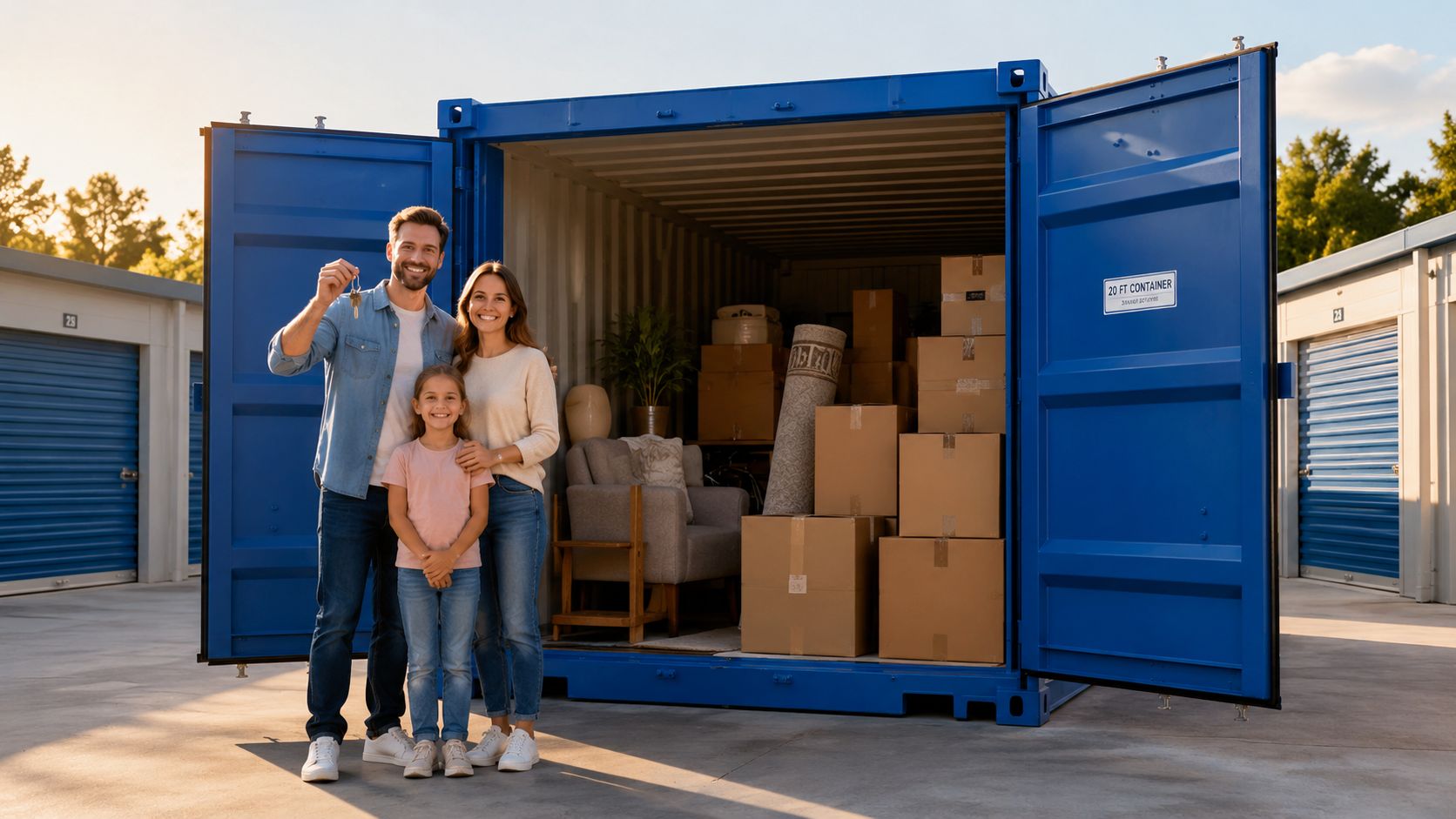
A home mover often needs space before the new property is ready. A 20-foot unit can accommodate substantial household contents, including boxed possessions and bulky furniture, provided the loading plan is organised. Put the items you'll need first near the doors, wrap upholstered furniture properly and use sturdy boxes rather than weak cartons that collapse under stacking pressure.
A tradesperson has a different priority. The unit needs to work as a daily extension of the van, not as a distant cupboard. Store infrequently used equipment at the rear, keep consumables and hand tools accessible, and make sure the access route allows safe vehicle positioning. Ground-level doors remove much of the wasted effort involved in carrying heavy kit through an indoor building.
Stock storage for online sellers
An e-commerce seller can use a container as a straightforward stock room for boxed products, packaging materials and dispatch supplies. Shelving and clear labels turn the space into a usable picking area. Keep best-selling lines close to the entrance and record what leaves the unit, otherwise frequent access quickly becomes disorganised.
The format suits sellers who need physical capacity without taking on a full warehouse. It also gives delivery vehicles a simple loading point, though you should check the site's vehicle rules and access hours before signing.
Short-term storage for students
Students usually need a compact, clearly defined storage solution between terms or during a move. A smaller container may be sufficient for boxes, a desk chair, kitchen items and personal belongings, while a larger unit makes sense when several people share space.
Pack by category, label every box and keep a written inventory. Grouping items by room makes collection much faster. More practical ideas for arranging household and business contents appear in these container storage ideas.
The common thread is access. These customers aren't choosing a container because it's cheap. They're choosing a format that lets them load, retrieve and remove physical items without unnecessary handling.
Security Features and Access Requirements to Consider
Start with the compound, not the brochure. You want controlled vehicle entry, a clear perimeter, functioning CCTV and a lock arrangement that protects the individual container. A personal access token or PIN is particularly useful because it limits entry to authorised customers and can create a record of site access.
A strong operator combines several layers rather than relying on the steel door alone. Ask whether cameras cover the entrance, perimeter and container rows, whether access is recorded, and whether staff are present during operating hours.

Match access to your routine
Daily business users need reliable access at the times they work. A household storing furniture may care more about straightforward weekend visits and an easy move-in process. Ask specifically about:
- Gate access: Find out how customers enter and whether access is available on the days you need.
- CCTV coverage: Confirm that monitoring covers the compound, not only the reception or main gate.
- Individual locks: Check whether you provide your own lock, whether the facility supplies one, and whether a protected lock box is available.
- Vehicle movement: Ask about turning space, loading restrictions and whether vans can park beside the container.
- Contract terms: Confirm notice periods, payment dates, deposits and how easily you can change unit size.
- Insurance: Read the contents requirements carefully and arrange suitable cover before moving goods in.
Security also includes the way vehicles and people move through a site. Guidance on protecting warehouse perimeters and dock doors is useful background when assessing gates, access points and perimeter weaknesses, even though a storage compound has its own layout and controls.
Check the paperwork before loading
Never rely on a verbal promise about access or insurance. Ask for the terms in writing, check what happens if your storage period changes and confirm whether the operator can move you to a different unit if your needs grow. You can also review the practical detail in this guide to contents insurance for storage units.
Visit the facility if possible. Look at the condition of the container, the ground surface, lighting, gate operation and the distance between parking and doors. A secure site that's awkward to use will still waste your time.
Making Your Final Decision and Next Steps
Choose a container when you're storing bulky goods and need frequent vehicle-level access. Choose an indoor room when environmental stability matters more than drive-up loading. Then check the unit's internal dimensions, ventilation, security controls, access arrangements, insurance terms and contract flexibility.
Measure the largest items, make a basic packing plan and request a quote that includes every required charge. Visit the site before committing, especially if you'll bring a van or access stock regularly. Container Self Store provides ventilated 10-foot and 20-foot containers, indoor rooms, gated compounds, CCTV, on-site staff and seven-day access at sites in Nottingham and Northampton, so compare those features against the way you'll use the space.
If you're storing tools, stock, furniture or household contents, visit Container Self Store to review container and indoor options in Nottingham and Northampton. Request a quote, check the size guidance and choose the unit that makes loading and access straightforward from the first visit.