
You’re probably here because you’ve looked at a storage price list, seen 25 sq feet, and thought, “Right. But what does that mean?”
That’s a very normal reaction. Many individuals don’t naturally think in square feet. They think in furniture, boxes, bikes, winter clothes, paperwork, and the pile in the spare room that’s been annoying them for months.
For first-time renters in places like Nottingham and Nottingham, this is often the sticking point. You don’t want to overpay for space you won’t use, but you also don’t want to turn up on moving day and realise the unit is too small. The good news is that 25 sq feet is one of the easiest unit sizes to make sense of once you stop thinking about maths and start thinking about everyday items.
Why '25 Sq Feet' Can Be So Misleading
A lot of people assume the number will instantly tell them everything they need to know. It doesn’t.
If you’re moving house, storing things between tenancies, or clearing a room before decorating, “25 sq feet” can sound either tiny or surprisingly roomy depending on what you imagine. One person pictures a broom cupboard. Another pictures a mini garage. Neither is quite right.
Why the number alone causes confusion
The biggest issue is that square feet only tells you the floor area. It doesn’t tell you how high the unit is, how well your belongings stack, or whether your things are bulky or compact.
A neatly packed set of archive boxes behaves very differently from a room full of awkward-shaped items like lamps, a bike, and a dismantled bed frame. That’s why two people can rent the same size unit and have completely different experiences.
Practical rule: Don’t judge a storage unit by the number alone. Judge it by the combination of floor space, height, and the shape of your own belongings.
There’s another reason 25 sq feet appears so often. UK self-storage data shows that 25 sq ft units hit a sweet spot, balancing affordability and capacity, and they’re a core option in busy urban facilities including places such as Nottingham and Nottingham, especially for first-time users who need fast help with moving or decluttering (Explorage guide to 25 square foot self-storage units).
The first-time renter mindset
Most customers I’ve spoken to over the years fall into one of these camps:
- You’re moving soon: You need somewhere for the contents of one room while dates line up.
- You’re decluttering: The house isn’t overflowing, but a few key items are making daily life feel cramped.
- You’re storing short term: Student belongings, business stock, or seasonal gear need a secure stopgap.
If you’re still unsure, a proper size guide helps far more than guessing. This storage unit size guide is useful when you want to compare a small locker with something slightly roomier.
Visualising 25 Square Feet in Real Terms
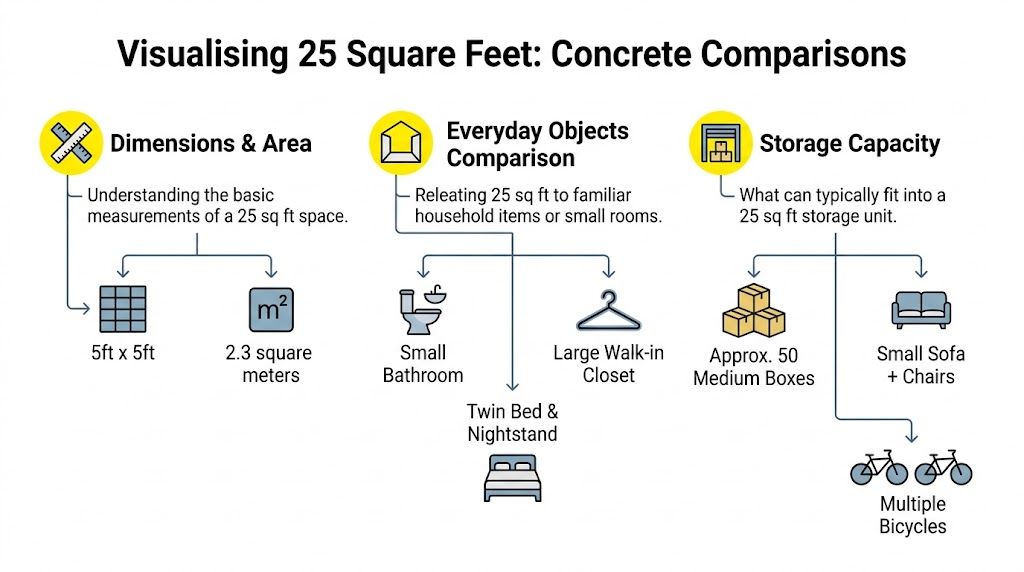
The simplest way to picture 25 sq feet is this. It’s usually a 5 ft by 5 ft space.
That still sounds abstract to many people, so it helps to bring it back to familiar UK settings. Think of a compact square area that’s large enough for stored belongings, but not intended for the contents of an entire home.
What that looks like in everyday life
A 25 sq feet unit is often easiest to imagine as something close to:
- A large walk-in wardrobe
- A small garden shed
- Part of a box room rather than the whole room
- A compact storage area for one room’s overflow
Some people also find it helpful to compare room footprints before they book. If you want to measure your own spare room, hallway corner, or office nook, a room size calculator can help you map what 25 sq feet feels like against a space you already know.
Why small can still be useful
The average UK dwelling has a floor area of 94 square metres, or 1,012 sq ft, which means a 25 sq ft unit represents about 2.5% of that space (The Mortgage Reports summary citing UK housing data). That’s a helpful reminder that this isn’t meant for a full house clearance.
It is meant for targeted storage.
That could be the things from one bedroom while you redecorate. It could be the items making your hallway, loft, or spare room feel unmanageable. It could be student belongings between terms, or stock for a side business that’s currently creeping across your dining table.
Small units work best when your problem is specific. One room. One category of belongings. One stage of a move.
A better way to judge the size
Instead of asking, “Is 25 sq feet big or small?”, ask:
- Am I storing one room’s worth of items, or more than that?
- Can most of my belongings be stacked safely?
- Do I need regular access, or can I pack it tightly?
Those questions usually give a clearer answer than the raw measurement.
What Actually Fits in a 25 Sq Ft Storage Unit
This is the part many find important. Not the dimensions on paper, but the actual contents.
A 25 sq ft unit with a 5 ft x 5 ft footprint and an 8 ft ceiling gives you 200 cubic feet of volume. Packed efficiently, that space can hold the contents of a typical storage cupboard, including items such as a dresser, seasonal belongings, and up to 10 medium-sized boxes (Public Storage size guide).
The key phrase there is packed efficiently. A 25 sq feet unit isn’t a dumping ground. It works best when items are grouped, stacked, and planned.
Typical use cases
Here’s a practical guide to the sort of combinations that usually make sense.
| Scenario | Typical Items That Will Fit |
|---|---|
| Student move | Boxes of clothes, bedding, kitchen kit, books, a desk chair, and small flat-pack items |
| Spare room clear-out | Seasonal decorations, keepsakes, folded furniture, suitcases, sports gear, and boxed household items |
| One-bedroom overflow | Mattress, chest of drawers, bedside items, soft furnishings, and boxed personal belongings |
| Business storage | Archive files, packaging supplies, small inventory batches, printed materials, and lightweight equipment |
| Hobby or resale stock | Storage tubs, labelled boxes, listing supplies, props, and sorted items for online selling |
What tends to fit comfortably
A 25 sq feet unit is well suited to:
- Boxed items: Books, documents, clothing, toys, kitchenware, and décor
- Small furniture: Bedside tables, chairs, compact drawers, dismantled shelving
- Soft contents: Bedding, coats, cushions, curtains, and rugs
- Business basics: Samples, tools, paperwork, and e-commerce stock in manageable quantities
What usually catches people out is width, not volume. A sofa, for example, might fit if it’s compact and positioned carefully, but a chunkier one can be awkward. The same goes for wardrobes, wide desks, and anything that doesn’t dismantle neatly.
A sensible way to test your list
Before booking, split your belongings into three mental groups.
Flat and stackable
These are your easiest items. Boxes, folded chairs, dismantled furniture panels, and storage tubs make excellent use of a compact unit.
Bulky but light
Things like duvets, lampshades, or children’s equipment take up space fast. They fit, but they need planning.
Awkward shapes
Bikes, armchairs, tall mirrors, and wide furniture pieces are the ones to measure properly. They may fit well, but they often determine the layout of the whole unit.
If one oversized item dictates where everything else has to go, treat that item as the starting point for your plan.
A good 25 sq feet booking is usually one where you know your “anchor items” in advance. That might be a mattress and drawers. It might be archive boxes and stock shelves. Once those are placed, the rest becomes much easier to picture.
Maximising Your Space with Smart Packing Strategies
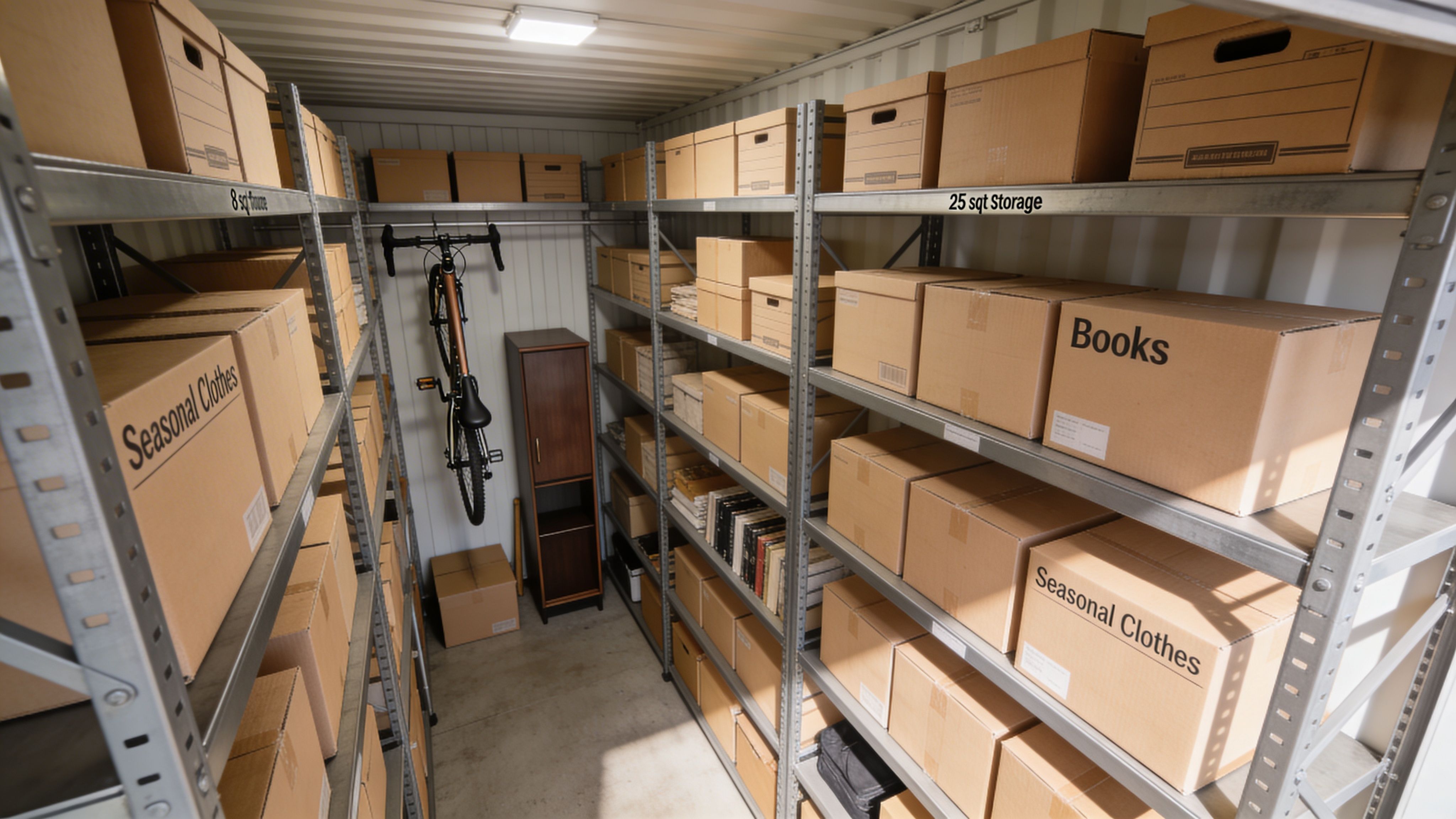
A small unit rewards good packing more than a large one does. When you organise well, 25 sq feet can feel surprisingly capable. When you don’t, even a few badly packed items can waste the whole front half of the space.
Use the full height
Because the unit offers 200 cubic feet of volume, the floor is only part of the story. The gain comes from stacking upwards sensibly.
That means sturdy boxes on the bottom, lighter ones on top, and tall items standing where they won’t crush anything fragile. Uniform boxes make this much easier than a random collection of shopping bags and half-filled cartons.
Pack for access, not just for fit
Many people make one common mistake. They pack as if they’ll never need to open the unit again.
That’s fine for a short house move. It’s less fine if you need winter coats in November, account files next month, or resale stock every week.
Try these habits instead:
- Label more than one side: You shouldn’t need to turn every box around to find the right one.
- Keep front-access items obvious: Put things you may need again near the door.
- Break down furniture: Bed frames, tables, and shelving usually store far better in pieces.
- Use soft items as padding: Bedding or cushions can protect delicate belongings.
A lot of practical decluttering advice follows the same principle. If you’re sorting before you store, this guide on the best way to declutter your home gives a useful starting point.
Build a simple internal layout
You don’t need a formal diagram. A rough plan is enough.
Back wall
Place the least-used items here. Think keepsakes, archived paperwork, or out-of-season belongings.
Middle layer
This is for stackable boxes and medium furniture. It forms the main body of the unit.
Front section
Keep your essentials here. Cleaning bits, stock you need to reach, or anything you’ll want without unpacking half the unit.
Leave yourself a narrow access strip if you expect repeat visits. Losing a little space at the front often saves a lot of frustration later.
The best-packed 25 sq feet units usually look boring. That’s a compliment. Straight stacks, clear labels, and no dead space means you’re using the unit properly.
Who Should Rent a 25 Sq Ft Storage Unit?
This size works best for people with a clear, contained storage problem. Not a whole-house move. Not a workshop’s worth of equipment. Something smaller, sharper, and easier to define.

Students between terms
In Nottingham especially, students often need somewhere for belongings during summer, placements, or a gap between tenancies.
A 25 sq feet unit suits that pattern well when the aim is to store the practical contents of student life rather than large household furniture. Clothes, bedding, books, kitchen gear, and a few compact furniture items can usually be managed far more neatly than trying to scatter them across friends’ houses or back seats of cars.
Home movers and decorators
This is one of the most common uses.
If you’re selling, renovating, or just trying to make the house feel less crowded, a small unit can take the pressure off one room at a time. That can be enough to make a spare bedroom usable again, clear the dining room before viewings, or create breathing space while flooring or painting is done.
Some people also use short-term storage as part of a broader reset at home. Articles like this one on how to reclaim your space at home can be useful if you’re trying to decide what should stay in the house and what should move out of it.
Small businesses and side hustlers
A 25 sq feet unit also makes sense for local business use, especially around Nottingham and Nottingham where many people want practical storage without taking on workshop or warehouse costs.
For UK remote workers and side hustlers, a compact unit can serve as a strategic business asset, giving you separate space for stock or equipment without paying for a traditional office or warehouse. It can also help separate home life from work materials, which many people find useful for both organisation and routine (US Chamber article on trending business ideas).
This can suit:
- Online sellers with shelves of packaging and small stock lines
- Tradespeople storing lighter materials, samples, or records
- Consultants and freelancers needing room for equipment and files
- Resellers who want a tidy holding space away from the family home
People who need a first step, not a giant solution
That’s the core strength of 25 sq feet. It’s approachable.
If you’ve never rented storage before, booking a compact unit often feels less risky and easier to budget for. For a lot of people, it’s the right starting point. Large enough to solve a real problem, small enough to stay manageable.
Common Questions About 25 Sq Ft Storage Units
A few questions come up again and again with this unit size. Usually, they’re less about the measurement and more about whether the unit will work in everyday life.
Is a 25 sq ft unit big enough for a sofa
Sometimes, yes. It depends on the sofa.
A compact sofa or small two-seater may fit if it can be stood safely or positioned alongside other items. A deep, bulky sofa can be the piece that makes the whole unit harder to use. Measure it first, especially the width and depth.
What is the typical monthly cost in the UK
Pricing varies by facility, location, access type, and whether the unit is indoors. The verified UK guidance available for this unit size places typical monthly pricing at £59 to £99.
That range is one reason many first-time renters start here. It’s often the point where storage still feels practical rather than excessive.
Do I need insurance for a small unit
In many cases, yes, or at least you should strongly consider it.
The size of the unit doesn’t matter as much as the value of what’s inside. Even if you’re only storing boxes, those boxes may contain clothing, electronics, paperwork, or sentimental belongings that would be difficult to replace. If you want a clearer idea of how cover works, this guide to contents insurance for storage units is worth reading.
Can I use 25 sq feet for reselling or side income
Yes, and this is becoming a very practical use for small units.
UK homeowners are increasingly using micro-storage as part of decluttering for secondary income, with a 25 sq ft unit acting as a product incubation space for items being sorted and resold through platforms such as Vinted or eBay (Income School article on niche site ideas). In plain terms, that means you can clear the house, organise stock properly, and keep your resale activity from taking over the spare room.
Is 25 sq feet enough for a full house move
Usually not.
It’s far better for the contents of one room, a selected group of belongings, or a tightly packed short-term need. If you’re moving the contents of several rooms, you’ll probably want to look at a larger option.
What’s the best sign that this size is right for me
If your storage list sounds like “boxes, a few furniture pieces, seasonal items, or business stock”, 25 sq feet is often a very sensible fit.
If your list sounds like “my whole flat”, it probably isn’t.
If you’re weighing up whether 25 sq feet is enough, the easiest next step is to speak to a team that handles these questions every day. Container Self Store offers secure, flexible storage in Nottingham and Nottingham, with straightforward advice, clear size options, and practical help for home movers, students, and businesses who want the right space without the guesswork.