Space problems in Nottingham usually arrive all at once. You're midway through a house move near the Arboretum, your buyer and seller dates don't quite line up, and every room is full of boxes. Or you're a Nottingham Trent student staring at a room that has to be cleared before summer, with nowhere sensible to keep your things. Or you're a tradesperson whose van has become a rolling storeroom, with tools, fittings and leftover stock jammed in wherever they fit.
That's when self storage stops being a “nice to have” and becomes a practical fix.
Nottingham has a mature storage market because the city creates steady demand from students, commuters, families and small firms. Nationally, the sector now reports £940 million+ in annual turnover, more than 5,100 facilities, and 64.3 million sq ft of storage space, which is stated to be 7.2% year on year higher in UK self-storage market data. In plain terms, storage isn't a niche service anymore. It's a normal part of moving, renovating, downsizing and running a business.
Your Guide to Self Storage in Nottingham
A good storage decision comes down to three things. Type, size and access.
Choose the wrong type and you make loading harder than it needs to be. Choose the wrong size and you either overpay for fresh air or end up trying to stack boxes to the ceiling on move-in day. Get access wrong and even a well-priced unit becomes a nuisance when you need your things in a hurry.

Who storage suits in Nottingham
For students, storage solves the gap between term dates and accommodation contracts. The main need is usually short-term space for clothes, books, kitchen kit and a few valuables, with a simple move-out and move-back process.
For families, the pressure is different. You may need room during a chain delay, while decorating, or after inheriting furniture you're not ready to sort yet. In those cases, what matters most is ease. You want somewhere secure, easy to reach, and simple enough that you're not still dealing with admin weeks later.
Local businesses use storage more tactically. Stock, tools, paperwork and spare equipment all take up expensive room at home or in commercial premises. A flexible unit often works better than forcing everything into a garage, spare bedroom or overloaded van.
Practical rule: Don't start by asking which facility looks nicest online. Start by asking how often you'll visit, what the heaviest item is, and whether you need to park right outside the unit.
If you're comparing options, it helps to look at a provider that clearly separates room storage from container storage and explains access upfront, such as secure self storage in Nottingham and Nottingham.
What saves time and stress
The best approach is simple:
- Match the unit to the job: Student boxes and household valuables often suit indoor rooms. Heavy furniture, tools and business stock often suit drive-up space.
- Think about the journey, not just the rent: A cheaper unit can cost you more in repeated awkward trips.
- Plan your first month properly: Most problems happen on move-in day, when people realise they've guessed at size or access.
If you get those basics right, Nottingham self storage becomes straightforward rather than frustrating.
Indoor Rooms vs Drive-Up Containers
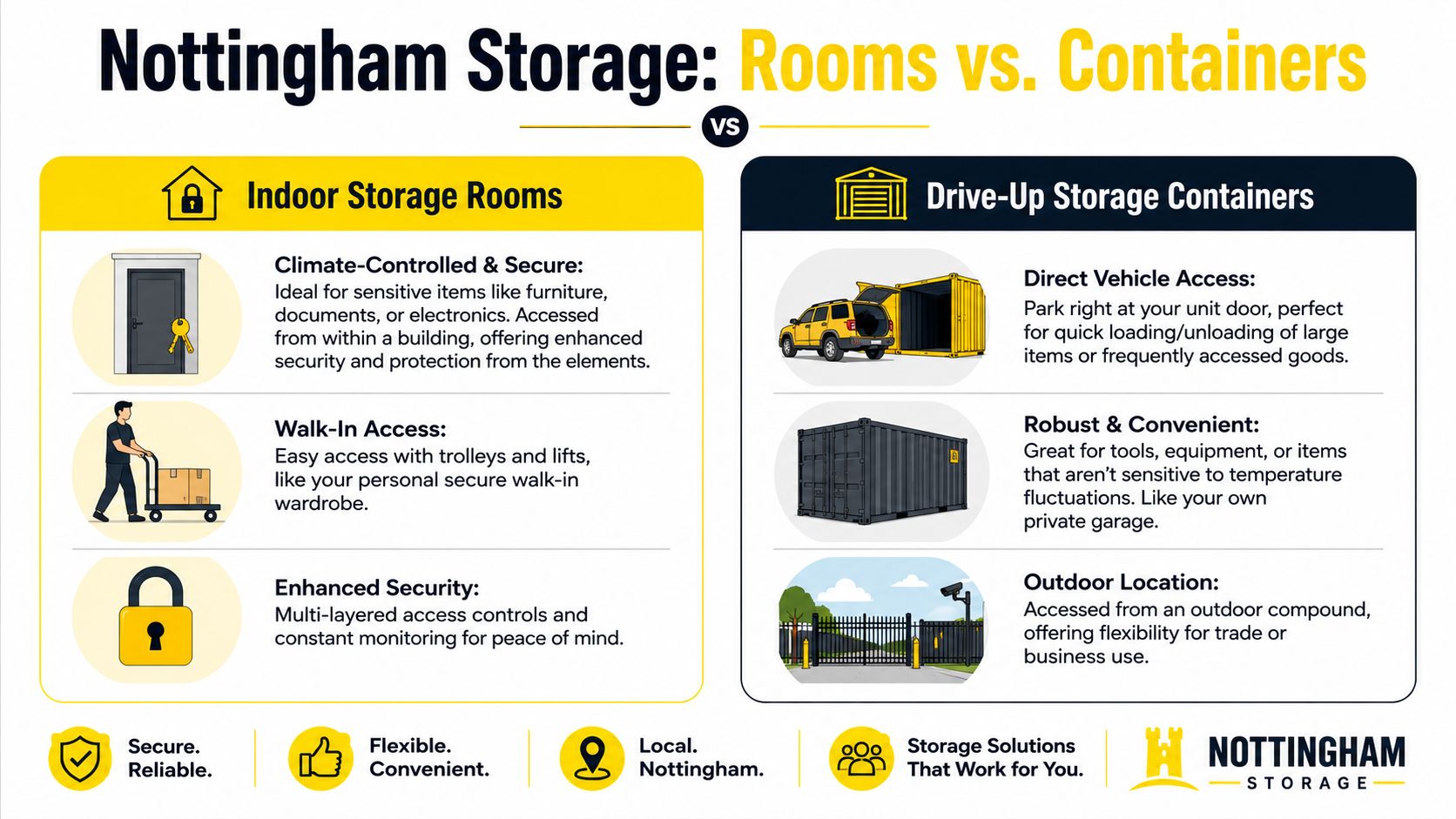
The primary choices for self-storage in Nottingham are indoor storage rooms and drive-up containers. They do different jobs, and the wrong choice usually shows up when you're carrying something heavy in the rain.
An indoor room is like a secure cupboard inside a larger building. A drive-up container is more like your own ground-level garage. That comparison is simple, but it's the quickest way to work out what fits your life.
When indoor rooms make more sense
Indoor rooms are usually the better pick when the contents are awkward to protect or organise. Think boxed documents, electronics, clothing, books, smaller furniture, archived household items, and anything you'd rather move on trolleys through a building than wheel across a yard.
They also suit customers who want a tidier, more controlled loading process. If you're sorting shelves, labelling cartons, or storing things you may browse through occasionally, indoor space tends to feel easier to manage.
Indoor rooms often work well for:
- Students: Boxes, bedding, kitchen items, monitors and study materials.
- Households: Spare furniture, keepsakes, prams, seasonal decorations and family records.
- Office users: Files, archived paperwork and equipment that benefits from a cleaner internal setting.
When drive-up containers are the smarter option
Containers are about speed and convenience. If you can pull up close to the door, open the unit, and unload straight from a car or van, the whole job is quicker. That matters for sofas, white goods, tools, racking, packed stock, and anything bulky enough to make corridors and lifts a nuisance.
For tradespeople, drive-up access is usually the deciding factor. Daily in-and-out use doesn't suit a complicated route through a building. The same goes for online sellers moving parcels, packaging and inventory.
A container often fits best if you need:
| Storage type | Best fit | Less ideal for |
|---|---|---|
| Indoor room | Boxed items, valuables, documents, student belongings | Repeated loading of bulky materials |
| Drive-up container | Furniture, tools, stock, trade equipment | Delicate browsing of many small items |
If you'll visit often and carry heavy loads, convenience matters more than a slightly neater internal environment.
The trade-off people miss
People often focus on security first, and that's fair, but handling time is what affects daily life. If every visit means finding a trolley, waiting for a lift, and making several trips, an indoor room can become tiresome for trade or stock use. If your contents are mostly boxed and you value internal access and order, a container can feel rougher than necessary.
The best Nottingham self storage choice is the one that matches how you'll use it each week.
Choosing the Right Storage Unit Size
A parent clearing a child's room before the September start at Nottingham Trent. A family between exchange and completion in West Bridgford. A tradesperson trying to fit tools, spare materials and a ladder into one unit without paying for dead space. In each case, the wrong size costs money or creates hassle.
The usual mistake is guessing from memory. A better method is to list what takes up real volume, then choose a unit that still lets you get to the items you will need first.
Start with a practical inventory
Before asking for prices, break your contents into four groups:
- Large furniture such as beds, wardrobes, sofas and tables
- Appliances such as washing machines, fridge freezers or tumble dryers
- Boxed items including books, clothes, kitchenware and paperwork
- Awkward extras such as bikes, pushchairs, ladders or long tools
This works better than trying to picture an empty square on the floor, especially if you are packing in stages over a few weeks.
Common mistake: Items spread around a house look bigger than they store. Once furniture is dismantled and boxes are stacked properly, the space needed can change a lot.
Use size bands, not guesswork
Most Nottingham sites offer everything from small lockers to rooms suitable for full house moves or business stock. The exact mix varies by branch, so treat the examples below as a planning guide rather than a guarantee that every size is available at every facility.
| Unit Size (sq ft) | Equivalent To | Typical Contents |
|---|---|---|
| 10 | A small locker or compact cupboard | A few boxes, luggage, student essentials, small electronics |
| 25 | A large walk-in cupboard | Boxes, small furniture, bikes, archive storage |
| 50 | A small room | Contents from a modest flat or a larger student or household mix |
| 100 | Half a garage feel | Furniture from several rooms, business stock, tools and equipment |
| 200 to 500 | Garage to warehouse-style space | Full house contents, trade materials, larger stock holding, bulky commercial items |
In practice, students in Nottingham often need less room than they first request, particularly over the summer when it is mostly clothes, bedding, kitchen gear and a desk chair. House movers often need more, because “just the big bits” usually turns into big furniture plus garage items, spare chairs, garden tools and boxes from the loft.
Choose for how you will use the unit
If the unit is for a short, closed period, such as a gap between tenancy dates, pack for density. Dismantle bed frames, stand mattresses on edge if the facility allows it, and use same-size boxes so they stack cleanly.
If you will be in and out every week, pack for access. Leave a walkway. Keep stock lines, work tools or student essentials near the front. Saving a small amount on rent is not worth spending twenty minutes shifting boxes every visit.
That is the trade-off people feel after move-in, not on booking day.
A simple local rule of thumb
Students usually overbook because they count the whole room, not just what is coming home from halls or a shared house. Families in a move tend to undercount lofts, sheds and “we'll deal with that later” items. Tradespeople around Nottingham and the A52 corridor often underestimate length as much as volume. Ladders, conduits, shelving and long cases can make a unit awkward even when the square footage looks right.
If you are unsure, ask the site to size the unit from your item list, not from “one bedroom flat” or “small van load”. Those labels vary too much.
For a broader item-by-item comparison, this storage unit size guide gives a useful planning baseline before you book. If security equipment is part of your shortlist for higher-value contents, it can also help to compare wider South Wales security options so you know what a serious CCTV setup looks like.
Go up a size if access matters, timing is tight, or you know more items will be added later. That usually saves more stress than trying to cram everything into the cheapest unit available.
Understanding Security and Access in Nottingham
Security matters, but in Nottingham self storage, access design often matters just as much. A unit can be secure on paper and still be awkward in real life if the opening hours don't suit how you work.
One Nottingham facility offers 7-day access from 7am to 8pm, another has standard Monday to Friday access with 24/7 access by arrangement, and a separate site uses app-based smart entry plus fully vented container units, according to Quick Self Storage Nottingham South information on access and entry systems. That tells you something important. Local operators aren't just selling square footage. They're designing around quick visits, repeated loading, and customers who don't all keep office hours.
What useful security actually looks like
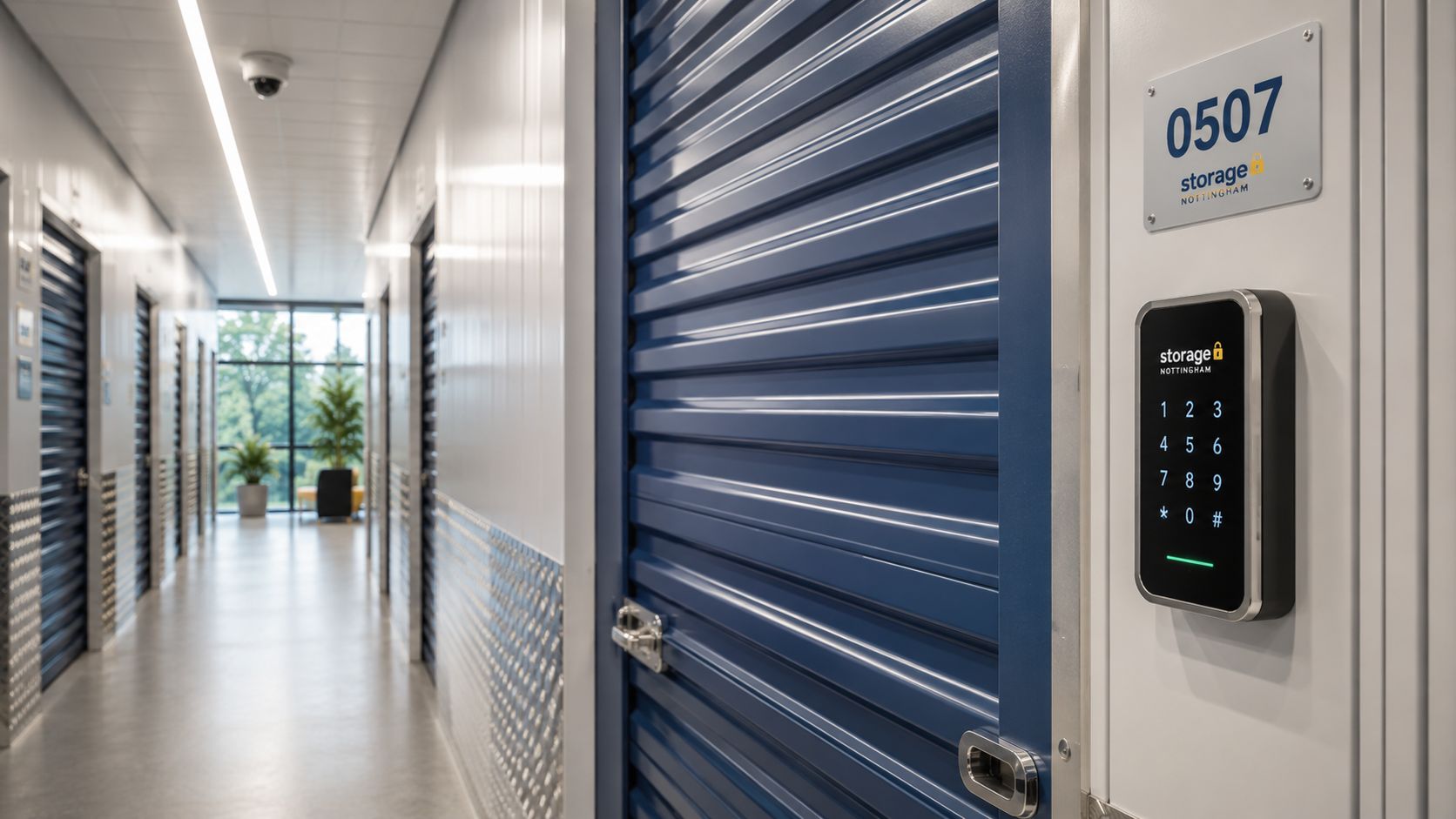
The basics are familiar. Gated entry, CCTV, individual locks, on-site staff, controlled access. What matters is how these layers work together.
If you're storing family furniture during a move, you want simple reassurance that only authorised users can get in and that the site isn't open in an uncontrolled way. If you're storing business equipment, you also want a facility layout that doesn't leave you exposed while loading or unloading.
Look for these points when asking questions:
- Entry control: Is there a gate, keypad, fob or app-based system?
- Unit-level security: Do you supply your own lock, or is there an integrated system?
- Site visibility: Are loading areas overlooked by CCTV and staff?
- Visit practicality: Can you get in and out without hanging around in a busy yard?
If you want a broader sense of what modern monitored systems involve, this overview of South Wales security options is a useful reference point for the kinds of CCTV and perimeter measures people now expect from commercial premises.
Why access hours can make or break the unit
For a student or household customer, standard daytime access may be completely fine. For a plumber heading to a first job, or an online retailer doing evening dispatch prep, restricted access can become expensive in lost time.
The best access hours are the ones that match your routine without needing special arrangements every other week.
Road links matter too. If you're travelling in from Beeston, Long Eaton, Stapleford or further out towards the M1 and A52 corridors, a well-sited facility can cut the friction from every collection and drop-off. That's especially relevant for trade users who can't afford to spend half the morning crossing the city for one box of fittings.
Pricing Contracts and Booking Your Unit
Storage quotes look simple until move-in day. Then people discover that the rent is only one part of the decision. The right question isn't just “What's the price?” It's “What am I paying for, what's extra, and how easy is it to leave when I no longer need the space?”
That matters whether you need Nottingham self storage for a month between house moves or as a rolling base for stock and tools.
What to check in the quote
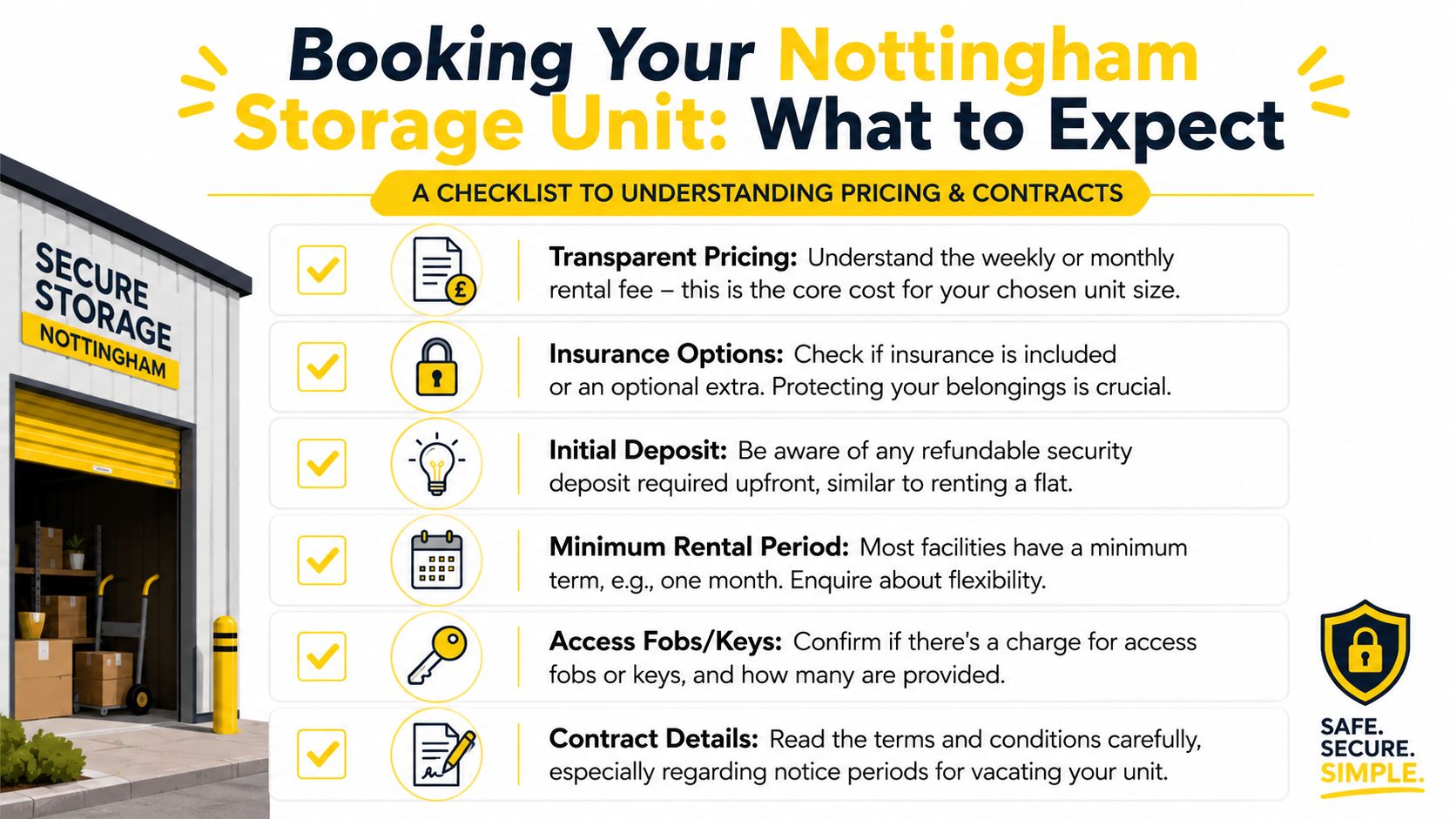
A storage quote usually centres on the rental fee for the unit itself. Beyond that, ask what else applies. Some facilities require contents protection or insurance. Some expect you to buy a specific lock. Others may have admin steps, notice requirements, or minimum rental terms that affect how flexible the arrangement really is.
Read the agreement with the same care you'd use for a gym cancellation or broadband contract. You're looking for practical details, not legal drama.
Check these points carefully:
- Notice period: How much warning do you need to give before leaving?
- Billing cycle: Are you paying monthly, and when does that cycle begin?
- Protection cover: Is insurance included, required, or optional?
- Access terms: Are all access arrangements covered by the standard price?
- Unit changes: Can you move to a larger or smaller space if your needs change?
For businesses comparing storage with outsourced fulfilment or overflow warehousing, a cost calculator can help frame the decision. If that's your situation, this guide can help you optimise your 3PL spend before you commit to the wrong setup.
A booking checklist that prevents last-minute problems
Booking a unit is usually straightforward if you do the prep in the right order.
List what's going in
Don't estimate from memory. Write the big items down.Choose the storage type first
Decide between indoor room and drive-up container before discussing size.Ask about access before price
A cheaper unit with awkward hours often stops being cheap.Reserve the unit
If your moving date is tight, reserve as early as you can rather than waiting for final confirmation on every detail.Buy proper packing materials
Strong boxes, tape, furniture covers and clear labels save a lot of time.Pack by retrieval priority
Keep what you may need first near the front. Don't bury kettle cables, work tools or tenancy documents at the back.Confirm move-in day logistics
Check arrival procedure, paperwork, lock arrangements and whether you need ID.
Booking tip: If a contract looks flexible but the notice rules are awkward, it isn't as flexible as it sounds.
What works and what doesn't
What works is a simple rolling arrangement, clear access terms, and a unit you can use without hassle.
What doesn't work is booking purely on price, underestimating your size, and turning up with unlabelled bags, loose items and no plan for the first load.
Specialised Storage for Businesses and Trades
A Nottingham joiner finishing a job in West Bridgford does not need more office space. He needs somewhere practical to unload sheet materials, keep spare fittings dry, and get back on the A52 or towards the M1 without wasting half an hour wrestling with access.
That is the business case for storage in Nottingham. It gives local firms room to operate without taking on a bigger workshop, shop unit or long commercial lease before they need one.
Which businesses benefit most
Trades tend to see the clearest payoff. Plumbers, electricians, kitchen fitters, decorators and exterior specialists usually need fast van access, room for bulky gear and a layout that lets them grab the next day's kit without unpacking half the unit. For that job, drive-up space often earns its keep.
Online sellers usually need something different. They are better served by a clean, organised unit where stock, packaging, returns and seasonal lines can be shelved properly. If you are sending parcels every day, the time lost hunting through mixed boxes soon costs more than the difference between a cheaper unit and a usable one.
Office-based firms also use storage well, but for quieter reasons. Archived files, spare desks, exhibition kit, marketing materials and infrequently used equipment can all sit off-site instead of taking over expensive workspace in the city centre.
Nottingham's local mix helps here. Around New Basford, Lenton and the ring-road routes, businesses can usually choose between smaller rooms for records and stock, or larger spaces that suit tools, materials and regular loading. Closer to central Nottingham, convenience matters more than square footage if staff need to reach the unit between appointments.
Why storage can beat taking extra premises
Extra premises bring fixed costs that many small firms do not need yet. Rent is only part of it. Business rates, utilities, fit-out costs and longer commitments can turn a space problem into a cash-flow problem.
Storage suits the stage where the issue is operational overflow rather than customer-facing space. That is common with growing e-commerce businesses, mobile trades and firms carrying seasonal stock. Christmas retail overflow, event equipment in summer, or extra materials during a busy contract period all fit storage far better than a permanent lease.
Used properly, storage helps with:
- trade tools, fittings, cables, consumables and spare parts
- retail or e-commerce stock that does not fit neatly at home or in a back room
- archived files and office equipment that must be kept but not kept close
- displays, packaging, samples and event kit that come in and out during the year
If you are comparing options for stock, tools or company equipment, this guide to commercial storage for rent in Nottingham is a useful starting point alongside local room and container facilities.
What works and what catches businesses out
The best setup matches your actual working pattern. A bathroom fitter starting early near Arnold has different needs from an online seller dispatching from Mapperley or a caterer covering weekend events across Nottinghamshire.
What works is simple. Put heavy, low-value bulk items deeper in the unit. Keep fast-moving stock or the next day's job materials near the door. Leave enough floor space to reach what you need without a full reshuffle every visit.
What catches businesses out is choosing on headline price alone. A cheap unit loses its value quickly if access is awkward, loading is slow, or the site sits well off your usual route. For many trade and small business customers in Nottingham, easy loading and sensible location matter more than polished branding.
Nottingham Self Storage FAQs
Can students in Nottingham rent storage just for the summer
Yes, short-term storage is common for students. The main thing is to check the minimum rental period, notice rules and access arrangements before booking. Pack in stackable boxes, label clearly, and keep passport, tenancy papers and laptop separate rather than buried in the unit.
Is drive-up access worth it for tradespeople
If you use the unit regularly, usually yes. Drive-up space saves time when you're loading tools, materials or stock from a van. It's especially useful if your day starts early or your gear is too bulky to move comfortably through internal corridors.
Can I get storage quickly if my house move changes at the last minute
Often you can, but availability depends on the unit type and size you need. If your completion dates look shaky, reserve early rather than waiting for absolute certainty. Even a short delay in a property chain can create a lot of pressure, so it helps to have the storage side arranged in advance.
What items are usually not allowed in storage
Most facilities won't allow perishable goods, hazardous materials or illegal items. As a practical rule, don't try to store anything flammable, explosive, leaking, living, or likely to spoil. If you're unsure about paint, fuel-related items, gas canisters, food, plants or restricted tools, ask the facility before move-in day.
Do I need an indoor room or a container
Choose based on handling and contents. Indoor rooms suit boxed items, student belongings, documents and household goods you want in a more internal environment. Containers suit bulky furniture, tools, trade materials and stock you need to load directly from a vehicle.
What's the biggest mistake people make
They book too quickly without thinking about visit frequency. A unit that looks fine online can be the wrong fit if you need fast repeat access, have awkward loading requirements, or underestimate how much space your largest items really need.
If you need practical Nottingham self storage without overcomplicating the process, Container Self Store is worth a look. It offers indoor rooms and ventilated drive-up containers, with Nottingham access that suits home movers, students, trades and businesses who want straightforward storage near the M1 and A52.