Stock creeps into every spare corner before most owners admit there's a space problem. A few boxes become shelving in the office. Packaging moves into the hallway. Tools stay in the van overnight because there's nowhere sensible to unload them. Archive files end up where people should be working.
That's usually the point where commercial storage for rent stops being a nice idea and becomes an operational decision. If you're running an online shop, a trade business, a small office, or a growing local firm, the right unit can do more than clear clutter. It can protect stock, improve access, reduce handling, and buy you time before you take on a bigger property commitment.
Is Your Business Running Out of Space
Running out of space rarely happens all at once. It shows up in small frictions. Staff can't find stock quickly. Deliveries block the entrance. Your garage, back room, or spare office starts doing the job of a warehouse, only badly.
That's why more businesses now treat storage as part of normal operations rather than a last-minute fix. The UK self-storage sector is a mature commercial property segment, with 2022 occupancy at 83.3% and average rental rates rising 9% year on year to £26.13 per square foot, according to Storeganise's UK self-storage trends report. Those figures matter because they show this isn't a fringe service. Businesses and households are using it at scale, and operators are pricing space in a market with real demand.
The signs that space is now costing you money
A cramped setup doesn't just look untidy. It slows work down.
- Stock control starts slipping because items are stored wherever they fit, not where they belong.
- Handling damage becomes more likely when boxes are stacked in walkways or moved too often.
- Staff waste time shifting things to reach what they need.
- Your premises stop serving their main purpose because storage takes over desks, meeting rooms, or work areas.
Practical rule: If space is causing repeated delays, access problems, or avoidable damage, you don't have a tidiness issue. You have a business-space issue.
What good storage should solve
A useful commercial unit should answer a few simple questions. Can you get to your goods when you need them. Can you load and unload without creating extra handling. Can you keep stock, tools, paperwork, or equipment in a secure and predictable environment.
Those are the points that matter most in practice. Not marketing language. Not vague promises about flexibility. Just whether the space works for the way your business runs.
What Modern Commercial Storage Really Means
A lot of owners still hear “storage” and think “overflow”. A lock-up for spare chairs, old files, or seasonal stock. That view is out of date.
For many small firms, commercial storage for rent is closer to a lightweight alternative to warehouse space. It gives you room to hold inventory, manage returns, stage materials, or prepare jobs without taking on the overheads that come with a conventional industrial lease. That matters because, as noted in this commercial storage market perspective, many SMEs aren't really choosing between “storing” and “not storing”. They're choosing whether to avoid warehouse costs while still getting practical operational space.
When storage is smarter than a warehouse
A warehouse starts to make sense when you need dedicated industrial premises, heavier operations, or activities a storage site won't allow. But many businesses aren't at that stage yet. They need access, not a long lease. They need room for stock and equipment, not a full property management burden.
Commercial storage tends to suit you when:
- Demand changes month to month and you don't want to be tied into more space than you need.
- Your business is still proving volume and taking a full unit or warehouse would lock in unnecessary cost.
- You need ground-level practicality more than office finish.
- You want to separate stock from home or customer-facing premises without taking on a larger site.
The operational angle most people miss
The best business users don't treat storage as dead space. They organise it like a working stockroom. That means clear aisle paths, labelled inventory zones, and a layout that supports quick loading and picking.
If you're selling online, it also helps to manage your inventory with Vorby so your storage setup and stock records stay aligned. A tidy unit without reliable inventory control still creates errors. The physical space and the stock system need to support each other.
Commercial storage works well when it removes friction from the business. It works badly when it becomes a cheaper version of disorganisation.
That's the main distinction. A good unit gives you low-overhead space with room to scale. A poor setup just moves the mess off-site.
Exploring Your Business Storage Options
Not every unit suits every stock type. The right choice depends on what you're storing, how often you need access, and whether your priority is protection or loading convenience.
Most business users end up comparing indoor storage rooms with drive-up container units. Both can work well. They just solve different problems.
Indoor rooms
Indoor rooms are usually the better fit when the contents need a cleaner, more sheltered environment. They're often chosen for archive boxes, office furniture, packaged retail stock, spare equipment, and items that shouldn't sit in a basic external unit.
At many sites, sizes range from compact lockers to rooms large enough for serious business use. Container Self Store, for example, offers indoor rooms from 9 sq ft to 200 sq ft based on its published facility information. That range suits businesses that want to start small, then move up without changing provider.
Drive-up containers
Drive-up containers are about speed and ease. You park nearby, open the doors, and load directly. That's useful for trades, heavier equipment, bulky stock, tools, event kit, and anything awkward to move through corridors or lifts.
Ventilated 10 ft and 20 ft container units are common options at specialist sites, including the publisher's own facilities. They're practical when you're in and out regularly and don't want multiple handling stages between vehicle and unit.
Indoor Room vs Drive-Up Container Which is Right for You
| Feature | Indoor Storage Room | Drive-Up Container |
|---|---|---|
| Best for | Documents, boxed stock, office items, sensitive inventory | Tools, materials, bulky stock, equipment |
| Access style | Usually through internal corridors or loading areas | Direct vehicle-to-unit loading |
| Handling effort | Better for organised shelving and smaller-item picking | Better for larger loads and rapid unloads |
| Protection | Often a more controlled internal environment | Strong on convenience and robust access |
| Typical users | Offices, online sellers, professional services | Tradespeople, installers, event firms, local retailers |
| Loading speed | Slower if goods move in smaller batches | Faster for heavy or repetitive loading |
| Layout choice | Good for racking, filing, boxed stock rotation | Good for stacked materials and equipment access |
Choosing by stock type, not just by size
A common mistake is picking a unit by square footage alone. In real use, stock shape matters just as much. Long materials, boxed SKU lines, archive files, loose tools, and palletised goods all occupy space differently.
Think about the job the unit needs to do:
- Archive storage usually needs dry, tidy stacking and straightforward retrieval.
- E-commerce stock benefits from shelving, pick faces, and room for packing materials.
- Trade equipment often needs direct loading and a layout that avoids repeated lifting.
- Seasonal retail overflow needs quick in, quick out access with clear labelling.
If your goods are bulky and your visits are frequent, drive-up often wins. If your items are smaller, more sensitive, or need cleaner organisation, indoor space usually works better.
Key Security and Access Features to Demand
For business use, security isn't just about a padlock on the door. It affects insurance, staff routines, stock protection, and whether the unit is workable on a busy day. A compliant site also has to think about safe storage arrangements, fire risk, and what the building can physically support.
According to this warehouse specifications overview, fire safety, access control, and documented load limits are critical for commercial use. That's the right way to assess a facility. Don't ask only whether it's secure. Ask whether it's secure and suitable for the way your business stores goods.
What to inspect on site
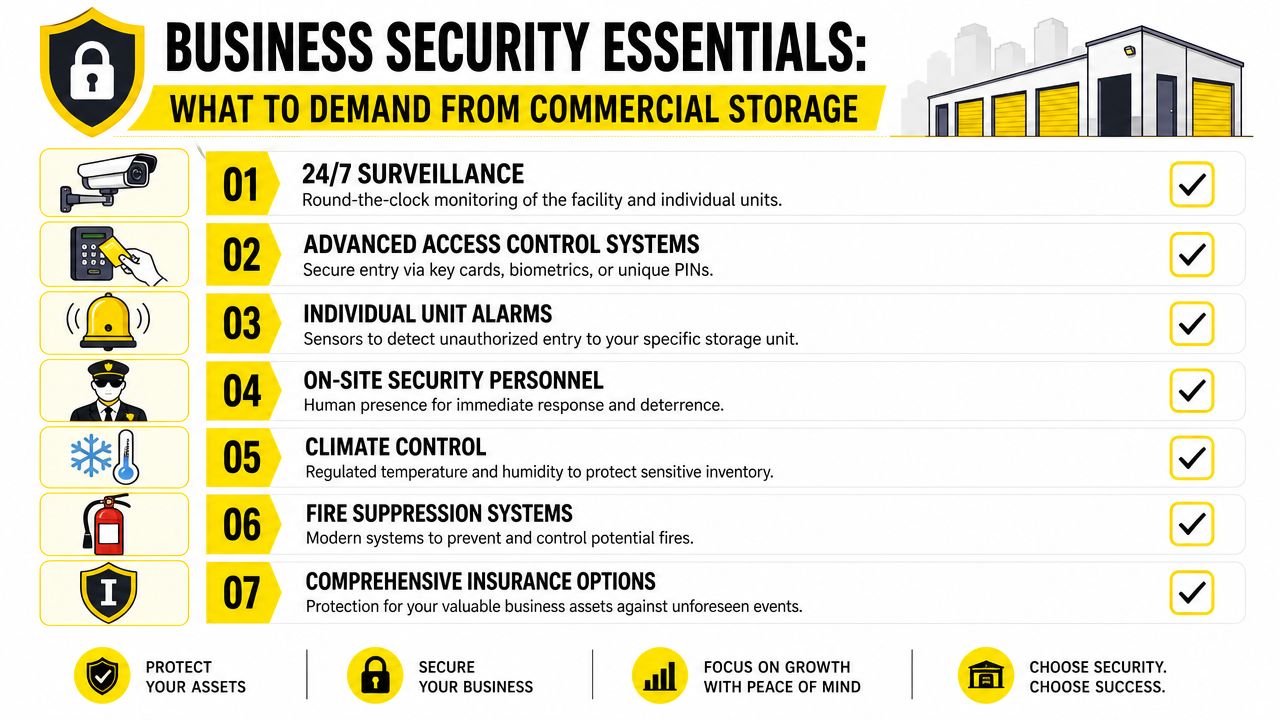
A proper business facility should show you how access is controlled, how the site is monitored, and what rules apply to storage layout. If staff can't answer those questions clearly, that's useful information in itself.
Check for the following:
- Gated entry so random vehicle access is controlled.
- CCTV coverage across approach roads, compounds, corridors, and key pinch points.
- On-site staff presence during trading hours, not a completely unattended yard.
- Clear fire routes that aren't blocked by stored goods or poor layout.
- Documented load guidance if you plan to use shelving, racking, or dense stacking.
- Lighting and ventilation that let you work safely and inspect stock properly.
- Access terms that fit your routine, especially if you collect early, return late, or need weekend access.
Security and access have to work together
A site can have cameras and still be inconvenient. It can have good access and still be weak on control. The balance matters.
For example, a drive-up ground-level unit can save handling time and reduce damage risk, but only if the site also has controlled entry and sensible monitoring. If your stock is high value, or your team visits outside standard office hours, it's worth understanding what reliable business alarm monitoring looks like in practice so you can ask sharper questions about response, escalation, and accountability.
You should also compare a facility's published security features against a dedicated page such as this guide to secure self storage, which shows the sort of practical standards many business users now expect.
If a facility talks confidently about locks but vaguely about fire routes, access logs, load limits, or site supervision, keep looking.
A Clear Guide to Pricing and Agreements
Business owners often overcomplicate storage pricing because they assume it works like a commercial lease. Usually, it doesn't. The main attraction is that it's simpler.
The useful benchmark for context is the average UK self-storage rental rate of £26.13 per square foot, with rates having risen 9% year on year in the 2022 market data cited earlier by Storeganise. That figure is a market indicator, not a quote for your exact unit. Actual cost depends on unit type, location, access convenience, and what's included.
What you're usually paying for
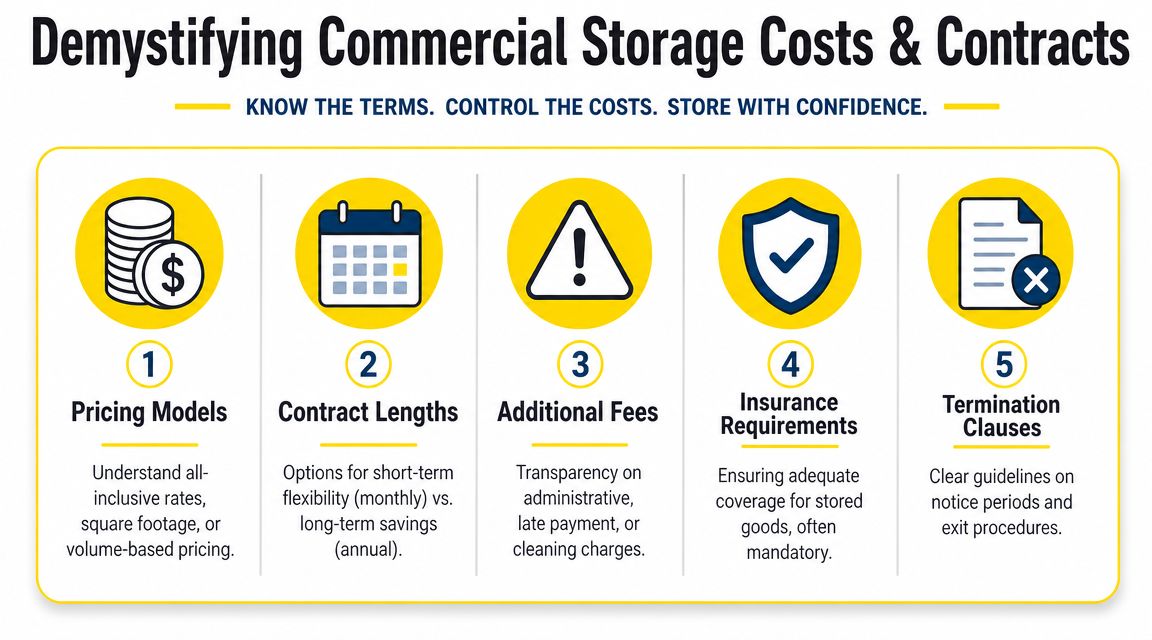
In practice, storage pricing is easier to manage when you break it into three questions.
What is the base unit cost
This is the monthly charge for the unit itself. Size and access type usually drive most of the difference.What comes with the site
Security, gated entry, general site management, and standard access arrangements are often part of the package rather than separate line items.What conditions apply
Insurance requirements, notice periods, late-payment terms, and any admin rules matter just as much as the headline rent.
Agreement points worth reading properly
A short, flexible agreement is one of the biggest reasons businesses choose commercial storage for rent. But flexible doesn't mean you should skim it.
Read these parts carefully:
- Notice period so you know how to leave without surprises.
- Access conditions including any limits on times, vehicles, or site use.
- Permitted goods because storage rules can exclude certain items.
- Insurance obligations so you know what cover you need to arrange.
- Payment timing and what happens if a direct debit fails.
If documents are sent digitally, these online contract signing tips are worth a quick read before you commit. It helps to know what to verify before you click through.
For a broader look at how business-focused facilities present terms and options, it's useful to review a specialist example of storage facility business space. Not because every operator is identical, but because it shows the kind of clarity you should expect.
A good agreement should be boring. Clear terms, plain access rules, simple notice requirements, no mystery charges.
Matching Storage to Your Business Needs
The best unit isn't the biggest one. It's the one that matches your workflow. That means looking at what you store, how often you move it, and whether the space is purely for holding goods or part of daily operations.
The UK has 5.5 million private-sector businesses, most of them small, and demand is shifting towards spaces that combine storage with light operations, as noted in this SME space overview. For small firms, the decision often comes down to access, power, connectivity, and convenience rather than raw floor area.
Why cubic space matters
A unit can look generous on paper and still perform badly. Usable capacity depends on height, layout, and access geometry, not just footprint. The technical point is simple. You're not only renting square feet. You're choosing working volume and the paths people need to move through it.
The background guidance in the verified data makes this clear. Stack height, aisle width, and racking configuration all affect how much stock you can really store and how quickly you can pick it. A badly planned layout can create bottlenecks even when the room looks large enough.
Four common business fits
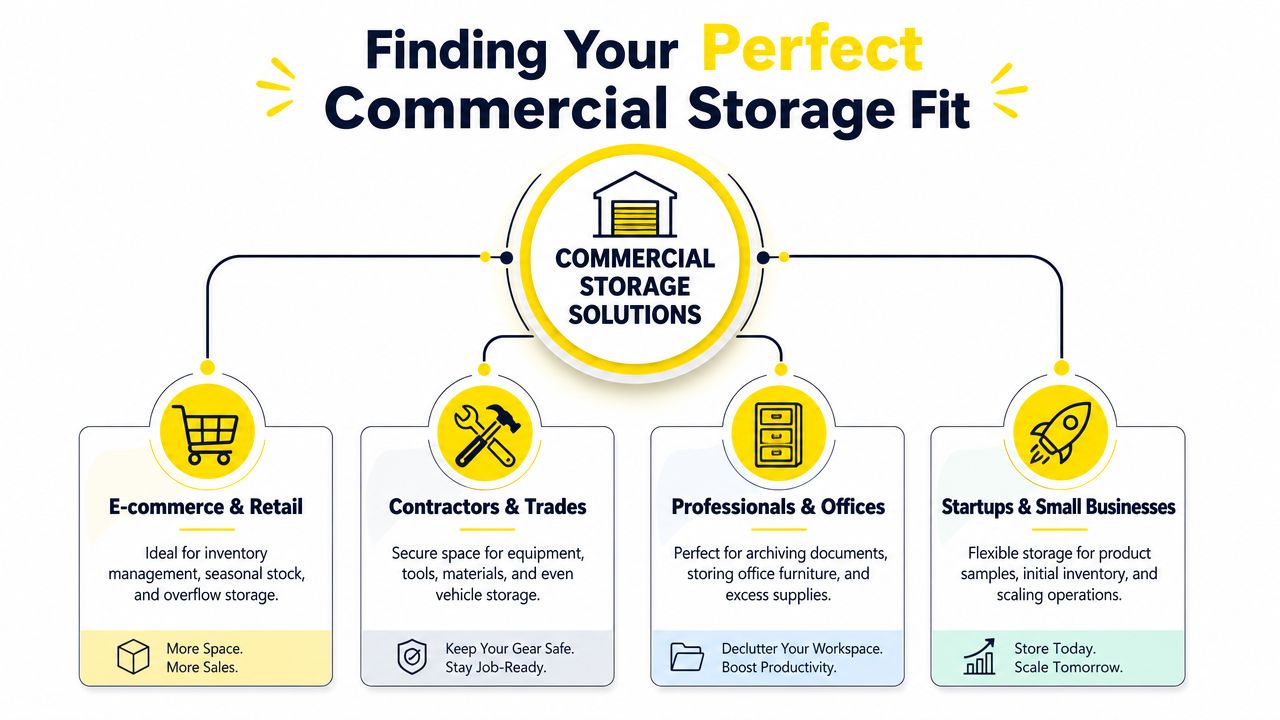
E-commerce sellers
Online retail businesses usually need more than somewhere to pile boxes. They need organised stock zones, room for returns, space for packaging, and access that supports frequent collections.
Indoor rooms often suit this profile well if you're storing varied SKU lines and picking by hand. If your operation is edging into daily dispatch work, it may be worth exploring options beyond standard storage, including facilities that offer power and Wi-Fi for light operational use.
Trades and contractors
Tradespeople tend to value speed over polish. Ground-level loading, secure access, and enough room for tools, consumables, and bulky materials usually matter more than internal finishes.
For firms working around Nottingham or Nottingham, route convenience can make a bigger difference than people expect. Sites near the M1 and A52 in Nottingham or the A45 in Nottingham cut wasted travel and make early starts or end-of-day drop-offs easier.
Offices and professional services
Archive files, spare furniture, printed materials, and IT equipment call for a neater environment and a predictable layout. You want retrieval to be straightforward and you don't want delicate items jammed behind heavy stock.
A smaller indoor room often does the job better than a large container if your main priority is tidy access rather than bulk volume.
Start-ups and hybrid operators
Some firms sit in the middle. They need storage, but they also need a place to do light admin, prep orders, test samples, or meet a courier. That's where hybrid business space becomes relevant.
If that sounds like your setup, a guide focused on small business storage can help you separate standard units from spaces designed for broader day-to-day use.
The right question isn't “How much space can I afford”. It's “What type of space lets my business run cleanly for the next stage”.
Your Next Steps to Secure the Right Unit
Once you know what you're storing and how you'll use the space, choosing a unit gets much easier. Most mistakes happen when people book too quickly, visit too late, or focus only on headline price.
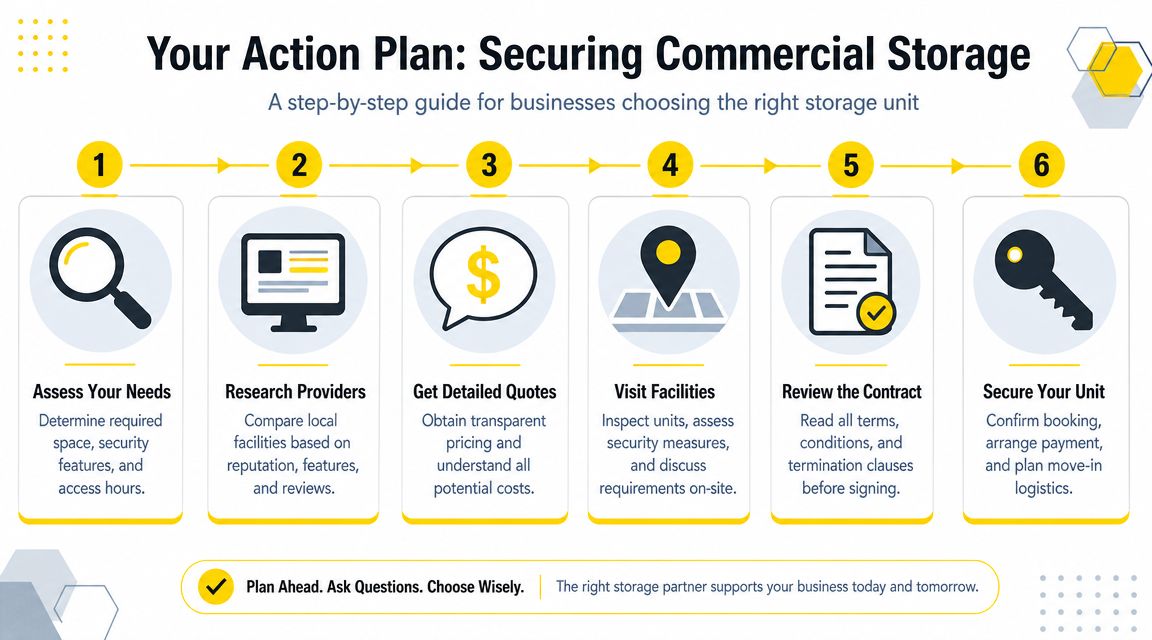
A simple way to decide
Start with this short process:
List what's going in
Separate archive boxes, picked stock, bulky equipment, long items, and anything sensitive.Decide how often you'll visit
Weekly bulk access needs a different setup from daily in-and-out use.Measure for layout, not guesswork
Allow for shelving, aisle space, door clearance, and safe handling.Ask what activities are permitted
Some sites are ideal for storage only. Others can support more operational use.Visit before signing
Photos don't tell you how easy the site is to work from.
Site visit checklist
Use the visit to test the basics:
- Look at cleanliness because messy communal areas usually signal weak management.
- Check visibility of security so you can see cameras, gates, lighting, and controlled access points.
- Ask direct questions about permitted goods, insurance, and notice periods.
- Walk the route from vehicle to unit to judge real handling effort.
- Notice how staff answer. Clear answers usually mean clear processes.
If the space is easy to reach, easy to load, and easy to understand, you're probably looking at a workable option. If every answer feels vague, it won't get better once you move in.
If you need secure, flexible business storage in the East Midlands, Container Self Store offers indoor rooms, drive-up container units, and practical business space options across Nottingham and Nottingham. It's a straightforward place to compare unit sizes, check access options, and get a clear quote without taking on warehouse-style overheads.