Boxes are stacked under the desk. Packing materials have taken over the spare room. A van full of tools doubles as overnight storage because there’s nowhere else to put them. For many small firms in Nottingham, Nottingham, and the wider East Midlands, that isn’t a growth plan. It’s a space problem.
Small business storage sits in the middle ground between “make do with what we’ve got” and “sign a warehouse lease we’re not ready for”. That middle ground matters more as online selling expands. Global e-commerce is projected to grow at a 6.5% CAGR, which helps explain why more firms need flexible space for stock, returns, packaging, and equipment (Yardi).
A good storage setup gives a business breathing room. It can clear a home office, protect expensive tools, and make stock handling less chaotic. If you want broader context on how storage fits into logistics and operations, this complete guide to warehousing & storage solutions is a useful companion read.
Introduction to small business storage
A small online retailer often starts with one shelf, then one room, then half the house. The tipping point comes when daily work slows down because stock is everywhere. Orders take longer to pack. Returns get mixed up. Simple admin jobs become harder because paperwork shares space with product boxes.
That’s where small business storage becomes practical rather than optional. It gives you extra room without forcing you into a full warehouse commitment. For a tradesperson, that may mean secure ground-level space for tools and materials. For an office-based firm, it may mean somewhere dry, organised, and separate for archived files and spare equipment.
Storage works best when it removes friction from the working day, not when it simply hides clutter somewhere else.
In places like Nottingham and Nottingham, location also matters. If your stock or tools are near the routes you already use, loading and unloading becomes part of the job rather than a detour. That’s one reason many SMEs look for simple, flexible units before they ever consider industrial premises.
Understanding the concept of small business storage
Small business storage is rented space used for business items rather than household overflow. The principle sounds simple, but people often confuse it with either personal self storage or a conventional warehouse.
What makes it different
A personal unit is usually chosen for life events such as moving house or renovating. A warehouse is a larger operational base that may suit bigger stock volumes or more fixed logistics. Small business storage sits between those two.
It’s best understood like this:
- Your garage is convenient, but it isn’t designed for business stock control.
- A warehouse offers scale, but it can be too large and too rigid for a small firm.
- A business storage unit gives you dedicated space without taking on more premises than you need.
That middle option matters because SMEs represent 99.9% of UK businesses, or 5.6 million in 2025, and East Midlands industrial vacancy was 3.8% in Q4 2025, showing how tight the local space market can be near major motorway routes (Source Equipment).
What to look for in practical terms
Business users usually need more than “four walls and a lock”. They need a unit that fits the way they work.
Key features often include:
- Flexible terms so you can scale up or down if stock levels change
- Useful access for vans, regular visits, or early starts
- Suitable conditions for what you store, especially paperwork or electronics
- Technical suitability if you’re storing heavier items, shelving, or palletised goods
- Optional extras such as workspace pods, power, or Wi-Fi where available
A florist storing display stands has different needs from an electrician storing reels of cable. An e-commerce seller handling returns needs a different layout from a builder storing equipment. The concept stays the same. The right space supports daily operations instead of competing with them.
Why businesses get stuck on this choice
Many owners ask the wrong first question. They ask, “What’s the cheapest unit?” A better question is, “What kind of work will happen around this unit?”
If you’ll visit once a month for archive boxes, a simple indoor room may be enough. If you’re loading tools every morning, access and floor strength matter more. If you need to answer calls, print labels, and meet a customer occasionally, a pod-style space may make more sense than storage alone.
Comparing small business storage unit types
Not all storage works the same way. The best option depends on what you’re storing, how often you visit, and whether you need storage only or storage plus workspace.
The three main formats
Indoor rooms are often the neatest option for boxed items, records, light equipment, and contents that benefit from being inside a building. Drive-up containers are more practical for bulky loads, repeated trips, and van access. Pods add another layer by combining storage with a usable working environment.
Comparison of storage unit types
| Unit type | Size range (sq ft) | Access | Best use-case |
|---|---|---|---|
| Indoor storage rooms | 9 to 200 | Internal building access | Files, boxed stock, office equipment, household or business overflow |
| Drive-up container units | 10 ft and 20 ft container formats | Ground-level, direct vehicle access | Tools, materials, bulky stock, furniture, palletised items |
| Business or Trade Pods | Varies by provider | Storage with workspace features | Firms needing storage plus power, Wi-Fi, and a base for day-to-day tasks |
Indoor rooms
These suit businesses that want clean, straightforward storage. Think archived paperwork, marketing materials, spare office chairs, or boxed product lines that don’t need forklift-style handling.
They’re usually easier to keep organised because you’re less likely to overfill them with awkward items. Shelving, labels, and box categories work well here.
Best for: office users, online sellers with lighter stock, service firms keeping records off-site.
Drive-up containers
These are often the most practical option for trades and stock-heavy firms. You can pull up, open the unit, load or unload, and leave without carrying items through corridors or lifts.
The overlooked technical issue here is floor load capacity. For container units, floor loading is typically rated at 500 to 750 lb per sq ft, which is what allows heavy tools, equipment, and palletised stock to be stored without structural risk (Link Logistics).
Practical rule: If you plan to store generators, tile packs, machine parts, or palletised goods, ask about floor loading before you sign. “Will it fit?” isn’t the same as “Is it suitable?”
Best for: tradespeople, event firms, online retailers with regular van loading, businesses storing dense or awkward items.
Business and Trade Pods
These work for firms that need more than storage. A pod can act as a compact base where you store stock, plug in equipment, manage paperwork, and work on-site.
That changes the role of the space. Instead of being only a holding area, it becomes part of the working day.
Best for: small service businesses, mobile operators, firms in transition from home working to dedicated premises.
A simple way to choose
Use this shortlist:
- Choose an indoor room if order, boxing, and protection matter most.
- Choose a drive-up container if speed of loading and heavy items matter most.
- Choose a pod if the unit also needs to support daily business activity.
Benefits and use-cases for small business storage
The biggest benefit isn’t just extra space. It’s better control. When tools, stock, files, and packaging all have a proper place, the working day becomes easier to manage.
Common business situations
An online seller may use storage to separate home life from fulfilment work. Stock stays in one place, returns can be quarantined, and packaging supplies no longer fill the hallway.
A tradesperson may use a unit to keep expensive tools secure overnight and keep the van free for the next morning’s job. That also reduces the temptation to leave materials piled on-site or at home.
A small office may use storage for records, surplus desks, exhibition stands, and seasonal promotional material. The office stays usable for people, not boxes.
Why storage changes day-to-day operations
The effects are often practical rather than dramatic:
- Cleaner workflow because stock is grouped properly
- Faster retrieval because staff know where to find items
- Safer handling because heavy or awkward goods aren’t stacked in unsuitable rooms
- Better separation between active stock, old records, and personal space
For firms that handle many SKUs, labelling matters as much as square footage. A simple scan-and-track setup can help. If you’re reviewing ways to organise stock movement, this guide to using a QR code for inventory in your business gives a clear starting point.
The best unit is the one that supports a routine. Deliveries in one zone, active stock in another, dead stock reviewed regularly.
Businesses that often benefit
- E-commerce sellers with changing stock levels and returns
- Trades and contractors storing tools, materials, and small plant
- Professional services firms keeping archive files off-site
- Event and marketing businesses storing stands, print materials, and kit
- Student and relocation support services needing temporary overflow space between moves
Guidance on unit sizes and cost
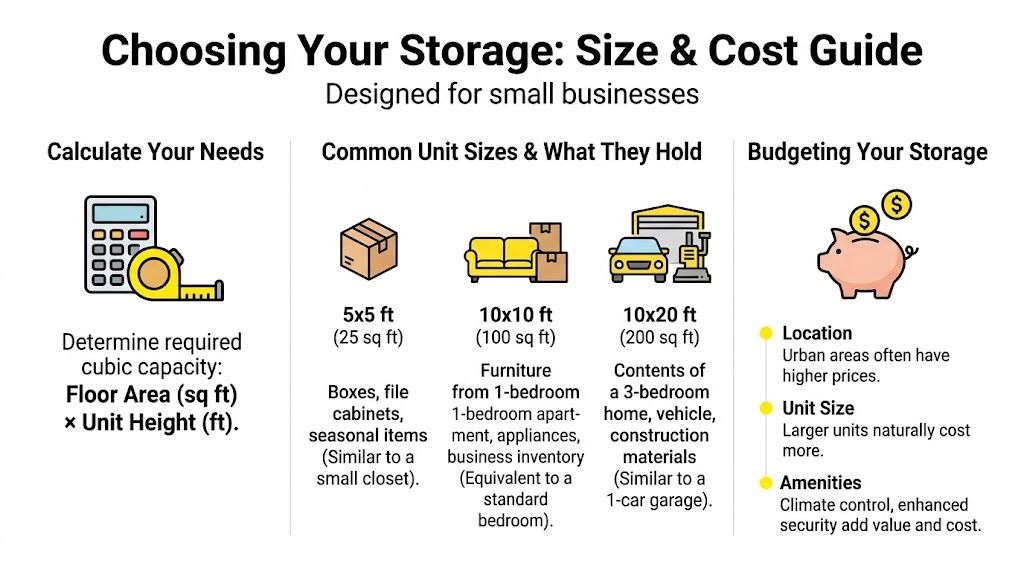
Many businesses choose storage by floor area alone. That’s where mistakes start. What matters is cubic capacity, not just square footage.
Start with volume, not guesswork
The basic formula is:
usable floor area × clear height = cubic capacity
That tells you how much stackable space a unit offers. A small firm often underestimates how much value sits in vertical storage. Shelving, stackable crates, and sensible aisle planning can make one unit work far harder.
Worked examples
A 10×10 ft unit at 8 ft height gives about 800 cu ft. Allowing for aisle space, that can fit around 35 to 40 file boxes. A 20 ft container offers about 1,280 cu ft, which shows why comparing volume, not just footprint, leads to better value (Regent CRE).
That’s the useful way to think about sizes:
- Smaller lockers and compact rooms suit documents, small equipment, and boxed stock.
- Mid-size rooms often suit a growing online shop or office move.
- Larger rooms and containers are better for furniture, trade materials, and denser business storage.
If you want help translating your inventory into a practical size choice, this unit calculator is useful: https://containerselfstore.com/what-size-storage-unit-do-i-need/
A quick sizing method
Try this before requesting quotes:
- List what must be accessed weekly. Put active items in one category.
- Separate awkward items. Long tools, shelving, or display equipment affect layout more than box counts do.
- Measure stackable goods. Crates and cartons can use height. Loose items usually can’t.
- Leave a working aisle. A packed unit that can’t be used properly is too small.
What affects cost
Without reliable, local, provider-specific pricing across all unit types, it’s better to think in terms of cost drivers rather than fixed rates.
The main factors are:
- Location. Easier access near major routes can justify the spend if it saves repeated travel time.
- Unit size. Bigger units cost more, but a badly chosen smaller unit can cost more in the long run if you outgrow it quickly.
- Access style. Drive-up convenience may be worth paying for if you load regularly.
- Features. Indoor conditions, added security, power, or workspace elements can change the price.
A cheap unit that wastes staff time is often more expensive than a better-planned one. Cost only makes sense once the unit supports your workflow.
Security access and provider selection checklist
Security isn’t one feature. It’s a combination of site design, access control, and clear operating terms. A small business should check all three.
What to inspect on-site
A provider may look fine online and feel very different in person. Walk the route from the entrance to the unit.
Use this checklist:
- Access control. Is the site gated, and is entry limited to authorised users?
- CCTV coverage. Ask where cameras are positioned and whether key access points are monitored.
- Lighting. Early starts and winter evenings make poor lighting a real operational problem.
- On-site staff. Staff presence can help with oversight, queries, and general site order.
- Vehicle movement. Check whether vans can manoeuvre comfortably near the unit.
- Unit condition. Look for clean doors, solid flooring, and signs of good maintenance.
If security matters highly to your business, it helps to compare your shortlist against a specialist overview such as https://containerselfstore.com/secure-self-storage/
What to ask before signing
The contract matters as much as the compound. Ask direct questions.
- Who can access the unit? Clarify named users if more than one person needs entry.
- What are the access hours? Make sure they fit your actual working pattern, not your ideal one.
- Is insurance required or optional? Know what is and isn’t covered.
- What can’t be stored? Restrictions on certain goods should be clear from the start.
- How do notice periods work? Flexibility only helps if the terms are straightforward.
A secure site should still be easy to use. If access is so awkward that staff avoid the unit, the setup won’t help operations.
Technical checks business users often miss
Heavy stock and commercial shelving put different demands on a unit than household boxes do. Confirm whether the floor is suitable for the weight you plan to store. Ask whether the site has power available if you need to charge tools or run equipment in a pod-style space. If documents or electronics matter, ask about the storage environment rather than assuming all units are equal.
Local solutions in Nottingham and Nottingham
For SMEs in the East Midlands, local fit matters as much as unit type. A well-placed site can make stock collection, van loading, and day-to-day storage less disruptive.
Why local access changes the decision
A Nottingham business serving customers across the city and beyond often needs quick links to the A52 and M1. A Nottingham firm may care more about getting in and out near the A45 without adding unnecessary miles to every run.
That practical point matters because the regional market is tight. Businesses often need flexible space rather than a long commercial commitment. Demand for hybrid space has also shifted. Since Q2 2025, hybrid Trade Pods demand rose 35% in the Midlands, and SMEs have saved 40 to 60% on overheads compared with traditional warehouses (Flex Space Logistics)).
What local SMEs often need
The common pattern is straightforward:
- Tradespeople want ground-level loading and dependable access.
- Online sellers want room for stock, packaging, and returns without taking over the house.
- Small firms in transition want somewhere to store, sort, and sometimes work.
- Students and movers who run side businesses may need short-term flexibility before committing to larger premises.
Some providers in the region offer a mix of indoor rooms, container units, and pod-style business space. That matters because it lets firms start small and change format as operations become more organised.
For businesses comparing nearby options, this Nottingham page is a useful reference point for what’s available locally: https://containerselfstore.com/self-storage-units-nottingham/
Local convenience isn’t just about distance. It’s about whether the site fits the roads, vehicle type, and routine your business already uses.
A sensible local decision test
When comparing sites around Nottingham or Nottingham, ask yourself three things. Can I reach it easily from my normal routes? Can I load and unload without hassle? Can this setup still work if my stock levels or working pattern change?
If the answer is yes to all three, the unit is more likely to support the business rather than create another task to manage.
Conclusion and next steps for small business storage
Small business storage works best when it matches how your business runs. The right choice depends on unit type, usable volume, access needs, security standards, and how often you’ll use the space. A neat indoor room, a drive-up container, or a pod can each be the right answer in different situations.
Take stock of what’s causing friction now. Measure what you need to store, list what needs frequent access, and compare providers with the checklist above. A quick quote and a site visit usually make the right option much clearer.
If you need practical storage or workspace in the East Midlands, Container Self Store offers flexible indoor units, drive-up containers, and business space in Nottingham and Nottingham, with straightforward access and security features designed for day-to-day use.