
Checkout is a fortnight away, the next room is not confirmed, and the hallway is already a pile of boxes, a bike, and a duvet you will want again in autumn. That is the usual shape of student summer storage: a short gap between one tenancy and the next, with more possessions than a train or a budget flight will take.
Match the window first. Your contract end date tells you when the room must be empty. The length of that gap tells you how long anything you keep has to sit somewhere else. Only then is it worth sorting what you will use again, sizing a space, and paying for it.
Summer Storage Options Compared at a Glance
| Option | Best for | Typical size or capacity | Practical limit |
|---|---|---|---|
| Indoor self storage room | Boxes, books and full household contents that need a dry, secure room | 9 sq ft locker up to a 200 sq ft room | Access limited to opening hours; cost rises with unit size |
| Container unit | Bulky furniture, bikes, tools and equipment loaded at ground level | 10 ft and 20 ft ventilated containers | Larger footprint, so book early in June |
| Keeping belongings in your room | Students who have booked and paid for a summer room | Your own room only | Often not allowed unless a summer booking exists; check your contract |
| Family or friend's home | Students who can travel home cheaply with a small load | Spare room, loft or garage the host can spare | Transport costs and no access to your own belongings |
| Shared storage with housemates | Groups moving out together who want one unit | Shared unit sized to combined belongings | Agreement on access and costs for every person |
Read the table against your actual load, not against what feels tidy on paper.
An indoor self storage room is the right row when the load is boxes, books and ordinary household contents that must stay dry. A locker covers a modest stack. A larger room covers a full set of possessions, including archived paperwork. You pay more as the floor area grows, and you can only get in during stated hours.
A ventilated container earns its place when the load is bulky. Sofas, bikes, toolboxes and sports kit load more easily at ground level than up a ramp into a small room. The 10 ft unit suits one bedroom's furniture. The 20 ft unit suits a shared house. Both take more site space, so June bookings go first.
Leaving kit in your room only works if the university has let you book and pay for that room over summer. A family home is cheaper when the journey is short and the load is light, but you cannot nip back for a charger in August. Sharing one unit splits the bill, and it fails the moment nobody agrees who holds the key or who pays if someone collects early.
At Container Self Store in Nottingham and Northampton, indoor rooms run from 9 sq ft lockers to 200 sq ft units, with ventilated 10 ft and 20 ft containers, gated access, CCTV-monitored compounds, on-site staff and 7-day access. Treat that as one local pattern, not the only pattern in the country.
Before you pay: check the monthly cost, the minimum term and the access hours, and check that the booking runs from checkout through to the day you collect.
Why the Summer Gap Forces a Storage Decision
Think of the tenancy year as a run of hotel stays. Checkout is fixed. The next check-in is on a different date, often in a different building. Student summer storage is the luggage room in that gap. Nobody sensible leaves a suitcase in the corridor and hopes the next guest will mind it.
Most UK student housing contracts run for about 40 weeks, typically September through June, according to Confused.com's guide to student accommodation. That leaves many students needing to vacate in July and August even when they are coming back to the same city in September.
Three groups feel that gap hardest.
Students with heavy kit cannot take furniture, books, kitchen equipment, clothing or a bicycle home at a sensible cost. A coach will take a rucksack. It will not take a desk and a crate of pans.
International students face a sharper version of the same problem. A flight home with several months of belongings means excess baggage or a shipment that costs more than the goods. A dry room near campus is often the cheaper hold.
Students switching between halls and a private rental rarely have matching dates. One contract ends while the next has not started, so there is nowhere legal to leave a single box overnight.
Holding everything until a new room appears is a gamble. HEPI reported in 2024 that only 8,692 new purpose-built student accommodation rooms became available in the UK during summer 2024, the lowest level this century. A room may not be ready on the day you land back.
Where will your belongings sit between checkout and the next move, and for how many weeks?
Your Tenancy and Vacation Dates Set the Window
There is no national move-out day. Your window comes from three things: your university's calendar, your contract length and your course level. Two students in the same city can face deadlines weeks apart.
The University of Warwick's accommodation FAQ is the clearest worked case. It sets a full move-out of 10:00 on 3 July 2027 for students in 35-week accommodation, while students in 50-week accommodation can stay until 10:00 on 11 September 2027. Summer vacation rooms there are limited, must be booked and paid for, and are allocated first come, first served. On the shorter contract, furniture, clothing, books and equipment need a home from early July, whether or not you feel ready to sort them.
| Situation | Date or rule | What it means for storage |
|---|---|---|
| Warwick 35-week accommodation | Fully move out by 10:00 on 3 July 2027 | Book summer storage before this date; rooms are first come, first served |
| Warwick 50-week accommodation | Can remain until 10:00 on 11 September 2027 | Storage only needed for items moved out earlier |
| Durham summer vacation | 26 June to 26 September 2027 | Plan for up to three months of storage |
| Postgraduate at Royal Holloway | No summer vacation | Storage only if you give the room up |
Durham's academic dates list the 2027 summer vacation running from 26 June to 26 September, so a full gap can stretch to three months, and the page warns that programme calendars can differ slightly. Read your own programme dates rather than borrowing a housemate's from last year.
Royal Holloway states that postgraduate students do not have a summer vacation, so storage only comes into it if you are giving the room up. Residence type shifts the dates too. Catered contracts often run shorter and can require belongings out over Easter, while some self-catered residences stay open in summer for students who are there for academic reasons.
Fix the dates before you price anything
Read your tenancy end date first, then your course calendar, then the start date of wherever you are moving next. The gap between those dates is the storage window you need to cover. If the room must be empty, every personal item goes with you. A room left "almost clear" still fails inspection.
While you are in that paperwork, an apartment cleaning checklist before moving from Canes Cleaners is a useful pass over the room itself, so cleaning charges do not arrive after you have already paid for a unit. If the gap is only a few weeks, look at short-term self storage rather than assuming you must take a whole summer on day one.
Deciding What to Store, Sell, Donate or Replace
The common mistake is storing everything because packing feels urgent. The first decision is whether an item should be stored at all. A unit full of things you would not buy again is just rent on clutter.
During UCL's 2025 summer move-out, students donated more than 1,100kg of unwanted clothing, kitchenware, bedding and electronics, as the UCL reuse scheme recorded. That volume did not need a summer address.

Four routes, not one pile
- Store: keep what you need on return, in good condition, and hard to replace locally. A decent coat, course books you will open again, and a pan set that cooks belong here.
- Sell: list what is outdated, unworn or easy to replace, while people are still in the city. A faded desk lamp shifts in June. It does not shift in August.
- Donate: pass on usable clothes, kitchenware and bedding through a university reuse point or a local charity shop. Housemates can run one shared “reuse first” pass before anyone books space.
- Recycle: take electricals and batteries to a proper collection point. Do not seal a mini-fridge, a charger graveyard or loose batteries into a carton for three months.
A basic kitchen set is the clearest replacement test. If a cheap set of plates, a pan and a kettle would cost less to buy again in September than three months of extra floor space, do not store the old set. Mattresses and damaged furniture usually fail the same test. Check the council bulky-waste collection and any hall reuse scheme before you pay to keep them.
Store versus donate
Storing keeps favourite pieces safe and ready. Donating cuts the unit size and the bill, and it keeps usable goods out of a skip. I would store the coat you wear every winter and donate the mugs you have not touched since freshers' week.
Textiles need a different standard from books. If you are keeping winter clothes, the same habits that work for storing kids' off-season clothes apply here: clean them, dry them fully, and do not crush them into a damp bag.
Ask each item four questions. Would you buy it again today? Will you need it before next summer? Is it clean and intact? Does keeping it force you into a larger unit? If the answers are no, no, no and yes, it does not go into storage.
Matching Your Belongings to the Right Unit Size
Your tenancy dates set the storage window. The pile that survived the keep-or-go sort sets the size. For a typical student room that pile is cartons of books, cookware, bedding and winter clothing, plus one or two awkward pieces. The awkward pieces matter more than the box count. One bicycle or mattress can move you up two rows on the table below.
| Belongings | Suggested space | Notes |
|---|---|---|
| Cartons of books, cookware and winter clothing, with no furniture | 9 sq ft locker | Suits a boxed load; one bulky item rules it out |
| Full household contents and archived paperwork | 200 sq ft indoor unit | Largest indoor room option |
| Bulky furniture, bikes, tools or equipment | 10 ft or 20 ft container | Ground-level loading for large items |
| Room contents that sit between a locker and a full household | Indoor room between the 9 sq ft locker and the 200 sq ft unit | Confirm the exact dimensions against the unit size guide |
A three-step sizing routine
- List by room and category. Walk through the bedroom, kitchen, and hallway. Write books, clothes, kitchenware, furniture, bikes, and tools as separate lines, and give kitchen drawers and under-bed boxes their own entries so nothing hides inside "miscellaneous".
- Count the cartons, then note the awkward pieces. A stack of sealed boxes and nothing else points to a locker. One bicycle, a desk, or a mattress changes the row completely.
- Take the smallest row that fits the list, then add a margin. You will pick up more things before September. A margin of a few boxes is enough. Paying for a whole extra size "just in case" means overpaying across your entire gap.
Edge cases that blow a locker
Winter coats and duvets take more volume than their weight suggests. A breathable bag of bedding can fill the space you thought was spare. A bicycle or a mattress rules a locker out on its own, and anything long and rigid resists stacking around cartons. Pieces like that need the container row, or they need to leave your plan entirely.
Furniture is the other trap. If one cheap flat-pack bookcase is the only thing forcing you up a size, cut the bookcase and keep the smaller unit. Selling it now and replacing it later usually beats renting extra floor space for the whole summer.
Before you pay, recheck the chosen size against a unit size guide. If the list only just fits, go up one step. If you are still guessing, you have not finished the list.
What Summer Storage Costs and How to Compare Quotes
Cost is the monthly rate multiplied by the number of months, plus any one-off fees. Compare every quote in GBP (£) on that same basis. A low headline rate with a long minimum term can cost more than a higher rate you can end on your collection date.
Ask for four things in writing. The monthly rate for the exact size you measured. Any deposit or administration fee. The minimum term. Whether you still pay full months if you leave early. Then ask whether access or collection carries a fee, and whether insurance is included or an extra line.
Here is an illustration with made-up figures, not a quote. A £40 monthly rate over four months is £160. Add a £20 one-off fee and the vacation total is £180. A unit one size larger at £55 a month is £220 before any fee. The second option is not “a bit more”. Over the whole gap it is a clear step up, and it is only justified if your list does not fit the smaller space.
Compare the total for the whole vacation, not the weekly teaser on the booking page.
A shorter minimum term is worth paying a little more for if your collection date is fixed. Paying until mid-July when you move back in early September is wasted money. Paying until September when you only needed six weeks is the same mistake in the other direction.
Put that total next to replacement cost. A basic kitchen set bought again in September can cost less than three months of space. That is why the sort comes before the booking, not after you have already got the key.
How to Pack and Label Belongings for Storage
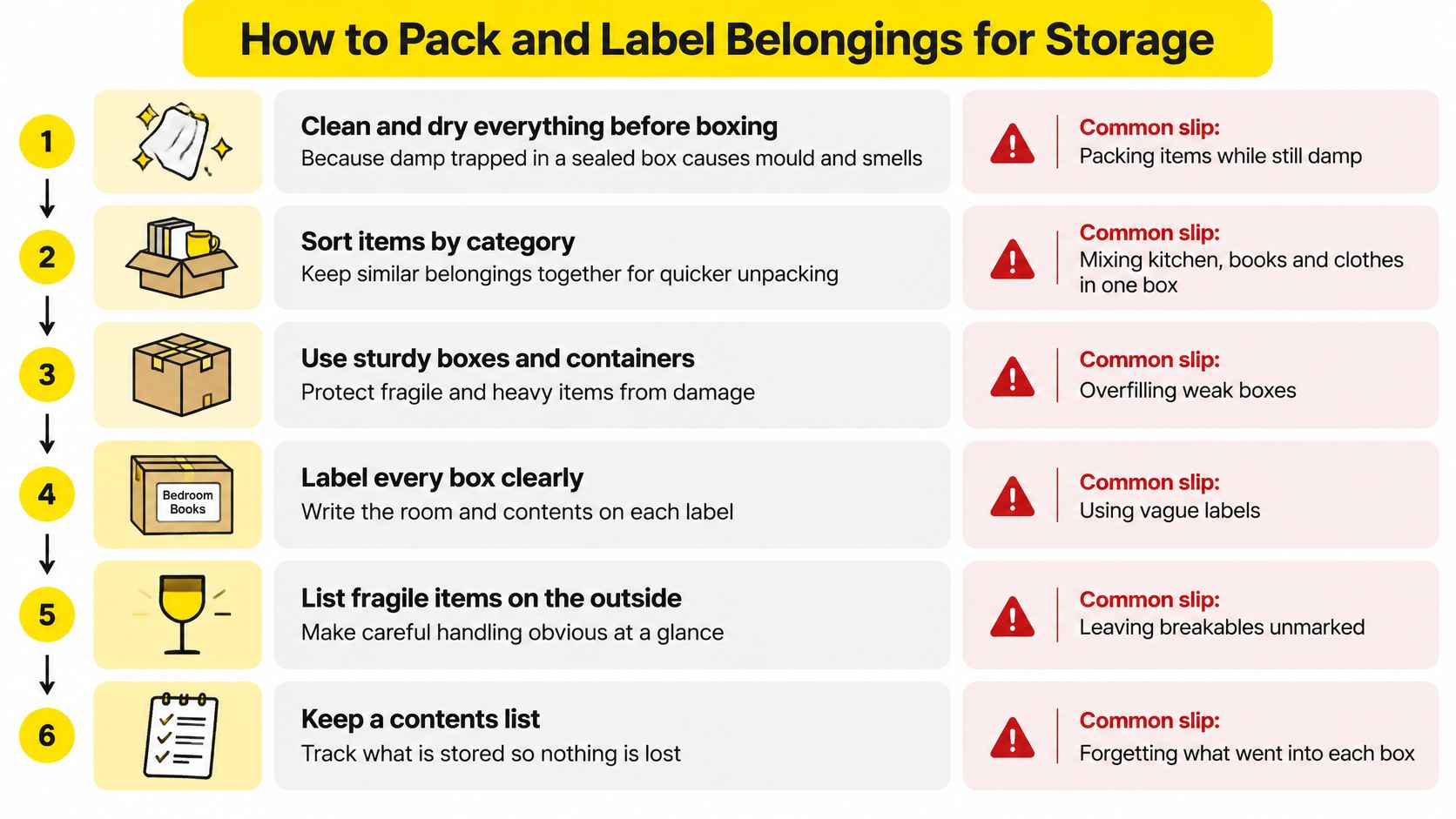
The picture above is the short version. The routine below is what keeps a unit usable in September. Each step has a reason, and each has a usual slip.
- Clean and dry everything before it goes in a box. Damp trapped in a sealed carton turns into mould and a smell you cannot air out later. The slip is packing a towel or a coat that still feels cool to the touch.
- Sort by room, not by whatever is nearest. The return should match the way you packed, so kitchen stays with kitchen. Mixing books, pans and clothes in one carton makes the first night back slower than the move-out.
- Seal each carton and label the contents plus the room it returns to. “Stuff” is not a label. Write “Bedroom: winter jumpers” on two sides, because one face always ends up against a wall.
- Pack books and kitchenware with heavy items low and light items on top. Overfilled cartons split on the way to the unit, usually on the bottom step. If you cannot lift it alone, it is too heavy.
- Wrap duvets and winter clothing in breathable covers, not plastic bags. Plastic holds moisture against the fabric. A cotton cover or a wardrobe box lets the textile breathe. More detail sits in this guide to packing a self storage unit.
- Dismantle furniture, bag the screws and tape the bag to the piece. Loose screws in a pocket do not survive a house move. A taped bag does.
- Write a separate inventory of high-use items and photograph each carton. The photos settle arguments about what was stored. The list tells you which carton holds the kettle and the charger.
- Record the access hours, who holds the key or code, and the collection date. Put that note somewhere you will still have in September, not only inside the unit.
What good packing looks like on collection day
Cartons are intact. There is no damp smell when you open the door. The inventory matches what is on the floor, including the screws still taped to the desk. If that is the picture, you packed it properly. If it is not, the failure was almost always step 1 or step 5.
Choosing and Booking Your Summer Storage
Pick by situation, then book in that order.
- Back to the same city, light load, academic-year contract: an indoor locker or a small room is enough. Do not take a container for five boxes.
- Furniture, a bike or tools: take a container so you can load at ground level. A room you cannot get a desk into is the wrong saving.
- Going abroad, or moving between cities: book a unit for the entire gap, plus a short margin past the day you expect to collect. Flights slip. So do new tenancies.
Then do the booking in this order.
- Check your exact tenancy end date and your course calendar.
- Measure the belongings you decided to keep against the size table.
- Get an online quote and confirm that size on the operator's unit guide.
- Book before move-out. Summer rooms and summer units both run short once exams finish.
- Confirm access days, gated entry and the hours you can collect.
A Nottingham or Northampton site with indoor rooms, ventilated containers, gated access and on-site staff covers that last check for students who are staying in those cities. If an item is still unclear, sort it before you pay, not after.
Book the size you have measured.
Container Self Store offers indoor rooms and ventilated containers in Nottingham and Northampton, with gated access and flexible terms that fit a summer gap between tenancies. If you are lining up student summer storage around a July checkout, get a quote for the size you have already measured. Visit Container Self Store and book before your room has to be empty.