
You're usually looking for storage in Nottingham at the exact moment life gets messy. A tenancy ends before the next one starts. A sale completes late. A spare room turns into a nursery or an office. Stock starts filling the hallway. Tools need to be locked away somewhere better than the van.
That's why choosing storage well matters. The wrong unit costs you twice. First in money, then in hassle. You either pay for space you don't use, or you cram everything into a unit that becomes impossible to access safely.
This guide is built to help you make the decision properly. Not just by postcode or price headline, but by matching your situation to the right type of storage, the right size, and the right access setup.
Finding Your Space in a Crowded City
A lot of people come to storage after trying everything else first. They've stacked boxes in the loft, filled the garage, borrowed a parent's conservatory, or moved things from one corner of the house to another until the whole place feels smaller. Then something changes. A move, a renovation, a term break, a growing business. Suddenly, keeping hold of your things and keeping them out of the way become the same problem.
That's a normal part of life in Nottingham. The city has students moving between halls and houses, families upsizing and downsizing, and small firms that need more room without taking on full commercial premises. Storage isn't a luxury purchase; it's a practical stopgap, and sometimes a longer-term working arrangement.
The wider market shows how mainstream that's become. The UK self-storage industry has an annual turnover of £890 million and offers 50 million square feet of available self-storage space across 1,997 facilities nationwide, with Nottingham identified as a key regional hub serving students, homeowners, and businesses with secure storage solutions, according to UK self-storage industry statistics.
Start with the reason, not the unit
If you begin by asking for “a small unit” or “a cheap container”, you can end up solving the wrong problem. Start with the actual use case instead.
- Moving house: you need easy in, easy out, and enough room to stage furniture properly.
- Student storage: you need short-term flexibility and sensible packing.
- Business overflow: you need repeat access, reliable security, and loading that doesn't waste half the day.
- Decluttering: you need a unit you can organise, not one you'll dread opening.
The best storage choice usually isn't the cheapest square footage. It's the option that saves time, protects what matters, and still works after the first week.
If you're comparing options outside the East Midlands as well, especially for a move involving the capital, it's worth looking at affordable storage for London residents to see how facilities in different cities structure short-term and household storage.
Indoor Rooms vs Outdoor Containers
A couple moving out of a terraced house in Mapperley usually needs something different from a plumber keeping spare fittings near the van. Both are looking for storage in Nottingham. The right format depends less on price per square foot and more on what you need to protect, how often you will visit, and how much lifting you want to do each time.
When indoor rooms make more sense
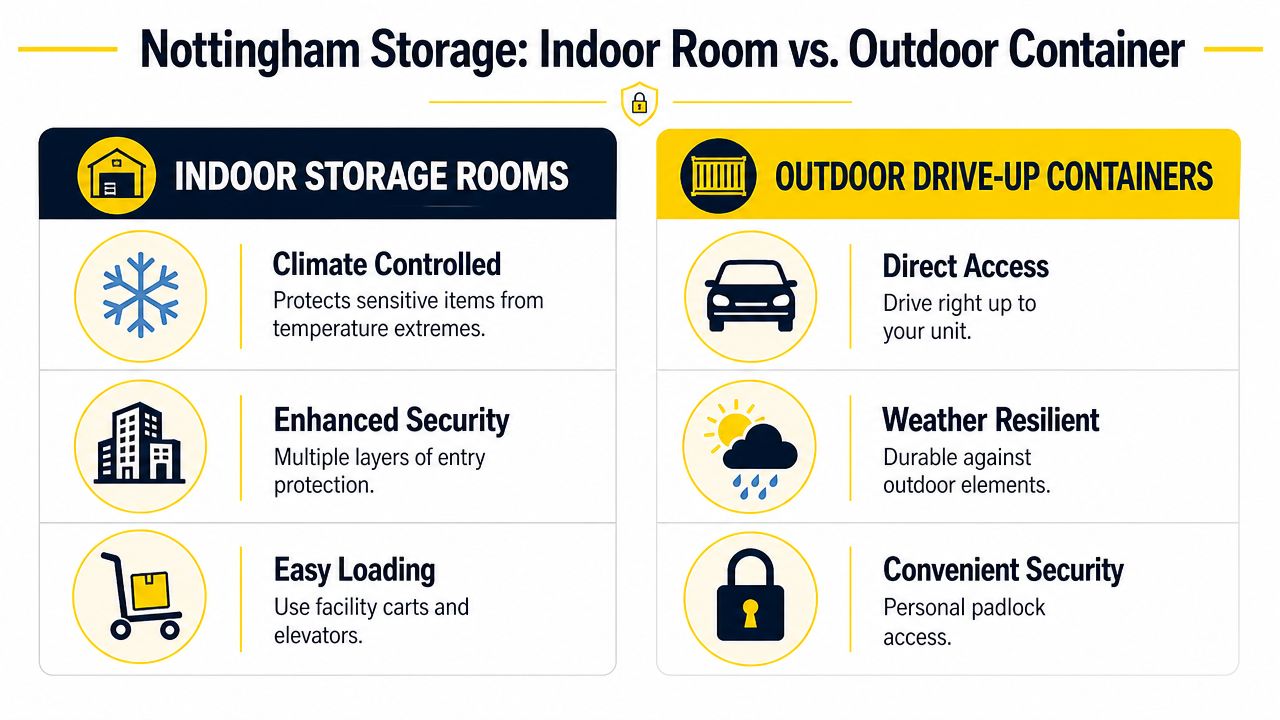
Indoor rooms are usually the safer choice for items that dislike damp, dust, or temperature swings. That includes upholstered furniture, mattresses, paperwork, electronics, clothing, books, and anything with a finished surface you want to keep in good condition.
They also suit customers who plan to stack neatly and leave the contents alone for a while. If your goal is to store the contents of a spare room during renovations, hold household goods between exchange and completion, or keep archive boxes in better condition, indoor space is often worth the extra handling on move-in day.
The trade-off is access. You may be parking, unloading onto a trolley, and taking goods through a corridor or lift rather than pulling up to the door. For some customers that is a minor inconvenience. For others, especially if they are in and out every few days, it becomes the deciding factor.
Where containers win
Outdoor containers are built around convenience. You drive up, open the doors, and load straight in. For tradespeople, landlords between lets, event firms, and small businesses holding stock or equipment, that can save a lot of time over a month.
They are particularly useful for awkward, heavy, or dirty items. Timber, tools, stock cages, spare fixtures, cable drums, and catering kit are all easier to move when the van stops a few feet from the unit. If regular access matters more than polished internal corridors, containers often make better operational sense.
The compromise is exposure. You are loading in the open, and the unit environment depends heavily on the site, the container condition, and how well you pack. Good ventilation matters, but so does the way you store your goods. Pallets, shelving, moisture absorbers, and leaving a little air gap from the walls all help.
If you are unsure how much room either option gives you in practice, this guide on what size storage unit you need helps put real item lists against common unit sizes.
The practical test
Ask three questions before you choose:
| Question | Indoor room usually fits better | Outdoor container usually fits better |
|---|---|---|
| What are you storing? | Furniture, boxes, documents, electronics, soft furnishings | Tools, stock, materials, bulky equipment |
| How often will you visit? | Occasional access | Frequent or repeat access |
| How do you load? | Trolley access is acceptable | Direct van access saves time |
One more point gets missed. Packaging quality matters more in containers because the unit often works harder. Uniform, stackable cartons such as Packaging Panda wholesale boxes make a noticeable difference if you want stable stacks and fewer crushed boxes at the bottom.
Some Nottingham sites offer both formats. Container Self Store is one example, with indoor rooms and ventilated drive-up containers on the same site. That setup is useful for customers whose needs change. A family might start with indoor storage during a move, while a local business may later switch to a container once stock turnover and access demands increase.
Matching Your Needs to the Right Unit Size
People usually get size wrong in one of two ways. They book too small because they're trying to keep the monthly cost down, or they book too large because they can't picture what the space looks like. Both mistakes are avoidable.
The easiest way to choose well is to think in categories, not dimensions. Are you storing boxes only, the contents of one room, the contents of a flat, or tools and stock that need regular access? Once you answer that, size gets much clearer.
Think in usable space
A packed unit isn't automatically an efficient one. If you stack floor to ceiling and block the back wall, you'll save space on paper and waste time every time you need one box.
A better setup leaves:
- A narrow walkway so you can reach the rear safely
- Heavier items at the bottom to keep stacks stable
- Frequently used items near the front if you'll visit often
- Clear labels on every side so you don't have to turn boxes round
For sturdy packing materials, Packaging Panda wholesale boxes are useful if you want uniform cartons that stack properly instead of a mix of supermarket boxes that collapse under pressure.
Nottingham Storage Unit Size Guide
| Unit Size (Approx.) | What It Typically Holds | Ideal For |
|---|---|---|
| Small locker | A few boxes, suitcases, small personal items | Students between terms, document overflow |
| Small room | Boxes from a spare room, seasonal items, bikes | Decluttering, short-term home storage |
| Medium room | Furniture and boxes from a one-bedroom flat | Movers, renters between properties |
| Large room | Full household contents from a larger home | Families renovating or relocating |
| 10 ft container | Bulky furniture, business stock, trade equipment | Tradespeople, online sellers, house moves |
| 20 ft container | Large mixed loads, stockholding, full clear-outs | SMEs, major moves, long-term business use |
That's a practical guide, not a promise. A neatly packed one-bedroom flat can fit very differently from a rushed one. Furniture shape matters. So does whether you dismantle beds, tables, and shelving before arrival.
Three checks before you book
List the awkward items first
Sofas, mattresses, wardrobes, fridges, ladders, and workbenches decide the size more than boxes do.Ask yourself how often you'll visit
If access will be weekly, leave room to move around. If it's long-term storage, denser packing can work.Use a size guide before committing
A proper storage unit size guide for common household and business loads helps you sanity-check your estimate.
If you're unsure between two sizes, don't just choose the smaller one. Choose the smallest space you can still use safely and logically.
Essential Security and Access Features
Price gets attention first. Security and access decide whether the facility is workable.
A good storage site should make two things easy to answer. First, how hard is it for the wrong person to get in? Second, how easy is it for the right person to get in when they need to?
What proper security looks like
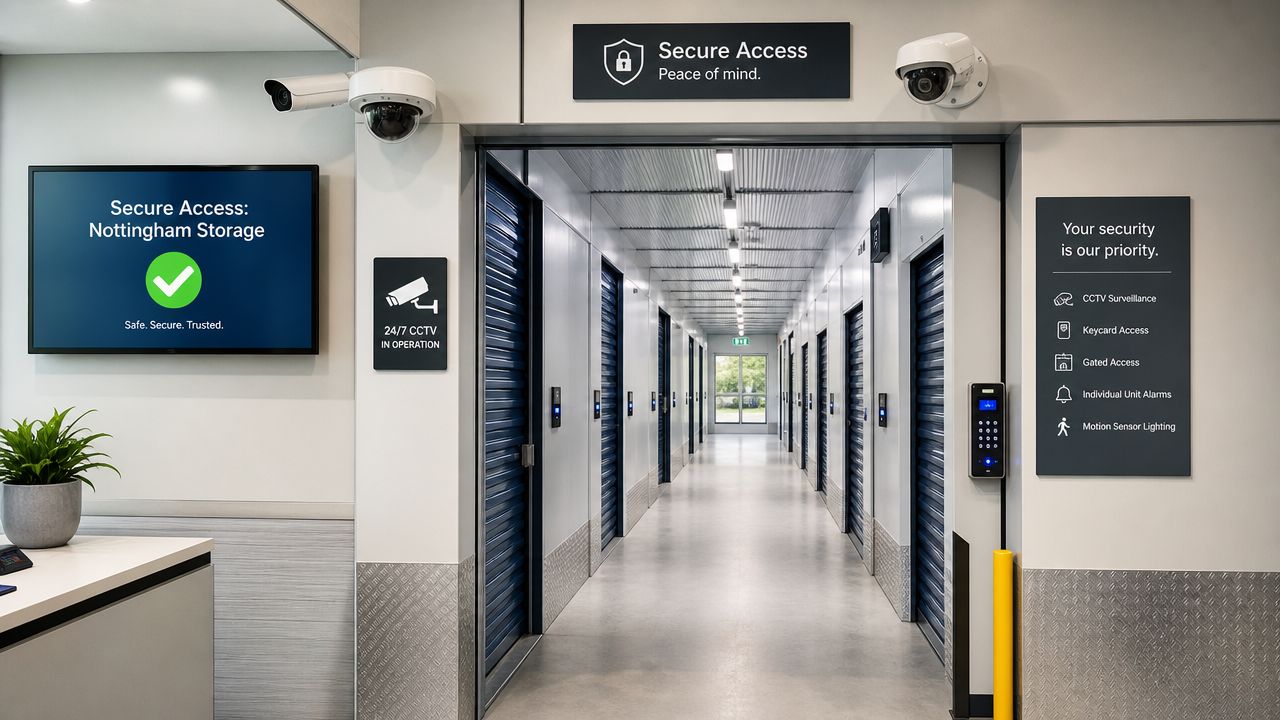
Security isn't one feature. It's layers.
You want to see a site where someone has thought through the whole chain, from the outer boundary to the individual unit. One decent camera on its own doesn't fix a weak gate, and a strong gate doesn't help much if unit areas are poorly supervised.
Look for these basics:
- Perimeter protection: fencing, gated entry, and a site layout that doesn't let anyone wander in unchecked.
- Recorded CCTV: coverage of entrances, lanes, loading points, and internal areas where practical.
- Individual locking responsibility: your unit should be secured in a way that keeps control with you.
- Visible staff presence: on-site staff don't replace systems, but they do add oversight and accountability.
One useful benchmark is whether the operator explains its security clearly and specifically. A vague “fully secure” claim tells you almost nothing. A detailed breakdown does. For instance, a page like secure self storage features and site protections serves as a useful comparison point when you're weighing sites.
Access matters just as much
Storage that's hard to reach stops being useful. This catches people out more than you'd think.
A family storing furniture during a move may only need weekend and daytime access. A self-employed electrician might need to collect kit early in the morning and return materials in the evening. An online seller may need several short visits a week. Those are different patterns, and the same access policy won't suit all of them.
Here's the trade-off:
| Access style | Works well for | Possible drawback |
|---|---|---|
| Managed hours | Occasional visits, planned moves, less urgent storage | Less flexibility if plans change |
| Extended or 7-day access | Regular home and business use | You still need to check how entry is controlled |
| Drive-up access | Heavy and awkward loads | Not ideal for delicate items during bad weather |
Location is part of access
In Nottingham, road convenience matters more than people admit at first. If you're making multiple runs, every awkward turn, congested approach, or city-centre loading problem adds friction. Sites with straightforward links from routes such as the M1 or A52 are often easier to use in real life than facilities that look close on a map but are awkward with a van.
A secure unit in the wrong location can be less useful than a slightly less polished site that you can actually reach without stress.
Who Uses Self Storage in Nottingham
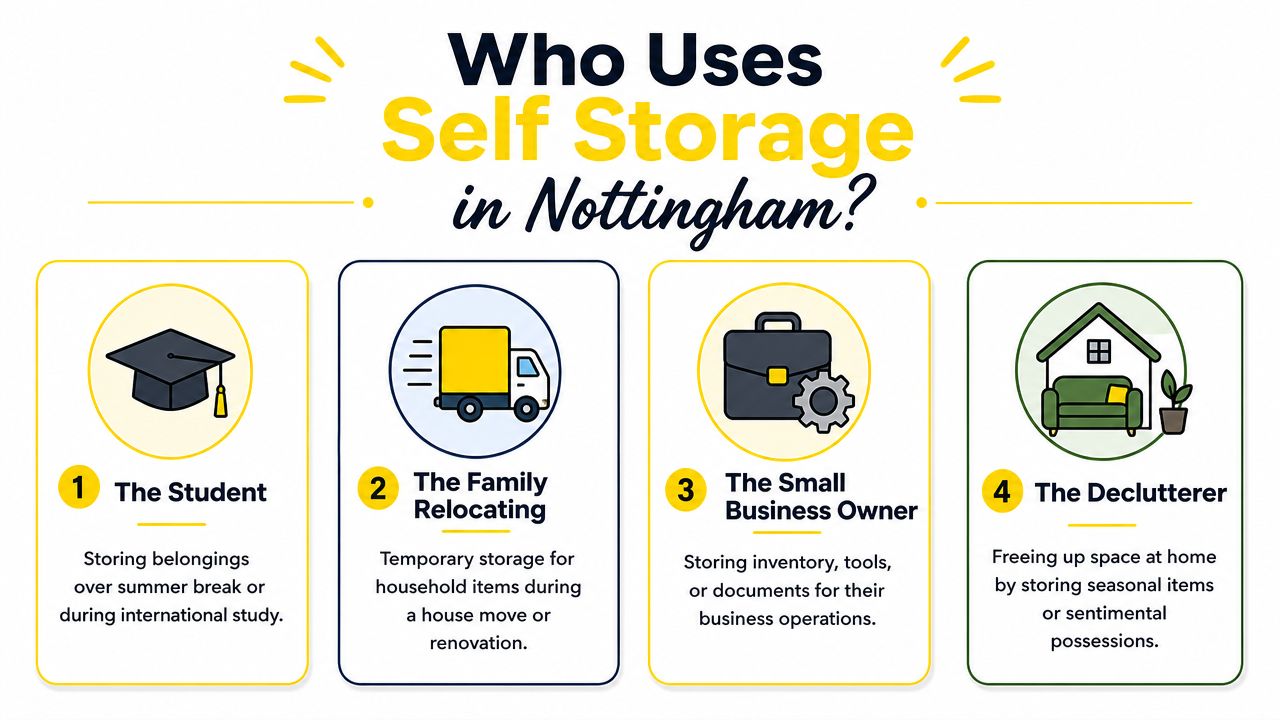
A third-year student packs up a room in Lenton for the summer. A family in West Bridgford is stuck between exchange and completion. A plumber needs somewhere to keep copper pipe, tools, and spare parts without turning the van into permanent storage. They are all looking for storage in Nottingham, but they should not all rent the same kind of unit.
The student between addresses
Students usually need short-term storage with a clear end point. The contents are rarely bulky on their own, but they add up fast once you include bedding, pans, folders, small furniture, sports kit, and a bike.
A small indoor room is often the sensible choice because it keeps everything together, dry, and easier to stack properly. The mistake I see most often is packing in soft bin bags and leaving no clear labels. Use taped boxes, keep one essentials box near the front, and label by contents rather than vague notes like "misc". If your move is tied to term dates or a house-share changeover, this guide to self storage for students in Nottingham and similar university moves will help you judge what kind of setup fits.
The family moving house
Families usually come to storage because timing has gone wrong, not because they wanted an extra errand.
That changes what matters. The right unit is the one that lets you get the whole house in safely, find what you need later, and avoid damaging furniture in the process. Indoor storage tends to suit sofas, mattresses, wooden furniture, and boxed household contents better, especially if the move may drag on longer than planned.
Space matters more here than people expect. A unit that is slightly too small creates extra labour every time you visit. If you may need school uniforms, paperwork, or the kettle before the move is over, leave a walkway and load by priority, not by whatever comes off the van first.
The self-employed tradesperson
This is one of the most practical uses for storage in Nottingham, and one of the least talked about. Tradespeople are not looking for polished reception areas. They need a base that cuts wasted time.
For a builder, electrician, decorator, or bathroom fitter, the best option is often a drive-up unit or container where materials and tools can be loaded straight in and out. That setup is less suitable for delicate stock, paperwork, or anything moisture-sensitive, but it works well for bulky gear, cable drums, spare fittings, and job-specific materials. Analysts at Flexspace Logistics note in their research on storage options for small and medium businesses that smaller firms often use storage to fill the gap between home working and taking on commercial premises.
For many Nottingham sole traders, that is its true value. Storage is not just overflow space. It is a cheaper, simpler operating base than paying for a workshop or locking stock in the van overnight.
The online seller with growing stock
Online sellers often outgrow the spare room in stages. First it is a few shelves. Then packing benches appear. Then daily life starts working around courier collections and incoming boxes.
The right setup depends on what you sell. Fast-moving stock benefits from frequent, predictable access and a layout that supports picking and packing without hunting through mixed cartons. Fragile, branded, or moisture-sensitive goods are usually better indoors. Tougher boxed stock, packaging supplies, or slower-moving items can sometimes sit happily in a container if access is the bigger priority.
Small businesses in Nottingham often sit between domestic and commercial needs. They do not need a full warehouse, but they do need order, repeat access, and room to grow for a few busy months without committing to long premises leases. That is where choosing by use case matters more than choosing by headline price or postcode alone.
Understanding Your Contract and Pricing
A low headline price can be perfectly fair. It can also hide the actual cost of the unit.
That's why contract terms matter more than many first-time customers expect. Storage often starts as a short-term fix and lasts longer than planned. UK self-storage facilities maintain an average occupancy rate of 96.5%, and the average rental duration is approximately 14 months, which underlines why flexible long-term terms matter when choosing a provider, according to UK self-storage occupancy and rental duration data.
What to check before you sign
Ask for the full monthly cost, not just the advertised rate. Then check what sits around it.
- Insurance: Is it included, optional, or required separately?
- Lock costs: Do you need to buy one on arrival?
- VAT position: Is the quoted price inclusive or exclusive?
- Notice period: How much notice do you need to leave?
- Introductory pricing: Does a short offer revert to a higher standard rate later?
These aren't trick questions. A decent facility should answer them plainly.
Flexibility beats false economy
The best contract for most customers is a simple rolling arrangement with clear notice terms. That suits students whose dates can shift, movers waiting on chains, and businesses whose storage needs rise or fall with workload.
A longer fixed commitment can make sense in some commercial cases, but only if the terms are transparent and the savings are real. What usually doesn't work is chasing the lowest first-month figure and ignoring the practical points that shape the total spend over time.
Cheap storage becomes expensive quickly if you're locked into the wrong unit, the wrong size, or terms that don't match how long you actually need it.
If a provider can't explain its pricing in straightforward language, that's usually your answer.
Frequently Asked Questions About Nottingham Storage
What can't I store?
Rules vary by operator, but dangerous, illegal, perishable, or highly restricted items are usually prohibited. If you're unsure about fuel, chemicals, batteries, food, or anything regulated, ask before move-in day rather than turning up and being told no at the gate.
Do I need insurance?
Many facilities either require contents insurance or strongly recommend it. Check whether cover is included in the monthly fee or arranged separately. Don't assume your household policy automatically covers items once they're moved into storage.
Can I access my unit whenever I want?
Not always. Some sites offer broad access across the week, while others use more limited managed hours. Match the access policy to your routine, especially if you'll need early starts or regular repeat visits.
Can I live in a storage unit?
No. In the UK, using a storage unit as a home breaches planning laws under the Homes (Fitness for Human Habitation) Act 2018, because storage units cannot meet the required standards for ventilation, heating, and sanitation, as explained in this guide on whether you can live in a storage unit in the UK.
If you need storage in Nottingham and want a practical starting point, Container Self Store offers indoor rooms and drive-up container units, along with clear size guidance, 7-day access, and straightforward terms. It's a sensible option if you want to compare formats and choose a setup that fits your move, business, or household storage without overcomplicating the process.