You’ve probably reached the point where the spare bedroom isn’t working as an office any more. Stock is piled behind your chair, tools are in the van because there’s nowhere secure to keep them, and every delivery feels like a workaround. That’s usually when Nottingham businesses start looking seriously at flexible space.
The problem is that most guides lump everything together. A hot desk in the city centre, a serviced office, a virtual address and a drive-up business pod solve very different problems. If you’re a consultant with a laptop, one setup works. If you’re a tradesperson, e-commerce seller or small firm that needs workspace and storage in one place, the answer is usually somewhere else entirely.
Why Nottingham Businesses Are Embracing Flexibility
A few years ago, many Nottingham firms were deciding whether to stay remote, bring staff back, or cut space altogether. Now the question is more practical. Businesses want space that fits the way they operate, without locking themselves into the wrong footprint for years.
That shift shows up in the local market. In 2024, office take-up across Nottinghamshire totalled 359,000 sq. ft, down 5% on 2023, while the average letting size rose 7% to 3,750 sq. ft. In the city centre, 56% of take-up went to Grade A space, which points to occupiers choosing better space more carefully rather than taking space for the sake of it, according to Nottinghamshire office market data from FHP.

What that means on the ground
For most occupiers, flexibility isn’t a trend any more. It’s risk management.
A traditional lease can still make sense if your headcount is stable, your use is predictable and you’re happy to invest in fit-out. But many smaller businesses in Nottingham don’t have that certainty. They need room to expand, contract, take deliveries, meet clients and keep overheads under control.
That’s especially true when your workspace depends on more than desks. A joiner, electrician, online seller or small distribution business needs somewhere functional. Power, access, parking, security and decent connectivity matter as much as a nice reception.
Practical rule: Choose space around how your business runs on a Tuesday morning, not how it looks in a brochure.
Hybrid working has also made businesses think harder about infrastructure. If your team splits time between site, home and office, the office has to earn its keep. Good connectivity is part of that. Firms reviewing premises often also review their IT setup, especially if they need resilient flexible networking solutions to support hybrid staff, cloud tools and client-facing work without overbuilding their setup.
Why quality and flexibility now go together
There used to be a trade-off between flexibility and quality. That gap has narrowed. Businesses now expect short or adaptable terms without accepting poor access, dated layouts or hidden extras.
In practice, flexible office space nottingham works best when it gives you three things:
- Control over cost: You know what’s included and what isn’t.
- Operational fit: The space supports your day-to-day work.
- Room to change: You can adjust as staffing, stock or workload shifts.
That’s why flexible space now attracts more than freelancers and startups. Established SMEs use it to stay nimble, avoid wasted space and move faster when requirements change.
Decoding Your Nottingham Workspace Options
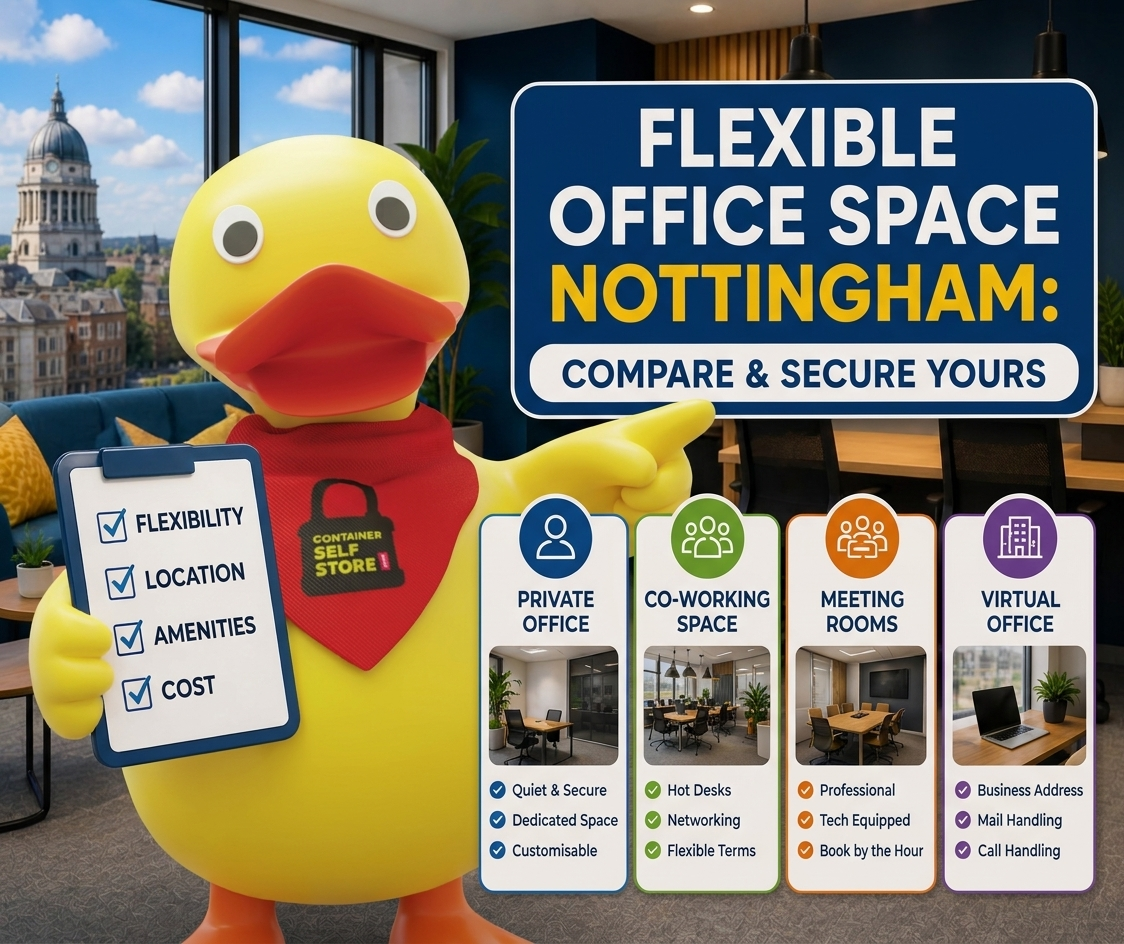
Not every flexible workspace means the same thing. Some options are office-first. Others are address-first. Others suit businesses that need a working base with practical access. If you’re comparing flexible office space nottingham, it helps to separate the categories properly.
As of 2026, Nottingham has 30 co-working spaces, equal to 9.1 spaces per 100,000 residents. The wider UK flexible office market is projected to grow from £3.84 billion in 2025 to £6.48 billion by 2030, based on Nottingham market data from Easyspace. That tells you there’s plenty of choice. It doesn’t tell you which type is right.
The five main types
| Workspace type | Best described as | Usually suits | Main limitation |
|---|---|---|---|
| Co-working space | Shared desk membership | Freelancers, solo consultants, remote staff | Limited privacy and storage |
| Serviced office | All-in private office | Small teams wanting simplicity | Can be poor for loading, tools or stock |
| Virtual office | Business address and admin presence | Firms needing credibility without full-time space | No real operational base |
| Short-let unit | Flexible private premises | Small firms wanting control | Quality and inclusions vary widely |
| Business pod | Private compact workspace with practical access | Trades, e-commerce, mobile SMEs | Less emphasis on city-centre prestige |
How to think about each option
A co-working space is like a members’ club for work. You pay for access, shared facilities and flexibility. It’s useful if you need somewhere professional to work without caring too much where you sit each day.
A serviced office is closer to an all-inclusive hotel for your business. You get a private room, shared building services and a simpler setup than a conventional lease. For many office-based teams, that’s the cleanest option.
A virtual office is different again. It gives you a trading address, and sometimes mail handling or call answering, without requiring you to occupy space daily. If you’re weighing that route, this guide to virtual offices is useful because it explains where a registered address helps and where it doesn’t.
A virtual office improves presentation. It doesn’t solve storage, deliveries, parking or workspace issues.
Where businesses often get this wrong
The mistake isn’t choosing flexible space. It’s choosing the wrong kind of flexible space.
A graphic designer and an online seller might both search for “office space”, but one needs a desk and meeting room access, while the other needs packaging space, easy loading and secure storage close at hand. If you skip that distinction, you can end up paying for amenities you rarely use while still lacking the basics your business depends on.
For Nottingham firms, that’s a key dividing line. Are you buying a place to sit, or a place to operate from?
A Side-by-Side Comparison of Flexible Spaces
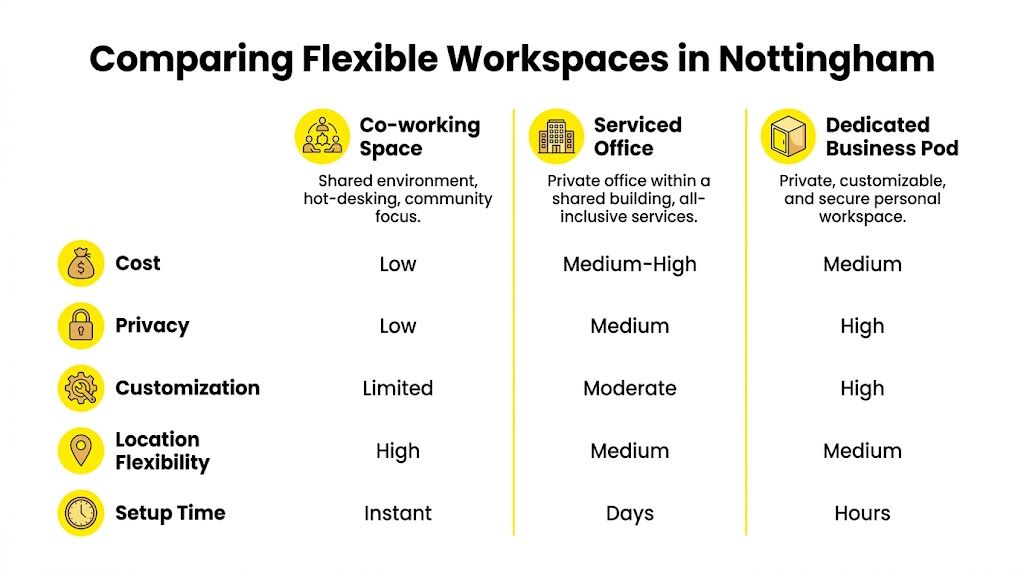
The fastest way to narrow your options is to compare them against the things that affect daily use. Cost matters, but so do privacy, setup time, access and how easy it is to change size later.
Here’s the quick view.
| Criteria | Co-working space | Serviced office | Dedicated business pod |
|---|---|---|---|
| Cost position | Lower entry cost | Mid to higher monthly cost | Mid-range, depending on setup |
| Privacy | Low | Moderate | High |
| Best for | Solo work, occasional meetings | Small teams, admin-heavy firms | Trades, e-commerce, SMEs needing workspace plus practical access |
| Setup time | Usually fast | Usually straightforward | Usually straightforward |
| Storage potential | Minimal | Limited in many schemes | Strong, especially when paired with on-site storage |
| Vehicle access | Often secondary | Varies by building | Typically far more practical |
Cost isn’t just the monthly fee
Headline rent can be misleading. In the UK flexible office market, tenants pay an average of 6% less in effective rent than those in traditional non-flexible offices, with savings linked to reduced fit-out costs, shorter terms and the ability to scale without penalty, according to the Property Research Trust report on valuing flexible offices.
That matters because many businesses focus too much on base rent and not enough on total occupation cost. A cheaper conventional unit can quickly become expensive once you add furniture, internet, utilities, repairs, notice obligations and wasted space.
What works for different business types
A co-working space works if your business is lightweight. You bring a laptop, you need decent internet, and you like being around other people. It doesn’t work nearly as well if you need to leave equipment, handle stock or take regular deliveries.
A serviced office suits firms that need privacy and a professional setting without taking on lease complexity. Client meetings, admin teams and satellite offices often fit well. If that’s your lane, it’s worth reviewing what’s included in serviced office space in Nottingham before comparing providers, because inclusions can vary more than the term “serviced” suggests.
A dedicated business pod fills the gap most mainstream guides ignore. It gives you private workspace, but it’s shaped around function rather than city-centre image. For tradespeople, mobile service firms and online retailers, that often turns out to be the better value choice because it supports the whole operation, not just the desk work.
Worth checking: If your business touches physical goods every day, convenience usually beats prestige.
Scalability in real life
Scaling up isn’t only about taking more desks. Sometimes it means adding room for materials, archived files, tools, returns, packaging or seasonal stock.
That’s where some glossy office options fall short. They scale neatly on paper, but awkwardly in practice. A pod or short-let setup linked to storage usually handles change better for operational businesses because you can adapt around workflow, not just headcount.
Beyond the Desk Location and Access Matter
Many Nottingham office searches start with the city centre as the default. That makes sense if your priority is rail access, walkable meetings and a corporate postcode. It’s less convincing if your day involves a van, stock deliveries, tools or frequent loading.
In Nottingham, 28% of SMEs cite access and parking as a top workspace barrier, and city centre parking averages £25 per day. Peripheral sites off roads such as the M1 and A52 are often the more practical answer, based on workspace access data referenced here.

Why city-centre logic breaks down
The usual city-centre pitch is easy to understand. Good public transport, nearby cafés, a strong impression on visiting clients. For some firms, that still wins.
But for many SMEs, those benefits come with friction:
- Parking becomes a daily cost: Staff, contractors and visitors all feel it.
- Loading is harder: Collecting stock or unloading materials turns into a time drain.
- Vehicle restrictions complicate routine jobs: Short stops and repeat visits become awkward.
- Space is often built around office use only: There’s little thought for storage or operational flow.
If you run a business that moves things, every one of those issues matters.
Edge-of-city locations solve a different problem
Peripheral locations don’t usually sell lifestyle. They sell practicality. That’s why they suit trades, field-based businesses, service engineers, online retailers and firms with mixed office and storage needs.
The right edge-of-city workspace gives you the kind of things city-centre providers often treat as secondary:
- Straightforward parking
- Ground-level access
- Better vehicle movement
- Easier collections and drop-offs
- A cleaner split between admin work and stock handling
For businesses comparing workspace and storage together, office storage options in Nottingham can make more sense than forcing everything into a standard office footprint.
If you need to carry stock, samples, tools or equipment in and out every week, access stops being a minor detail. It becomes part of the job.
Ask what the site lets you do
This is the practical question most occupiers should ask earlier. Not “is it a nice office?” but “what can I do there without friction?”
Can you park close to the unit? Can a courier find you easily? Can you unload in bad weather without dragging everything through reception? Can staff arrive by car without turning parking into a monthly headache? Those details decide whether a space helps your business or slows it down.
The Smart Solution Container Self Store Business Pods
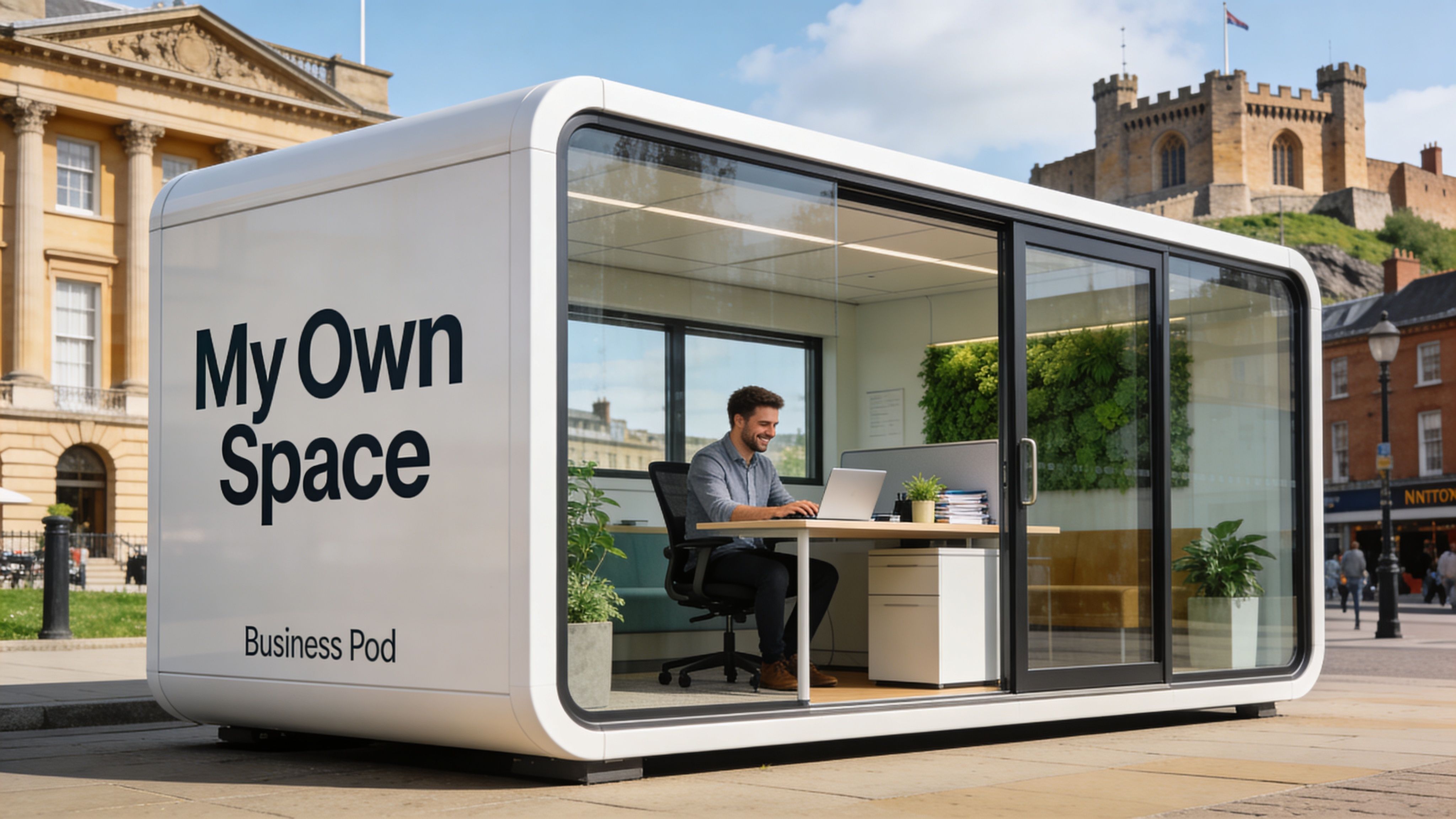
For Nottingham businesses that need more than a desk, Container Self Store Business Pods solve a problem that typical office products don’t address well. They sit in the middle ground between office, workshop base and operational unit.
That matters if your business doesn’t fit neatly into a standard city-centre office. A tradesperson may need a tidy workspace for admin, quotes and customer calls, but also secure room nearby for equipment and materials. An e-commerce seller may need somewhere to process orders, manage returns and keep packaging close at hand. A small SME may need privacy without taking on a large unit.
Why pods work better for practical businesses
A business pod works because it strips out the mismatch. You’re not paying for a city-centre environment built around hot-desking culture if your real priority is privacy, access and usable space.
Container Self Store offers Business Pods in Nottingham designed for businesses that need a proper working base with power, lighting and Wi-Fi, while keeping the feel more direct and functional than a conventional office suite.
In day-to-day terms, that usually means:
- Private space for focused work: Better than shared desks for calls, admin and confidential work.
- Practical access: Easier for businesses moving goods or equipment.
- Operational flexibility: Useful if your work blends office tasks with physical stock or tools.
- Cleaner overhead control: You avoid taking on more unit than you need.
The storage link matters
The setup becomes particularly useful as Container Self Store operates alongside Container Self Store at the same venue, allowing businesses that need workspace and secure storage to combine the two without splitting operations across separate sites.
That combination is hard to beat for:
- Tradespeople who need tools, parts and paperwork organised in one place
- Online sellers managing stock, packing materials and dispatch
- Small firms that need document storage or overflow room without leasing a bigger office
- Mobile teams who want a secure base between jobs
Businesses run more smoothly when workspace and storage support each other instead of competing for the same square footage.
A better fit than headline amenities
Many Nottingham office listings focus on coffee, breakout areas and central location. Those things aren’t useless. They’re just not the deciding factor for every occupier.
A more practical view of sustainability supports this too. Peripheral sites can reduce commuter emissions into congested city centres and may offer low-energy ventilated units, which is a more operational way to think about greener workspace choices, as discussed in this Nottingham workspace sustainability reference.
For the right user, a pod is the smarter fit. It gives you a professional base without forcing your business into an office model that was never built for how you work.
Your Checklist for Choosing the Right Nottingham Space
Before you sign anything, test the space against your workflow. Most bad workspace decisions happen because the viewing focuses on appearance and ignores day-to-day use.
Questions to ask before you commit
What exactly is included in the price? Ask whether utilities, internet, service charges, furniture, cleaning and access are included. A low monthly figure can stop looking low once extras are added.
How flexible is the agreement in practice? “Flexible” can mean many things. Ask about notice periods, moving to a larger unit, downsizing and what happens if your needs change faster than expected.
Can you operate from the site easily? Parking, loading, visitor access and delivery handling matter more than many providers admit. If you use tools, stock or samples, test the route from vehicle to workspace.
Will you use the amenities you’re paying for? There’s no value in a stylish breakout area if what you really need is privacy, storage and a reliable place to work.
What happens outside office hours? Security, gated entry, CCTV and out-of-hours access deserve direct questions, especially if you’ll leave stock, equipment or documents on site.
A simple way to shortlist options
Use this three-part filter:
Operational fit
Can you do your actual work there without constant workarounds?Financial sense
Does the total monthly cost still make sense once everything is included?Room to adapt
Can the setup grow or shrink with the business?
If you’re moving from home, from a small lock-up, or from an office that no longer fits, timing and logistics matter as much as the space itself. This guide to planning your office relocation is worth reading before the move, especially if you need to avoid downtime while shifting equipment, stock and IT.
A good workspace should remove friction from the week. If it adds admin, travel hassle or storage problems, it’s the wrong space.
Frequently Asked Questions about Flexible Workspaces
Can I use a virtual office address for my business?
In many cases, yes, if the provider allows business registration and mail handling. But you need to check the service terms carefully. A virtual office helps with business presence and correspondence. It doesn’t replace physical workspace if you need to meet clients regularly, store items or work from a dedicated base.
What sort of contract should I expect?
Flexible workspace agreements are usually simpler than traditional leases, but the exact terms vary by provider and product. Always ask for the notice period, renewal terms, deposit position and any charges linked to moving units or ending the agreement. Don’t rely on the word “flexible” alone.
Are bills and internet normally included?
They often are in serviced and managed workspace, but not always in the same way. Some providers include core services and charge separately for extras such as meeting rooms, printing or enhanced connectivity. Ask for a full list in writing so you can compare like for like.
Is 24 hour access available?
Some operators provide extended or round-the-clock access, while others work to building hours or staffed periods. If you’re a tradesperson, run an online store, or work irregular hours, make this a priority question. Access terms can make a workable unit unworkable very quickly.
Who benefits most from business pods rather than shared offices?
Business pods tend to suit occupiers who need privacy, practical access and a base that supports real operations rather than desk work alone. That includes self-employed trades, e-commerce businesses, small service firms and SMEs that need workspace with a more functional layout.
If you need a Nottingham base that handles more than desk work, Container Self Store is worth considering for secure storage, workspace and business pod options in one practical setup. It suits businesses that need straightforward access, flexible terms and room to run day-to-day operations without paying for space they won’t use.