
The van's booked for Saturday morning, the hallway is stacked three boxes deep, and the last thing to settle is where it all goes. The site you rang has offered an indoor room on the first floor, reached through a corridor that turns twice and a door that takes one box at a time. Your sofa won't enjoy that route.
Drive up storage units solve a narrower problem than most sales pages admit. They aren't a better version of indoor storage, they're a different workflow. A container puts your vehicle, the unit door and the load in one straight line, so the heaviest items travel a couple of metres instead of a couple of hundred.
I'd judge any unit on three things before looking at volume: how often you'll visit, how sensitive the contents are to damp and heat, and how big the vehicle is that you'll bring. Get those right and the size falls into place. Get them wrong and you'll rent a container you can't load comfortably or a room you'll dread visiting.
What a Drive-Up Storage Unit Is and Who It Suits
A drive-up storage unit is a lockable steel container at ground level inside a gated compound, with a parking bay beside its doors. You bring the van close, drop the tailgate, and move the wardrobe a few feet rather than hauling it through corridors and lifts.
The handiest comparison is domestic. A drive-up container behaves like a garage at the end of your own driveway, while an indoor room is closer to a locker you reach through a building. Both can be secure; only one lets you unload a mattress without help.
Drive-up units compared with indoor storage rooms
| Feature | Drive-up container | Indoor storage room |
|---|---|---|
| Access | Park beside the unit and load directly | Walk through corridors or lifts |
| Bulky furniture and tools | Well suited | Harder to move through a building |
| Exposure to damp and temperature change | Higher; needs ventilation and careful packing | Lower; inside a building |
| Security layers | Gated compound, CCTV and on-site staff where offered | Building access control, CCTV and a lockable room |
| Best for | Heavy loads, frequent access, trade stock | Damp-sensitive items, occasional small loads |
Who it suits follows from that table. Households moving home are the largest group, with 40% of domestic self-storage users reporting that they used storage during a move, according to Inside Self-Storage's summary of the 2025 UK industry findings.
Container sites are not a niche format. The 2025 UK Self Storage Annual Industry Report identified 1,135 predominantly container-based operations among 2,915 facilities, with sector floorspace up 7.2% to 64.3 million square feet. Read those as evidence of demand rather than a description of drive-up sites, because the totals blend indoor, outdoor and container formats.
After movers come students bridging a summer between tenancies, tradespeople loading tools from a van before seven, online sellers taking in a pallet delivery, and families clearing a house in stages. All of them want the same thing: fewer lifts and shorter carries.
The rule I'd apply: choose drive-up when the loads are heavy and access is frequent. Choose indoor when the contents are damp-sensitive, or when you'll arrive with small items you can carry in one go.
Sizing Your Drive-Up Unit to Your Belongings
Container storage comes in 10 ft and 20 ft lengths, which feels restrictive until you match them against real contents. Most first-time renters book a unit that's too small, then spend the tenancy shifting one box to reach another.
Typical contents and suggested drive-up unit size
| Contents | Suggested unit | Practical note |
|---|---|---|
| Studio or one-bedroom flat contents | 10 ft container | Bed, sofa, boxes and small appliances; check the largest item fits the door |
| Two-bedroom household contents | 20 ft container | Furniture and boxes; leave a clear route to the door |
| Tools and equipment for one tradesperson | 10 ft container | Keep heavy kit near the door for quick loading |
| Trade stock or e-commerce inventory | 20 ft container | Count pallets against floor area before booking |
| Archived paperwork | Indoor room, not a drive-up unit | Infrequent access and moisture control matter more than loading |
A sizing method that gets it right first time
- List contents by type, not by room. Furniture, boxes, tools and stock each stack differently and each needs its own floor, so grouping them shows the shape of the load rather than the story of your house.
- Measure the largest single item across its diagonal. A sofa or wardrobe has to pass the container door opening once it's tilted, and a piece that clears on height can still fail on depth.
- Reserve about half the floor. Stacking boxes two or three high along one wall leaves a walkway wide enough to carry a chair, which is what stops a tenancy becoming an obstacle course.
- Check the bay in metres against the vehicle. A 10 ft unit is about 3 m long and a 20 ft about 6 m, so measure your van, its turning space and the height needed for rear doors to open fully.
- Size up one length if the contents may grow. The gap between lengths is smaller than the cost of a second tenancy, and business stock rarely shrinks.
Boxes do the heavy lifting in most units, so buy cartons and bins rated for the weight you'll stack on them rather than whatever is cheapest that week; this guide to choosing bins with enough stacking strength covers what to look for. If you're still torn between lengths, the what size storage unit do I need guide sets the same logic out by household and business type.
A well-sized unit looks slightly empty on moving day. You can reach every box without shifting another, air moves between items, and the path from door to back wall stays clear. If you're shoving the last box in with your shoulder, you need the next length up.
What Belongs in a Drive-Up Unit and What Does Not
A container is a steel box that takes on the temperature of the day, and that single fact decides most of what belongs inside it. Cool nights and warm afternoons put moisture in the air, and moisture settles on the coldest surface going.
Most contents are fine. These are the regulars:
- Furniture and appliances. Sofas, tables, beds and white goods are ideal, provided washing machines and fridges are drained, cleaned and thoroughly dry before they go in.
- Tools and garden equipment. Mowers, strimmers, tool chests and mixers suit a container well; empty the fuel tank and drain the oil first so nothing leaks onto the floor.
- Bicycles, outdoor kit and seasonal items. Patio sets, camping gear and Christmas decorations are exactly what drive-up access was built for.
- Business stock in sealed cardboard. Palletised goods, packaging and display equipment stack neatly and come out the way they went in.
Other items need a decision rather than a blanket no. Electronics, photographs, paperwork, leather goods and solid wood furniture all react to swings in humidity, and a solid wood table left for a year in an unheated container can move and split. Textiles pick up mustiness faster than anything else on that list.
Some contents are excluded by operator terms rather than by physics: food, flammable liquids, gas cylinders and hazardous chemicals. Ask for the written list before you load, because it varies between sites and the exclusions aren't always obvious.
A packing routine that does the work
- Use breathable covers, not plastic. Dust sheets and cotton bags let trapped moisture out; polythene holds condensation against the surface.
- Get everything off the floor. Pallets, boards or a couple of timber bearers keep the bottom layer away from damp concrete.
- Add moisture absorbers to sealed boxes. Silica gel sachets in with paperwork and photographs cost very little and buy real protection.
- Leave a gap at the walls. A few centimetres of air between the load and the container sides lets air move, and airflow is what stops condensation settling.
- Label by category, not by room. "Kitchen" tells you little six months later; "crockery, fragile" tells you what to carry carefully.
Packing and labelling prevent far more damage than unit choice. A 10 ft container packed properly beats a 20 ft container packed in a hurry every time.
Security Questions to Ask Before You Sign
Cameras on a gate prove someone bought cameras. They don't prove the compound suits your contents, and that gap is where most storage decisions go wrong.
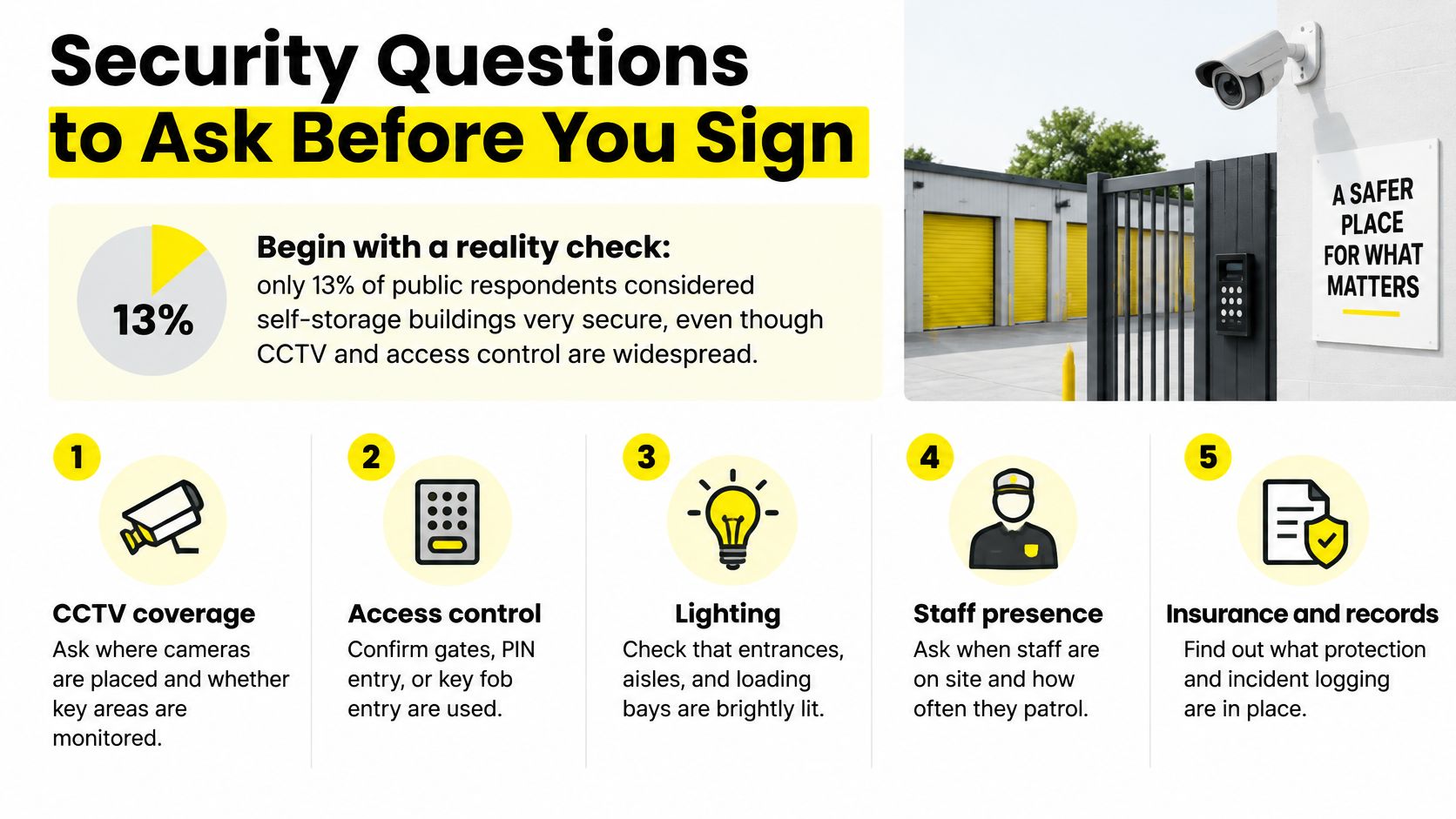
Only 13% of public respondents in UK and European research rated self-storage buildings "very secure", even though CCTV is close to universal on these sites, according to the FEDESSA Annual Industry Report. Operators keep investing in hardware that customers don't find convincing. The useful question isn't whether there's CCTV, it's what sits alongside it and whether that matches what you're storing.
The five checks below are the ones I'd want answered before signing.
The evidence on cameras is worth knowing precisely. The College of Policing's review of CCTV research found a statistically significant 13% reduction in crime in monitored places compared with places without cameras, across 76 studies. A Campbell systematic review of CCTV studies reported a modest effect that was strongest in car parks and against vehicle-related offences, and more pronounced in the UK than elsewhere. Both findings flatter a drive-up compound, which is part car park and part loading bay. Neither supports calling any site theft-proof.
What the evidence supports: cameras as a deterrent and a record, never as a guarantee. Ask what else is in place.
Turn the evidence into questions
- Coverage. Where are the cameras pointed, and do they see the gate, the lanes and the loading bays rather than just the office?
- Gate control. Is every user's code individual, and are entries logged so a visit can be traced afterwards?
- Staffing. When is someone on site, and does anyone patrol the compound at weekends?
- Unit locks. Do you bring your own padlock, and is there a lock box that keeps the shackle out of reach of bolt croppers?
- Insurance. What cover must you hold, and does it extend to goods in transit as well as inside the unit?
- Access ending. Is your gate code revoked on the day your contract ends?
Then ask about ventilation and packing, because a locked compound keeps people out and does nothing about the weather inside it. Those questions separate genuine secure self storage from a compound with one camera over the gate.
Location, Costs and Contract Terms
A site two miles closer on the map can add fifteen minutes to every visit if the last stretch is a single-track lane with nowhere to turn a van around. Location is about the drive, not the postcode.
Drive the route before you commit
Load the vehicle you'll use and drive it to the gate at the hour you'll usually visit. Check the approach road, the turning circle inside the compound, the gate height and whether the bay leaves room for rear doors to open. Opening hours matter as much as distance: a site locked at six is no use to a plumber reloading the van at half five for the next day's job.
Compare the total cost of the tenancy
Ask for the monthly rate in pounds for the exact unit length you need, then ask what the quote excludes. Deposits, administration charges, insurance, VAT and any charge for out-of-hours access all change the figure you pay. Shortlist two or three sites on identical terms: same length, same access hours, same minimum term.
The headline rate is a poor guide on its own. Work out the total across the period you expect to stay, one-off fees included, and compare that number instead. A cheaper monthly rate tied to a long minimum term can cost more than the site down the road.
Read the notice period and the size-change rule
Check how much notice you give, whether you can leave early, and whether you can move between unit sizes without signing again. Contents shrink and grow, and a contract that locks a length for a year will cost you when the contents no longer match it. Our storage rooms, containers and business units are offered without long-term commitments, so a change of size isn't a negotiation.
Before you sign, put four questions to every operator:
- What's the all-in monthly figure, with insurance and VAT included?
- How much notice do I give to leave, and is there a minimum term?
- Can I change unit size mid-tenancy, and is there a fee for it?
- What happens out of hours if the gate fails or I need access urgently?
How to Load and Access Your Unit Safely
A drive-up compound is a working yard. Vans reverse, container doors swing open, and people carry things they can't see past. Two minutes of planning at the gate beats an incident in the bay.
Here's the sequence to follow.
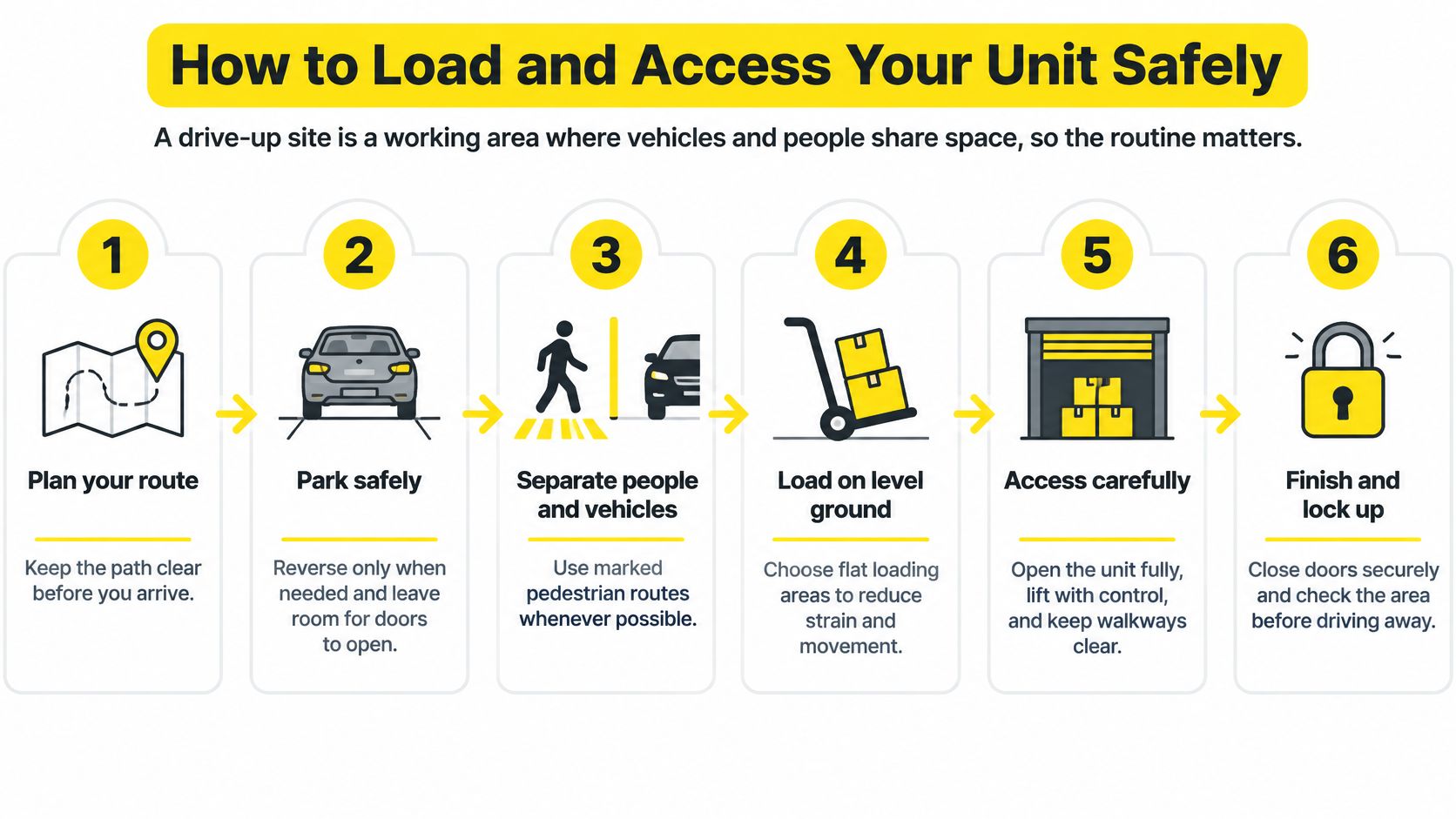
The Health and Safety Executive's guidance on loading and unloading treats separate pedestrian and vehicle routes as the most effective control, with loading areas kept on level ground, clear of unrelated traffic and free of overhead obstructions. That translates into marked lanes, defined walkways, turning space, and a bay that works for the largest vehicle a site expects rather than a typical hatchback.
Seven steps that keep you out of the traffic
- Read the layout before you drive in. Stand at the gate and trace the pedestrian route, the one-way lanes and the reversing points, so you aren't improvising with a loaded van blocking the way.
- Park so the rear doors open into the bay. A van left with its doors swinging into the lane shuts down the site and puts you in traffic while you carry.
- Match the bay to your vehicle with the doors open. Reversing sensors and mirrors are no substitute for getting out and checking the tailgate clears the container and the vehicle behind.
- Reverse with a guide. A second person standing where the driver can see them, or the marked reversing point, removes the blind spot that causes most damage on these sites.
- Stage items at the unit door, never in the lane. A pile of boxes beside the door is fine; the same pile in the walkway pushes everyone else into the traffic lane.
- Lock up before you leave. Close both doors, check the padlock hasp has seated properly, and give it a pull rather than a glance.
- Choose a quiet window. A Saturday at ten is the busiest hour on any storage site and a Tuesday at seven is empty, so shifting your timing makes the whole visit quicker.
Packing order matters as much as parking, and the Nottingham storage packing guide covers how to load a container so the last box in is the first one you need. Our sites are accessible around the clock, so early starts and late finishes both work.
A safe visit has three visible signs: an empty walkway, a clear loading zone, and a padlock you checked yourself before driving off.
Choose Your Unit Before You Book
Access frequency settles the choice more often than volume does. 15% of business customers access their storage daily, according to Cushman & Wakefield's 2025 UK self-storage report, which means most businesses visit far less often than storage marketing assumes.
The pattern you fit decides the format. A tradesperson collecting tools several times a week gets the most from ground-level loading, because the alternative is carrying a tool chest through a building on every trip. An online seller taking stock in batches needs floor area for pallets plus a corner for packaging, and should count pallets against the floor before booking a 20 ft unit. Someone storing archived paperwork visits twice a year, and an indoor room serves that better than a container, since moisture control matters more than a loading bay they'll never use.
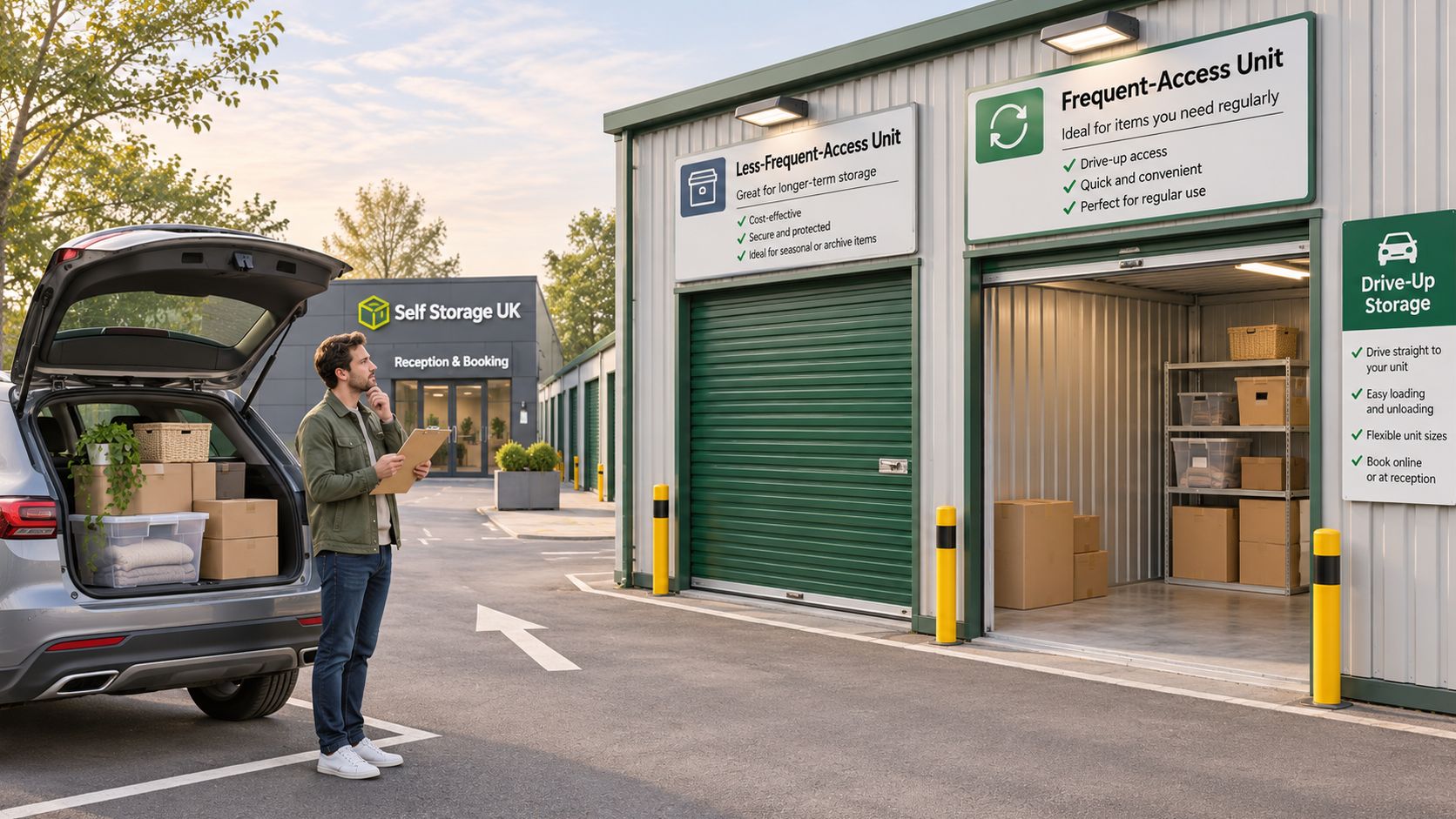
Five questions settle the fit:
- How often will you visit? Twice a week points to drive-up; twice a year doesn't.
- Are the contents damp-sensitive? Electronics, paperwork and leather point indoors.
- What vehicle will you bring? A long-wheelbase van needs turning space, not just a bay.
- How long will you stay? Short tenancies suit containers; multi-year storage suits a controlled environment.
- Do you need early or late access? Match the site's hours to your working day before you compare price.
Booking follows the same order. Request a quote for a specific length, confirm access hours and contract terms in writing, check the notice period, and ask for the site's permitted-items list so nothing gets turned away at the gate.
Confirm your pattern before you confirm the unit, and the size stops being a guess.
Container Self Store runs two sites, in Nottingham and Northampton, with ventilated 10 ft and 20 ft drive-up containers and indoor rooms from 9 sq ft to 200 sq ft, all behind gated entry with CCTV, on-site staff and access every day of the week. If you're weighing up which format suits your contents and how often you'll visit, the team will talk you through lengths, loading space and access hours before you commit, and there are no long-term commitments on storage rooms, containers or business units. Get a quote and reserve your unit at Container Self Store.