Your van's full of tools, the spare room's buried under stock, and the workshop rent is due whether you use every corner or not. For many Nottingham sole traders and small firms, the immediate problem isn't finding a warehouse. It's getting useful space back without adding a fixed cost that puts pressure on cash flow.
The right unit can make stock, equipment or records easier to manage. The wrong one can leave you paying for unused space, making awkward trips or discovering too late that the access and facilities don't suit the way you work. Judge a storage option by how your business operates, not just by its headline size.
Why Nottingham Small Businesses Need Flexible Storage
A Nottingham electrician finishes a job with a van full of tools, materials and equipment that can't stay there overnight. An online seller has seasonal stock stacked around the house, with no clear separation between items ready to ship and boxes kept for later. Both need space, but neither necessarily needs a warehouse lease.
That's a common reason small business storage in Nottingham has become practical operating space rather than an occasional overflow option. Flexible storage can hold tools between jobs, packaging and stock for an online shop, or paperwork that must be retained but doesn't need to occupy a workspace. It can also help a business handle a busy period without making a long commitment before demand is clear.
The scale and shape of the UK's small-business community helps explain why adaptable premises matter. At the start of 2024, the UK had an estimated 5.5 million private-sector businesses, including 5.45 million small businesses with 0–49 employees. SMEs made up 99.8% of businesses, and 4.1 million firms, or 74% of all UK firms, had no employees other than their owner or owners. These national figures don't describe Nottingham businesses individually, but they show how many firms operate without the staffing or premises of a large company. (UK business population estimates for 2024)
Storage as working space, not a warehouse substitute
The practical question is how to clear space without committing to a conventional warehouse. Before choosing a unit, decide what needs to be stored, how often you'll visit, whether you need to load from a vehicle, and how much capacity you can comfortably afford during a slow month.
Business needs change as firms start, grow, contract or close. The ONS recorded 317,000 business births in 2024 and 280,000 business closures, evidence of continuing movement in the UK business population. For a Nottingham start-up or sole trader, that makes flexible premises worth considering when a permanent lease would be premature. (ONS business demography for 2024)
Start with a simple stock record before you rent. A practical inventory management guide for small businesses can help you work out what belongs in storage, what should stay close at hand, and what you may be paying to keep unnecessarily.
Choosing Between Indoor Rooms and Drive-Up Containers
The best format depends on what you store and how you handle it. Don't choose by square footage alone. A room inside a storage building and a ground-level container solve different day-to-day problems.
Indoor rooms suit compact, organised stock
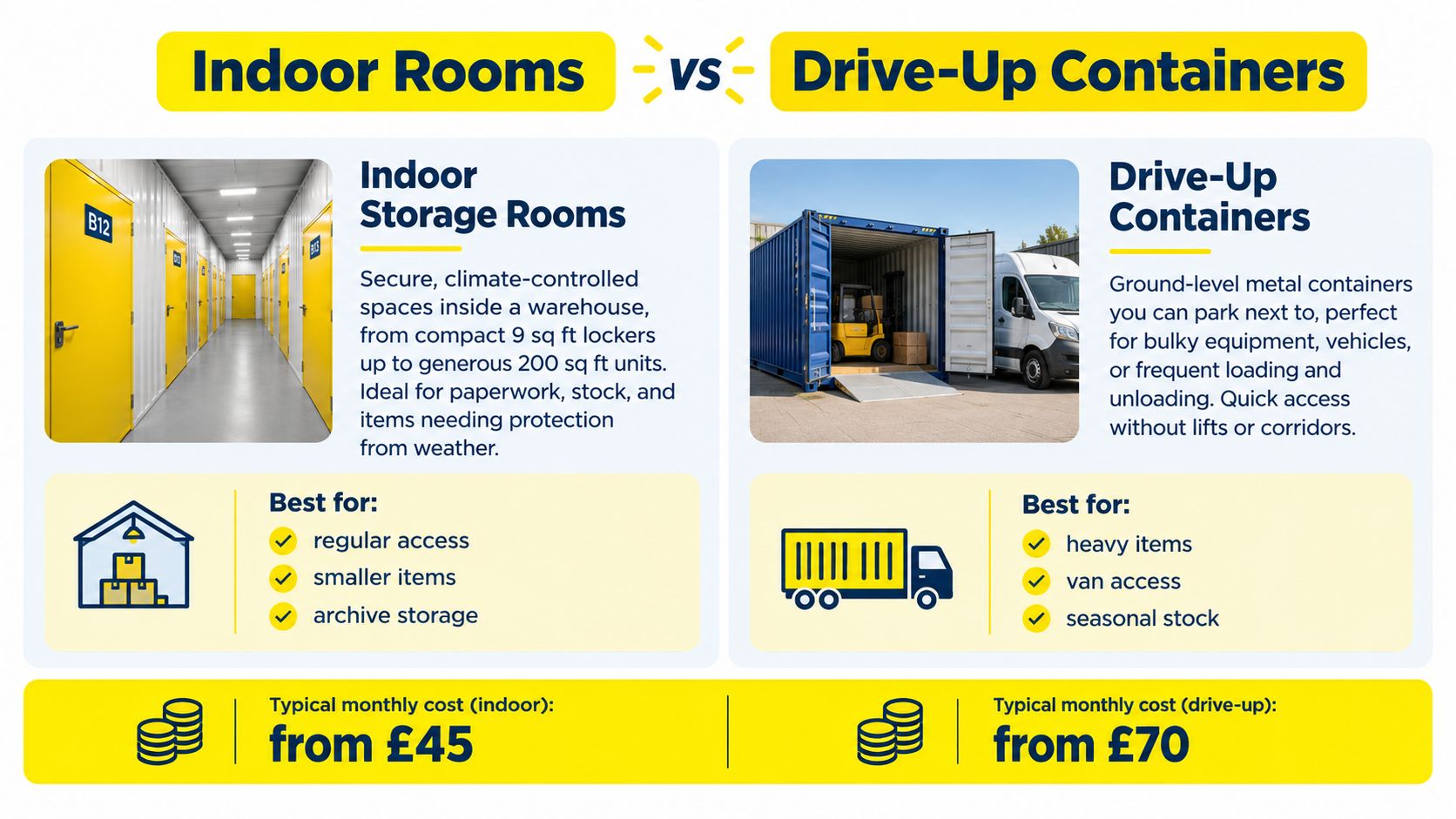
Indoor rooms range from 9 sq ft lockers to 200 sq ft units. They're a sensible choice for archived paperwork, smaller stock holdings, boxed products or items you want to keep inside a building. If you make frequent visits to retrieve modest quantities, an indoor unit can make those visits easier to manage, particularly when your goods are stored on shelves or in labelled boxes.
Drive-up 10 ft and 20 ft ventilated containers are designed for a different working pattern. You can load bulky tools, stock or equipment directly from a vehicle, without carrying everything through corridors or lifts. That convenience matters to tradespeople and businesses handling heavier goods, but you should check whether the container's environment is suitable for the items you intend to store.
| Format | Best for | Access | Typical contents |
|---|---|---|---|
| Indoor room | Compact goods and items best kept inside | Access inside the storage building | Paperwork, boxed stock, smaller items |
| Drive-up container | Bulky or frequently loaded goods | Vehicle access at ground level | Tools, equipment, trade stock |
Make the decision from your routine
Write down how often you'll visit, what you'll carry, and whether another person needs access. If staff or couriers will visit, check the facility's access rules rather than assuming a storage unit operates like a shop or dispatch centre.
For retailers building a tidy stock process, this inventory guide for small retailers offers useful context on organising goods before they go into storage. Whichever format you choose, label cartons and keep frequently needed items easy to reach. A unit that's technically large enough can still waste time if stock is piled in front of the items you need.
How to Size the Right Unit for Your Business
Guessing usually means paying for space you don't use or booking a unit that becomes cramped as soon as stock arrives. Size from your busiest realistic period, not from an average week. That gives you a better chance of keeping rent proportionate while leaving enough room to work.
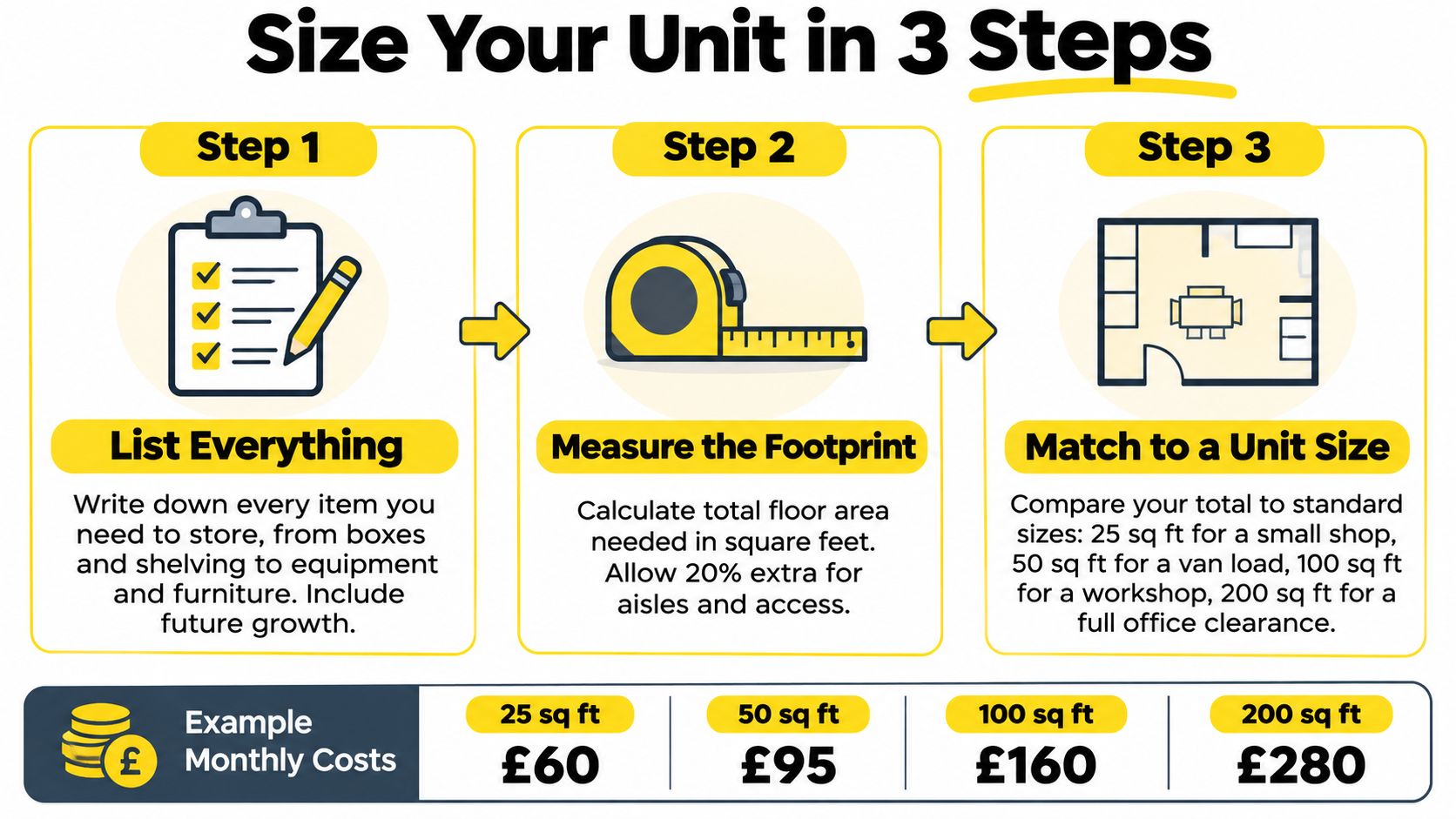
A three-step sizing method
- List what you'll store. Write down the tools, cartons, shelving, furniture and materials that need to go in. Separate items you access often from stock that can sit untouched for longer.
- Measure the peak footprint. Estimate the floor area occupied when inventory is at its seasonal high or a large job is under way. Don't size from a quiet month if you routinely hold extra stock before a busy period.
- Allow room to move. Include space for access, loading and any shelving you plan to install. A unit packed wall to wall can make every visit slower and increase the risk of damaging goods.
An electrician might put hand tools and frequently used materials in the van, then store bulky or backup equipment in a drive-up container. An e-commerce seller should estimate the largest stock holding they expect before a seasonal sales period, keeping active pick stock accessible rather than buried behind reserve cartons. A small retailer storing archived records and spare fittings may need an indoor room with clear shelves, not a container sized for trade equipment.
If you're packing goods into cartons, check the external measurements before estimating how many will fit on a shelf or pallet. A guide to corrugated bin box dimensions can help you plan the footprint of larger boxes rather than relying on a rough visual guess.
For a more detailed unit-size walkthrough, use this storage unit size guide. Take your list and estimated peak footprint to the provider, then ask which available unit allows you to load and retrieve goods without blocking access.
Understanding the Real Cost of a Nottingham Storage Unit
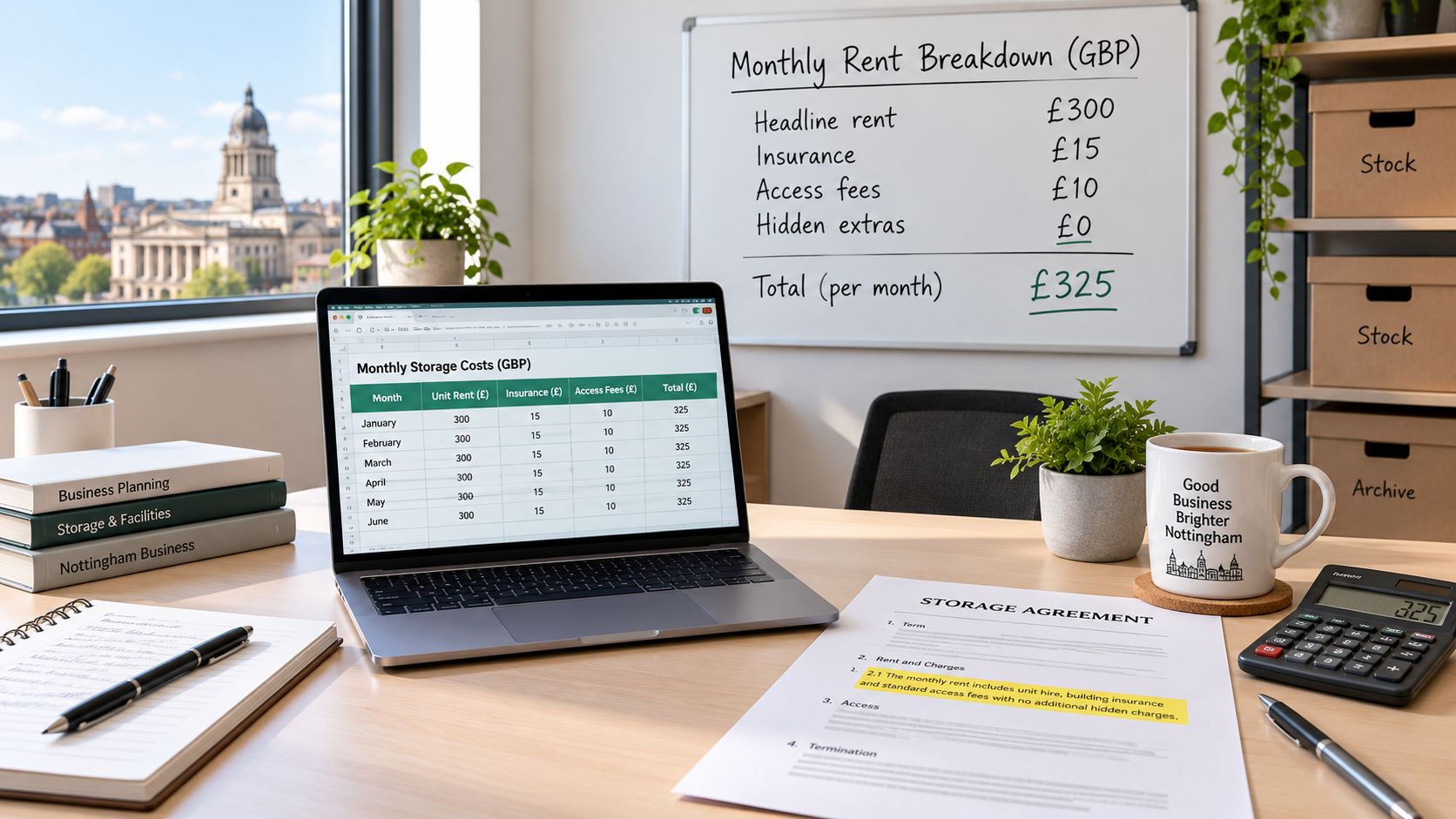
A monthly quote is only useful if you know what it includes. Compare the rent, contract terms and practical extras together, then test whether the total still makes sense if customer payments arrive late.
Compare the whole monthly cost
Ask whether the quoted rent includes the unit alone or also covers any required insurance, lock, out-of-hours access or other facility charges. Check how much notice you need to give, whether the rate can change, and whether you can move to a smaller or larger unit as stock levels shift. A short, clear agreement is often more useful to a small firm than a tempting headline price tied to terms that don't fit its cash position.
Storage can be a cautious alternative to taking on premises that are much larger than current operations require. A Logistics UK submission says a major distribution centre can face annual business-rates liabilities of approximately £1.5 million to £2 million. Those figures concern a major facility, not the rent a small business would pay for self storage, but they illustrate why a warehouse commitment carries a different scale of property overhead. (Logistics UK submission on business rates and investment)
Stress-test the rent against cash flow
Late payments are a working-capital risk, not merely an inconvenience. UK-wide research reports that late payments affect 28% of businesses annually, leave firms owed an estimated £26 billion at any given time, and contribute to around 14,000 business closures each year. Those figures are a reason to be conservative about fixed costs, not a prediction of what will happen to your firm. (Small Business Commissioner late-payments research)
Cash-flow rule: Don't rent extra capacity for stock you may not sell or invoices you haven't collected. Choose the smallest unit that handles your measured peak safely, and check that the monthly commitment remains manageable when cash is tight.
To compare unit options fairly, divide the monthly rent by the usable floor area to get a rent-per-square-foot figure. Then compare access, security, contract flexibility and any extras alongside that number. The cheapest rate isn't automatically the lowest-cost option if awkward loading or poor access adds time to every visit.
Security, Access and Contract Terms That Matter
A storage unit holds business assets, so check the facility as carefully as you'd check a workshop or supplier. Security features are useful only if you understand what they cover and what responsibility remains with you.
Check the site, not just the brochure
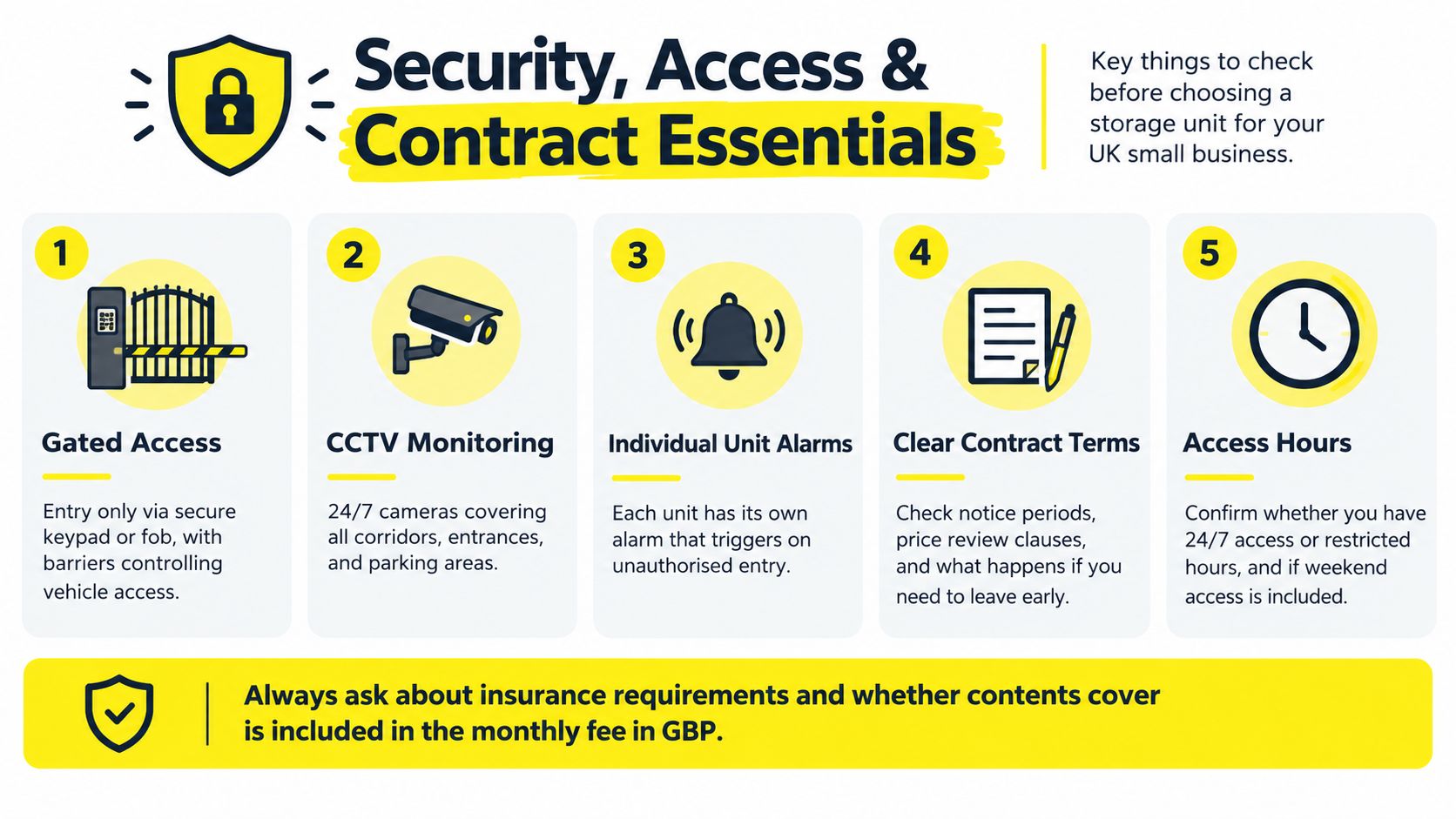
Look for controlled entry, CCTV coverage, staff presence and unit-level alarms where offered. Ask how access is managed, which areas cameras cover, and what happens if a gate or alarm develops a fault. Don't assume a CCTV-monitored compound means every unit has an individual alarm.
Access hours should match your working day. A tradesperson may need to collect equipment before a job, while an online seller may need to retrieve stock outside a typical office routine. Confirm whether access is available at weekends and whether the facility's rules allow the visits your business expects.
Read the agreement and check insurance
Before signing, make sure you understand:
- Notice and exit terms. Check how much notice you must give and whether you can leave early.
- Price changes. Ask how and when the monthly rate can be reviewed.
- Access conditions. Confirm opening arrangements, weekend availability and any limits on who can enter.
- Insurance responsibility. Find out whether contents cover is included, required separately or subject to exclusions.
- Prohibited items. Ask about restrictions on hazardous or unsuitable goods before moving stock in.
Keep an up-to-date inventory with item descriptions, quantities and values. That record helps you manage stock day to day and gives you a clearer basis for an insurance claim if goods are lost or damaged. Don't treat a storage provider's security measures as a replacement for checking your own cover.
Self Storage or Warehouse, Which Operating Model Fits
Self storage works well when you need space, not a complete logistics department. The important distinction is whether your business needs to store goods or run a daily receiving, picking and dispatch operation.
A Nottingham sole trader with tools and occasional materials might choose a drive-up unit, collect what's needed for each job and keep the van available for work. An online retailer with manageable stock could use an indoor room to separate active products from slower-moving reserve stock, provided the unit and facility rules suit the way orders are fulfilled. A small trades firm holding seasonal equipment might start with a container and review its needs as contracts change.
Use the storage-to-warehouse decision
Flexible storage is a reasonable fit for low-to-medium turnover stock, tools, archived records and seasonal overflow. It's less likely to fit when daily pallet movements, regular staff access, regulated goods or tightly integrated dispatch are central to operations. Ground-level access can make loading easier, but it doesn't provide goods-in booking, fulfilment, dispatch software or permission to store every type of material.
That distinction matters in Nottingham's commercial setting. The city sits within East Midlands transport routes, including the M1 and A52, while Nottingham Trent University describes a regional FinTech cluster of 188 companies, with 39% identified as SMEs and 18% as start-ups. Those figures relate to the wider city-region's FinTech sector, not to every local business, but they underline that firms with different operating needs share the same area. (Nottingham Trent University analysis of the city-region FinTech cluster)
If your daily work depends on pallet handling, staff circulation or integrated order fulfilment, choose a warehouse or fulfilment partner. If you mainly need secure, accessible space for goods and equipment, paying for warehouse functions you won't use can add avoidable pressure.
Compare the options against your workflow, not a simple rent figure. This guide to warehouse and self storage options can help clarify which operating model matches the job your space needs to do.
Real Nottingham Use Cases and Next Steps to Rent
A Nottingham electrician with a full van and spare tools to store can use a drive-up 10 ft container near the M1 for equipment and materials not needed on every job. Ground-level loading helps with collection, while keeping the van stocked for paid work. Check the facility's storage rules and opening hours before relying on the unit for work-critical kit.
An e-commerce seller may prefer an indoor room to separate current pick stock from returns and slower-moving cartons. A growing trades firm could need lighting, power and Wi-Fi as well as storage. A Trade Pod or Business Pod may suit that work better than paying for a larger unit. Match the space to current operations, then leave room in the budget for slower-paying periods.
Make the booking decision
Before choosing a unit, work through this checklist:
- Measure peak inventory. Include the stock, equipment and records you expect to store at your busiest.
- Shortlist two sizes. Ask the provider what you gain with the larger option and whether that extra capacity earns its cost.
- Check access and security. Confirm opening hours, vehicle access, site controls and insurance requirements.
- Read the agreement. Clarify notice periods and any price-review terms before signing.
- Start conservatively. Choose a unit size and initial term you can afford if demand or cash flow changes.
Container Self Store offers indoor rooms and drive-up containers for Nottingham businesses, with flexible terms and ground-level access on suitable units. Compare the costs with your stock, access needs and available working capital before committing.
Container Self Store provides storage for stock, tools, equipment and records without requiring a warehouse lease. Request a quote from Container Self Store to discuss suitable unit options.