
Feeling overwhelmed by clutter? You’re not alone. Across the UK, people are looking for a bit of extra space that won’t break the bank. The secret to finding cheap storage units near me isn’t just about luck; it’s about knowing what drives the cost—location, size, and features—and being smart about what you actually need.
Your Search for Cheap Storage Units Starts Here
Finding the right self-storage can feel like a real chore, but it doesn’t have to be. Whether you’re moving house, finally clearing out the garage, or a student needing a place for your things over the summer, the goal is always the same: find a secure spot at a sensible price. This guide is your no-nonsense roadmap, designed to cut through the jargon and give you clear, practical advice.
We’ll kick things off by looking at what really affects storage prices, then show you how to search smarter than just a quick online query. Often, the best value for money comes from uncovering those local providers and hidden gems.
Understanding Your Main Options
Before you start comparing prices, it’s crucial to know the two main types of self-storage you’ll find in the UK. They each have their pros and cons, and your choice will make a big difference to both cost and convenience.
- Traditional Indoor Units: Think of these as rooms inside a larger, often multi-storey, building. They’re great for smaller items and boxes, but wrestling a sofa into a lift or down long corridors isn’t always fun.
- Modern Container Storage: These are individual steel containers on a secure, ground-level site. The game-changer here is drive-up access—you can park your car or van right at the unit door, making loading and unloading a breeze. This convenience often comes at a much friendlier price, too.
It’s also worth broadening your perspective by understanding various storage solutions available for different needs, which can help you narrow your search right from the start.
The biggest mistake I see people make is paying for fancy features they don’t actually need. By figuring out if you really need indoor access versus the simple practicality of a drive-up container, you can instantly focus on the most cost-effective options.
Students, for example, often find container storage is the perfect solution. If that’s you, our guide on self-storage for students has some tailored advice to save you time and money. Making an informed choice on the type of storage first is the foundation for finding a great deal.
Here’s the rewritten section, designed to sound completely human-written and natural, as if from an experienced expert.
Pinpointing the Best Value Storage in Your Area
Finding a great deal on storage isn’t just about chasing the lowest monthly price. True value comes from finding a unit that’s not only affordable but also secure and reliable. You have to be a bit strategic. While popping your postcode into a comparison site is a decent first step, it rarely gives you the full picture.
Often, the real gems are the local, independent storage companies. They might not have the marketing budget to show up first on Google, but they frequently offer much better prices and a more personal touch. It’s definitely worth digging beyond those top-sponsored results.
Look Beyond Your Immediate Postcode
Here’s a simple but effective trick: widen your search radius. A storage unit just a few miles outside of a city centre like Nottingham or Northampton can be dramatically cheaper. We’re talking about savings that could easily run into hundreds of pounds over a year. A slightly longer drive often pays for itself many times over.
The self-storage market in the UK is booming, with over 2,900 sites and a staggering 64.3 million square feet of space. That much competition is fantastic for us as customers. While the national average rental cost sits around £29.13 per square foot per year, you’ll see much steeper prices in prime city locations. That’s why looking at facilities on the outskirts is such a savvy move. If you’re interested in the details, you can learn more about the growing UK self-storage market from a recent industry report.
Don’t get fixated on just the headline price. A truly great deal is the sweet spot where an affordable monthly rate meets solid security, easy access, and a clear, fair contract. Cutting corners on security to save a few quid is a classic false economy.
Uncovering Discounts and Special Offers
Many storage facilities have deals that can slash your costs, but here’s the thing – you often have to ask. Keep your eyes peeled for these common money-savers:
- Introductory Offers: It’s common to see deals like the first month free or at a 50% discount to get new people through the door.
- Long-Term Rental Deals: If you know you’ll need the unit for six months or longer, ask about prepayment discounts. Paying for a block of time upfront can often lock in a much better rate.
- Special Rates: Always ask if they offer discounts for students, members of the armed forces, or NHS staff. You’d be surprised how often they do.
Finally, don’t underestimate the power of a good read-through of customer reviews. Go beyond the star ratings and see what people are actually saying about security, cleanliness, and the staff. Consistent, positive feedback on these points is a huge indicator of genuine value, ensuring your hunt for cheap storage units near me ends with a solution you can truly trust.
Choosing the Right Size Unit Without Overpaying
One of the quickest ways to overspend on storage is by renting a unit that’s far too big for your needs. It’s a really common mistake, but thankfully, it’s also an avoidable one. If you can accurately estimate how much space you’ll actually need, you’re well on your way to finding a genuinely cheap storage unit without wasting money on empty space.
It can be surprisingly tricky to visualise what a certain square footage actually looks like in the real world. For example, a 50 sq ft unit is a very popular choice, and it’s roughly the size of a large garden shed. That’s usually enough to comfortably hold the contents of a one-bedroom flat, including bigger items like a double bed, a sofa, a washing machine, and a good number of boxes.
A Simple Trick to Measure Your Needs
Before you even start getting quotes, try this simple exercise at home. Grab some masking tape and mark out the dimensions of a potential unit (say, 10ft x 8ft for an 80 sq ft space) on your living room floor or even on your driveway.
Once you have your outline, start moving the items you plan to store into that taped-off area. This hands-on approach gives you a much clearer, more tangible sense of how things will fit than any online calculator ever could. You’ll quickly see if you have too much space or not enough.
This visual guide shows the core principles of finding the best value when looking for local storage.
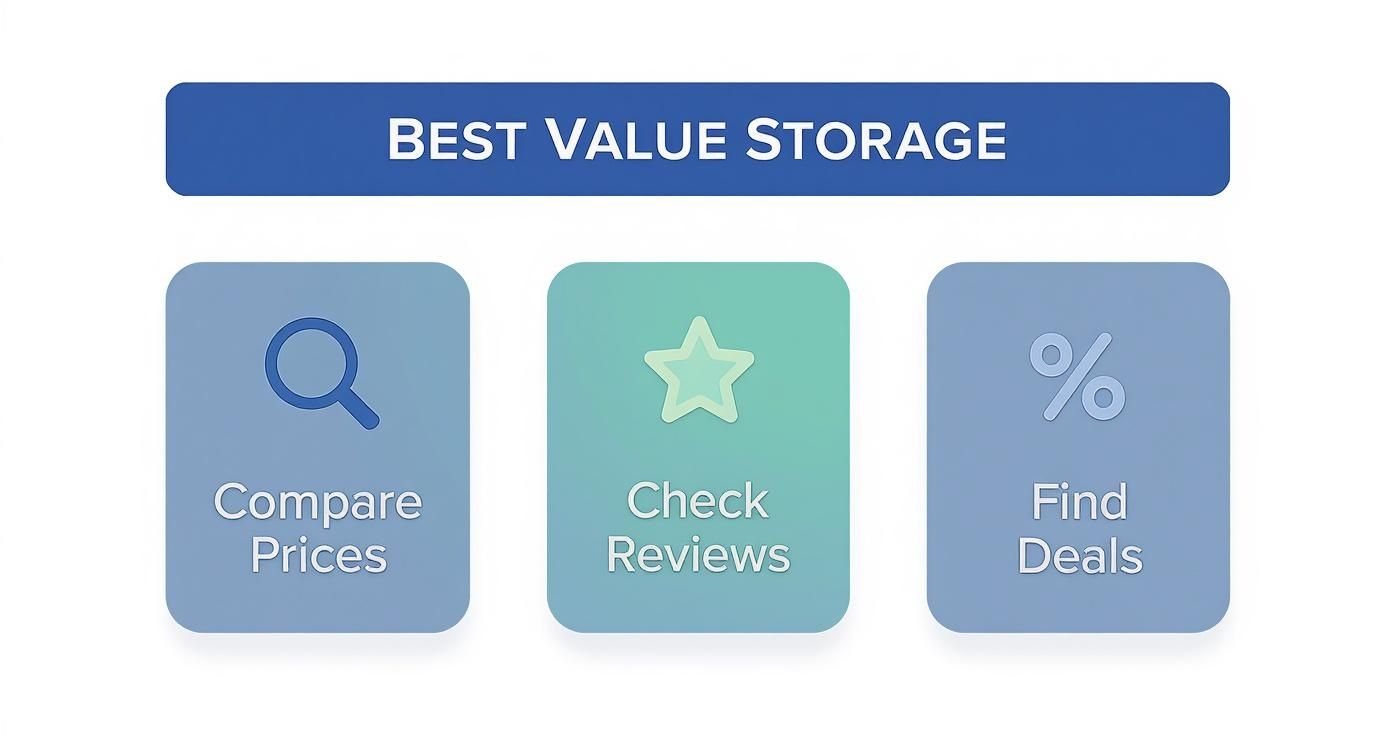
As you can see, a smart search involves more than just a quick Google. It means comparing prices, checking what other customers say in reviews, and actively looking for special offers.
Thinking in Three Dimensions
Here’s something people often forget: storage isn’t just about floor space; it’s about volume. This is where container storage often has a real advantage. Thanks to their high ceilings and uniform rectangular shape, you can stack boxes and furniture much higher and more efficiently than in some traditional indoor units.
For a more detailed look at the options, our guide on how to choose the right size storage room in Nottingham offers some specific, local examples.
The goal is to pay only for the space you actually use. Taking ten minutes to map out your belongings at home can save you hundreds of pounds over your rental period by helping you choose the perfect, most cost-effective unit size from the start.
To give you a better idea, here’s a practical table to help you match your belongings to the common unit sizes you’ll find in places like Nottingham and Northampton.
Quick Guide to Common UK Storage Unit Sizes
| Unit Size (sq ft) | Typical Dimensions (UK) | Equivalent To | What It Can Hold |
|---|---|---|---|
| 35 sq ft | 7ft x 5ft | A large garden shed | Contents of a student room, including a desk, chair, and around 20-30 boxes. |
| 80 sq ft | 10ft x 8ft | A single garage | Contents of a one or two-bedroom flat, including sofas, beds, and major appliances. |
| 160 sq ft | 20ft x 8ft | A standard shipping container | Contents of a three-bedroom house, bulky furniture, or a tradesperson’s tools and stock. |
Using a simple guide like this, combined with the masking tape trick, puts you in a much stronger position to confidently choose a unit that’s just right—not too big, and not too small.
Reading Between the Lines: How to Decode Contracts and Sidestep Hidden Fees
That brilliant monthly price you see advertised for a storage unit? It’s often just the tip of the iceberg. The real cost is usually tucked away in the small print of the rental agreement, and if you’re not careful, that great deal can quickly become a financial headache. To make sure the cheap storage you’ve found is actually cheap, you need to put on your detective hat and scrutinise the contract.
Signing on the dotted line without a thorough read-through is a classic mistake, and one that often leads to surprise charges later on. You absolutely have to understand the key terms of your rental, like how much notice you need to give before moving out or the company’s policy on rent increases. A low introductory offer is fantastic, but not if it’s going to double after three months without any warning.
Key Contract Clauses to Look Out For
Before you commit, always ask for a copy of the agreement and comb through it for these specific points. They can make a massive difference to what you end up paying.
- Price Increase Policy: Find out how often they can raise your rent and how much notice they are required to give you. A trustworthy company won’t be cagey about this.
- Notice Period: Most places require 30 days’ notice before you clear out your unit. If you forget, you could be on the hook for an entire extra month you didn’t even use.
- Prohibited Items: Every facility has a list of things you can’t store, like flammable materials, food, or illegal goods. Storing banned items can void your insurance and hit you with hefty penalties.
- Access Hours and Fees: Double-check the standard access hours. If you think you might need to get to your stuff late at night or on a bank holiday, see if it’s even possible and what extra fees are involved.
I’ve seen it time and time again: the biggest frustrations almost always stem from a misunderstanding about insurance. You must get this clarified from the start to avoid paying for cover you don’t need or, worse, discovering your belongings aren’t protected when you need it most.
Insurance is a big one. Many facilities will require you to have cover, but that doesn’t always mean you have to buy their policy. It’s well worth checking if your current home contents insurance can be extended to cover items in storage—it’s frequently a much cheaper route. If you go with your own provider, just be ready to show proof of cover. While transparent operators offering straightforward warehouse self-storage work hard to keep things simple, the responsibility to check the details always lies with you.
Your Checklist for Potential Extra Costs
The monthly rent is just the starting point. When you’re getting quotes, be direct and ask about these potential add-ons to get a true picture of the total cost.
| Potential Fee | What to Ask |
|---|---|
| Admin Fee | “Is there a one-off charge for setting up my account?” |
| Security Deposit | “Is a deposit needed, and what are the exact conditions for getting it back in full?” |
| Lock Purchase | “Do I have to buy a specific lock from you, or can I bring my own?” |
| Late Payment Fees | “What’s the penalty if I’m late with a payment, and is there any grace period?” |
By asking these simple questions upfront, you give yourself the power to accurately calculate the total cost and dodge any nasty surprises. A little diligence now ensures your affordable storage unit actually stays affordable.
Security and Accessibility: What to Check Before You Commit
A great price on a storage unit is fantastic, but it means nothing if your belongings aren’t safe or you can’t get to them when you need to. Before signing on the dotted line, you have to look closely at a facility’s security and accessibility. These two factors are what give you genuine peace of mind and dictate how useful the space will actually be.
Your goal might be to find cheap storage units near me, but real value is found where price meets protection. Never just take a company’s word for it—always plan a visit to see their security measures with your own eyes. What you find in person can be a world away from the glossy photos online.
Assessing a Facility’s Security Measures
When you get to a potential storage site, start with the big picture. Is there a sturdy, high perimeter fence? How tough does the main gate look? Good facilities will use electronic gate access that needs a personal code, which is a massive deterrent for anyone who shouldn’t be there.
Next, have a proper look at the CCTV coverage. A single camera aimed at the entrance just doesn’t cut it. You want to see cameras covering the driveways and walkways between the units. Comprehensive surveillance means all activity across the site is being monitored, not just who’s coming and going. The lock you use matters, too; a flimsy padlock can be cut in seconds, whereas a heavy-duty container lock—often supplied by the facility itself—offers far better protection.
Peace of mind comes from knowing a facility has multiple layers of security working together. A strong fence, controlled gate access, and comprehensive CCTV are the three pillars of a genuinely secure site.
Why Accessibility Is Just as Important
Security keeps your stuff safe, but accessibility is all about convenience. The best facilities provide 24/7 access, giving you the freedom to get to your things whenever it suits you, not just during restrictive office hours.
This kind of flexibility is a lifeline for business owners managing stock or tradespeople grabbing tools at the crack of dawn. But it’s just as handy for personal use—think about grabbing your camping gear on a bank holiday or dropping off boxes late on a Sunday evening. Drive-up units, like the ones you find at container storage sites, are a total game-changer for accessibility. Parking your car or van right at your unit door saves an incredible amount of time and effort, cutting out the hassle of dragging heavy items down long corridors or up in lifts.
To make sure you don’t miss anything on your visit, here’s a quick checklist to run through.
On-Site Inspection Checklist
- Perimeter: Is the site fully enclosed by a high, secure fence?
- Gate: Is access controlled by a keypad or electronic fob system?
- CCTV: Are there multiple cameras covering the entire compound, not just the entrance?
- Lighting: Is the site well-lit, so you feel safe accessing it after dark?
- Access: Can you get to your unit 24/7, and is it a simple drive-up process?
- Condition: Do the units and the overall site look clean and well-maintained?
By carefully checking these security and accessibility features, you can be confident that the affordable storage unit you choose is also a safe and practical one.
Frequently Asked Questions About Finding Cheap Storage
When you’re searching online for cheap storage units near me, a few questions always pop up. It’s completely normal to want to get the details right – you’re trying to figure out costs, compare options, and make sure your belongings will be safe without breaking the bank.
To give you a bit of clarity, I’ve put together answers to the most common queries we hear from people looking for affordable self-storage in the UK. Getting these sorted from the start means no nasty surprises later on.
Is Container Storage Cheaper Than an Indoor Unit?
In almost every case, yes. Container storage is the more budget-friendly choice, and the logic is straightforward. Because the units are based outside on a secure site, the facility’s running costs are significantly lower. We don’t have to worry about heating, lighting, and maintaining vast indoor corridors, and we pass those savings directly on to our customers.
Price isn’t the only perk, though. Container units come with drive-up access, which is a massive plus. You can pull your car or van right up to the doors, making loading and unloading so much easier and faster. While some indoor facilities might offer climate control, for most things like household furniture, garden tools, or business stock, a clean and dry container offers more than enough protection at a much better price.
Can I Negotiate a Better Price?
Absolutely. It never hurts to ask, and a few well-timed questions can lead to some decent savings. You just need to know what to ask for.
- Look for introductory deals: Most storage places run offers like 50% off your first month or even the first month free. It’s a common way to bring in new people and can seriously cut your initial costs.
- Ask about paying in advance: If you know you’re in it for the long haul—say, six months or a year—ask if they offer a discount for prepayment. Committing to a longer term often unlocks a better rate.
- Mention what the competition is offering: Found a cheaper like-for-like quote down the road? Bring it up. A good site manager often has the wiggle room to match a competitor’s price to get your business.
- Think about timing: Storage demand tends to slow down in the late autumn and winter months. If you can wait to rent until then, you might find facilities are more willing to negotiate just to fill their empty units.
Do I Have to Use the Storage Company’s Insurance?
Not necessarily, but you absolutely must have insurance cover in place. Any professional storage facility will insist on it as part of your rental agreement—it’s there to protect both you and them.
Before you sign up for the facility’s own insurance policy, it’s well worth checking your home contents insurance. Many policies can be extended to cover your goods while they’re in storage, and it’s often a much cheaper option.
If you can extend your existing cover, all you’ll need to do is show the storage company proof of your policy. If not, or if the excess on your home insurance is sky-high, then taking the facility’s insurance is the simplest way to make sure your belongings are protected from the unexpected.
Ready to find a storage solution that is secure, accessible, and genuinely affordable? At Container Self Store, we provide straightforward and cost-effective container storage in Nottingham and Northampton. Get a free, no-obligation quote online in minutes and see how easy it is to get the extra space you need. Find your perfect unit today at Container Self Store.