
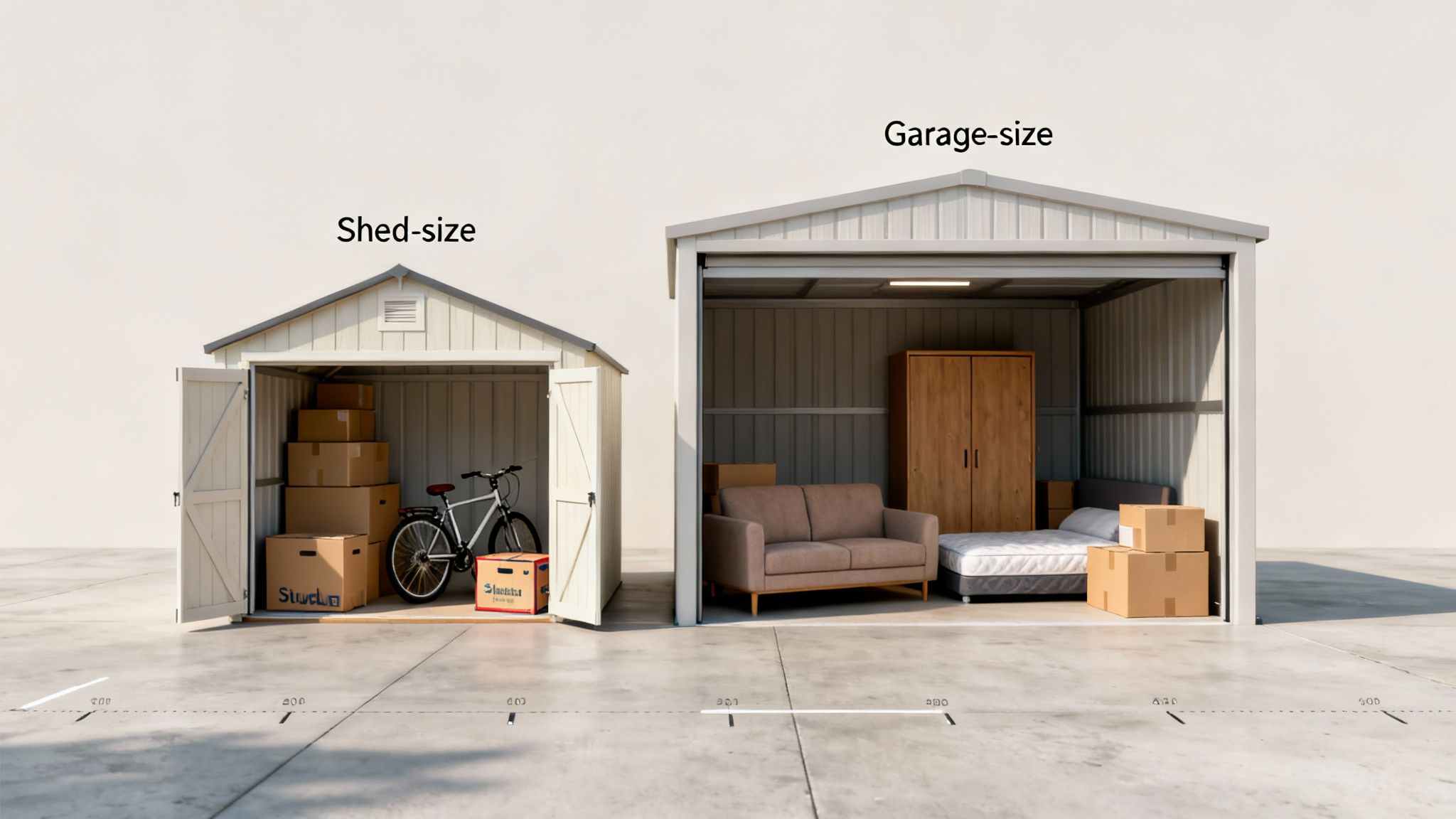
Trying to figure out what size storage unit you need can feel like a bit of a guessing game. But here’s the secret: for most people, it boils down to something pretty simple. You’re likely looking for a space that’s roughly the size of a garden shed or a single-car garage.
If you’ve got a handful of boxes and a few bits and bobs, think shed. If you're packing up an entire flat or house, think garage. It’s that straightforward.
Your Quick Guide to Choosing the Right Storage Unit
When you see storage units listed in square feet, it's easy to feel a bit lost. Who really knows what 100 sq ft looks like off the top of their head? The trick is to stop thinking in numbers and start comparing the space to rooms and areas you already know.
Instead of wrestling with measurements, ask yourself a simpler question. Am I storing the contents of a large cupboard? A spare room? Or is it more like an entire house? Answering this will instantly point you in the right direction. A small unit is perfect for a student’s things over the summer, while a family between moves will need something much bigger.
Getting to Grips with Unit Sizes
The biggest mistake we see is people paying for space they just don’t use. To make sure that doesn't happen to you, it helps to think of units in three main groups:
- Small Units (25-50 sq ft): Picture a large walk-in wardrobe or a garden shed. These are brilliant for seasonal gear, a few dozen boxes, or the contents of a student room.
- Medium Units (75-150 sq ft): Now you’re in the territory of a large shed or a small single garage. This size can comfortably hold everything from a one or two-bedroom flat, including sofas, beds, and tables.
- Large Units (150-200+ sq ft): This is your standard single-car garage. It’s built for the contents of a two or three-bedroom house, easily swallowing up big appliances, bulky furniture, and all the boxes that go with them.
Matching what you have to these familiar spaces is the key to making a smart, cost-effective choice. After all, you wouldn't hire a removal lorry to move a single armchair, and the same logic applies here.
See a Clearer Picture of Your Space
The hardest part is turning a pile of your belongings into a square footage number. Sometimes, seeing is believing. For a more hands-on feel, this visual guide to storage unit sizes can be a massive help in picturing how everything will fit together.
Ultimately, the goal is to find a unit that’s just right, not so cramped you can’t move, but not so big you’re paying for thin air. In the next sections, we'll walk through specific scenarios to help you nail that perfect fit.
Getting a Real Feel for Your Space: From Lockers to Large Containers
Numbers on a page, like square feet, can be a bit abstract. A 100 sq ft room feels completely different from a 100 sq ft container, and getting your head around that practical difference is the first step to figuring out what size storage unit you actually need. It’s about more than just the floor space; it’s about how the unit's shape, height, and accessibility work for the things you’re storing.
Visualising your storage isn’t just about picturing your stuff inside a box. You need to think in three dimensions. A tall, narrow unit might be perfect for stacking boxes and putting up shelving, whereas a wider, shorter space could be better if you need to get to business archives without unstacking a mountain of boxes first.
The right unit has to fit both your inventory and how you plan to use it. A high-ceilinged container, for example, gives you brilliant vertical room, letting you stack furniture and boxes safely to squeeze the most value out of every square foot. That’s where the smart money is, using the entire volume, not just the floor plan. If you want to dig deeper into the various types available, this complete self-storage options handbook is a great resource for comparing all your choices.
Indoor Rooms vs Drive-Up Containers
One of the first big decisions you’ll face is whether to go for an indoor storage room or an outdoor, drive-up container. They serve very different needs, and the best choice for you will come down to convenience, access, and what you’re putting away.
Indoor Storage Rooms: These are exactly what they sound like: rooms inside a main building, usually down corridors. They're great for things you might need to grab often in a clean, dry environment, like business documents, electronics, or delicate fabrics. The trade-off is that you'll have to carry everything from your vehicle to the unit itself.
Drive-Up Containers: This is where the game changes. You can pull your car or van right up to the door, making loading and unloading a breeze. If you've got heavy furniture, bulky equipment, or lots of business stock, this is an absolute lifesaver.
Key Takeaway: Drive-up access isn’t just a nice little perk; it’s essential for tradespeople storing tools, e-commerce businesses managing stock, or anyone moving the contents of an entire house. It saves a massive amount of time, effort, and backache.
Why the Small Details of a Unit Matter More Than You Think
Beyond the basic type, specific features can make or break your storage experience. For instance, if you’re storing anything that doesn’t like damp, think wooden furniture, books, or electronics, you need to be picky. A simple steel box just won't cut it.
That’s why ventilated containers are so important. They're designed to keep air circulating, which dramatically cuts down the risk of condensation and mould, especially during the UK's colder, damper months. Without good ventilation, you could come back to find your valuables ruined by moisture.
Height is another practical point. Our 20 ft container storage units have plenty of headroom, making them ideal for storing tall items like wardrobes upright or for creating really stable, tall stacks of boxes. Using that vertical space is the secret to efficient storage; it means you don't end up paying for a bigger footprint than you actually need. By packing smartly upwards, you can often fit the contents of a two or three-bedroom house into a space about the size of a single garage.
In the end, choosing the right unit comes down to a simple formula: the right dimensions plus the right features for the right items. Don’t just glance at the square footage on a price list. Ask yourself: will I be happy carrying heavy boxes down a long corridor, or do I need to unload straight from my van? Do my things need protection from the classic British weather? Answering these practical questions will make sure you hire a space that works perfectly for both your belongings and your back.
Matching Your Stuff to the Right-Sized Unit
Moving past vague guesses and into a solid plan is the secret to getting a storage unit that’s just right. The best way forward? Stop estimating and start listing. By looking at real-life situations, we can figure out exactly what you need, saving you both money and a world of hassle.
This simple bit of prep work means you won't end up paying for a half-empty unit or, even worse, discover you've run out of room on moving day. It’s all about replacing guesswork with a bit of practical planning. Let’s break down how common life events translate into specific storage needs.
The Student Summer Clear-Out
When term ends, students often need somewhere to stash their things for the summer. We’re usually talking about short-term, budget-friendly storage for the contents of a typical uni room: no heavy furniture, just the essentials of student life.
Think about what's actually in that room. You'll likely have a monitor, printer, several boxes of books and notes, a few bags of clothes, and maybe a small microwave or kettle. Don't forget the duvet, pillows, and a trusty desk chair.
- What you're storing: A single mattress, a desk chair, roughly 10-15 boxes, maybe a bike, a mini-fridge, and some electronics.
- The right size: A 25-35 sq ft unit is almost always the perfect fit. It’s about the size of a large walk-in wardrobe, giving you plenty of room to stack boxes and fit in the bigger items without a struggle.
Moving a One or Two-Bedroom Flat
Once you start storing the contents of a flat, furniture enters the equation, and that changes everything. Bulky items take up serious floor space, so you need to account for them first to get the right size unit.
For a one-bedroom flat, you're typically looking at a double bed (mattress and frame), a sofa, a wardrobe, a chest of drawers, a small dining set, and a TV. On top of that, you’ll have around 20-30 boxes of personal bits and pieces. A 40-50 sq ft unit can usually handle this, provided you pack it smartly.
When you move up to a two-bedroom flat, the inventory naturally grows. You'll have an extra bed and more bedroom furniture, plus probably some larger living room items.
Expert Tip: To comfortably fit a double bed, wardrobe, and chest of drawers, you need at least 40 sq ft of space. This lets you stand the mattress on its side, dismantle the bed frame, and place the furniture side-by-side, leaving space to stack boxes on top.
This handy flowchart helps you weigh up what kind of unit is best for your things.
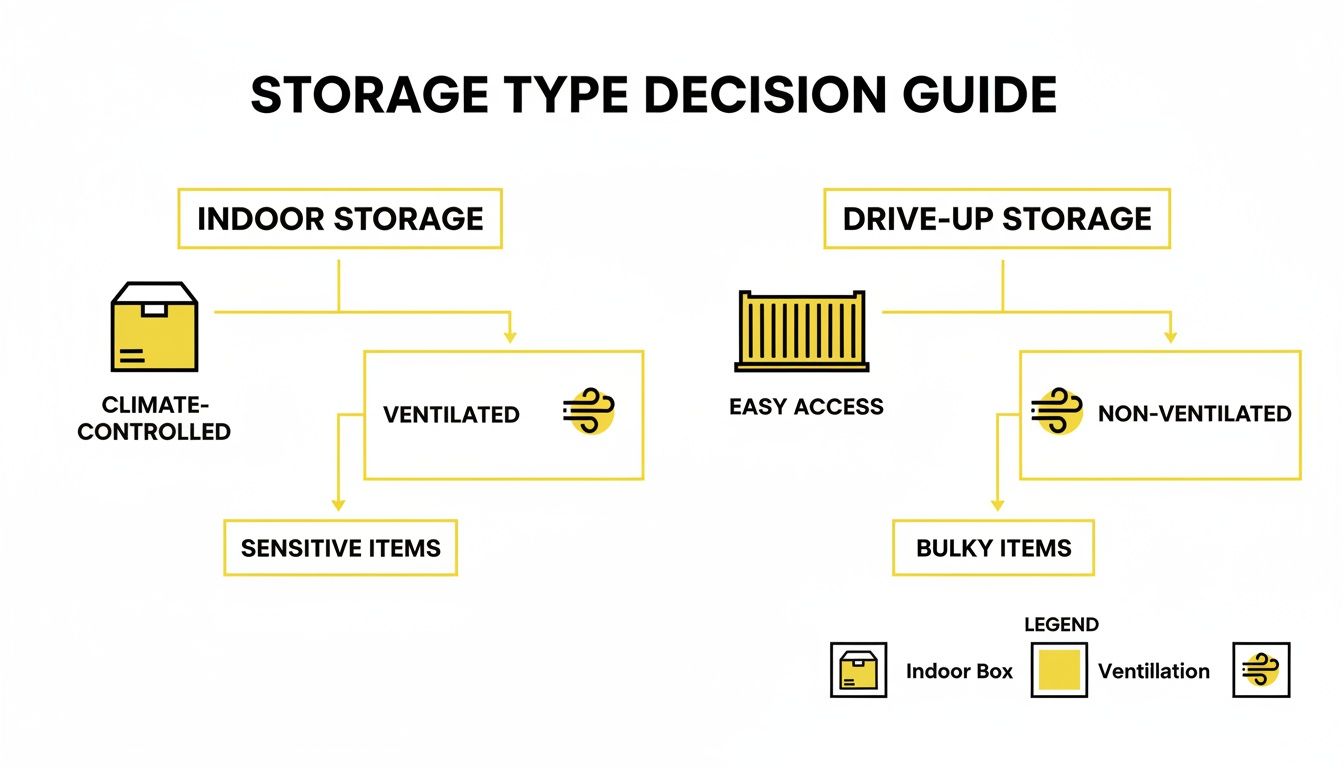
As you can see, it's a simple choice: if your items are sensitive to temperature or damp, an indoor unit is the way to go. If you just need easy access for big, heavy stuff, nothing beats a drive-up container.
Storing the Entire Contents of a Three-Bedroom House
Packing up a family home is a huge undertaking, and getting the storage right is a massive part of it. The contents of a three-bed house mean multiple pieces of large furniture, white goods, garden tools, and a serious number of boxes, often 50 or more.
Your list will probably include several beds, sofas, wardrobes, a large dining table, a fridge-freezer, a washing machine, and maybe a lawnmower and the contents of the shed.
- What you're storing: All major furniture, white goods (fridge, washer), garden equipment, and a lifetime of family belongings.
- The right size: A 150-160 sq ft unit is the go-to choice here. This is about the size of a single garage and is what our 20 ft containers offer. It gives you enough room to create a small walkway so you can get to your things without having to unpack everything.
Smart Solutions for Businesses and Tradespeople
Business storage is a different beast altogether. An online shop needs an organised space for stock, while a tradesperson needs a secure and accessible lock-up for their tools and materials.
E-commerce Stock Storage
For online sellers, being able to find and grab products quickly is everything. You need an organised system.
- What you’ll store: Product inventory, packaging materials like boxes and bubble wrap, shipping supplies, and essential paperwork.
- Recommended Unit: A 50-80 sq ft unit is a fantastic starting point. It provides enough space to put up some shelving and create your own mini-warehouse, all without the massive overheads of a commercial lease.
Tradesperson Tool and Equipment Storage
For plumbers, electricians, builders, and gardeners, a storage unit is more than just storage: it’s a secure base of operations. Here, drive-up access isn’t a nice-to-have; it’s essential.
- What you’ll store: Power tools, ladders, materials like pipes or cabling, and other bulky equipment.
- Recommended Unit: A 10 ft container (around 80 sq ft) is absolutely ideal. The ground-level, drive-up access means you can pull your van right up to the door to load and unload, saving you precious time at the start and end of every single day. Our ventilated containers also help protect expensive tools from damp and rust.
Scenario-Based Storage Size Recommendations
To make it even clearer, here’s a quick-glance table matching common scenarios to the best storage solutions.
| Scenario | Typical Items to Store | Recommended Unit Size | Best Unit Type |
|---|---|---|---|
| Student Storage | Single bed, 10-15 boxes, bike, desk chair | 25-35 sq ft | Indoor Locker or Small Room |
| 1-Bedroom Flat | Double bed, sofa, wardrobe, 20-30 boxes | 40-50 sq ft | Indoor Room |
| 2-Bedroom Flat | All of the above plus extra bedroom furniture | 75-80 sq ft | Large Indoor Room / 10ft Container |
| 3-Bedroom House | All furniture, white goods, garden tools, 50+ boxes | 150-160 sq ft | Drive-Up Container (20ft) |
| E-commerce Business | Stock on shelves, packaging, paperwork | 50-80 sq ft | Indoor Room (for climate control) |
| Tradesperson | Tools, materials, ladders, equipment | 80 sq ft (10ft) | Drive-Up Container (ventilated) |
By walking through these examples, you can get a much clearer picture of what you actually need. Take a few minutes to jot down your own inventory list: it’s the surest way to choose a unit that fits your belongings and your budget perfectly.
How to Figure Out Exactly What Size Storage Unit You Need in 3 Simple Steps
Working out how much storage space you need isn’t as daunting as it sounds. Rather than taking a wild guess and hoping for the best, a little bit of upfront planning can save you a lot of hassle, and money. Getting it right means you won't be paying for empty air or scrambling for more space on moving day.
Think of it like packing the boot of your car for a big trip. You wouldn't just start chucking things in. You’d figure out what needs to go in first and how it all fits together. We'll use that same common-sense approach here, breaking it down into three straightforward steps.
Step 1: Make a Full Inventory List of Everything You're Storing
First things first, you need to know exactly what’s going into storage. Grab a notepad or open a new sheet in Excel and do a proper walkthrough of your home, room by room. The more detailed you are now, the easier the next steps will be.
Don't just jot down "lounge furniture." Instead, get specific: one 3-seater sofa, two armchairs, one coffee table, a TV unit. When it comes to smaller bits and pieces, think in terms of boxes. For example, you might have 10 boxes from the kitchen, 15 boxes of books and photos, and 5 boxes of bedding and towels.
This list does two crucial jobs:
- It acts as a final checklist, so you don't accidentally leave anything important behind.
- It’s the foundation for figuring out the physical space you'll need.
It's easy to forget about the stuff tucked away in the loft, garage, or garden shed. Make sure you add things like the lawnmower, patio furniture, and those boxes of Christmas decorations to your list.
Step 2: Get the Tape Measure Out for Your Biggest Items
With your inventory ready, it's time to focus on the big, bulky items. Your sofas, beds, wardrobes, and kitchen appliances are what will take up most of the floor area. Think of them as the big rocks you need to place in a jar first; all the smaller pebbles (your boxes) will just fill the gaps around them.
Measure the length, width, and height of each of your largest pieces. You don't need to be a master surveyor: a rough measurement in centimetres or inches is fine. Write these dimensions down next to each item on your inventory list.
Top Tip: Remember you can often make things smaller! Mattresses can be stored on their side, dining tables can have their legs removed, and most bed frames come apart. Make a note of anything you can dismantle, as this can drastically shrink the amount of floor space you need.
Getting these dimensions is the real key to solving the storage puzzle. It helps you start to picture how everything will slot together, a bit like a game of Tetris.
Step 3: Put It All Together and Add a Bit of Wiggle Room
Now we turn that list of items and measurements into an actual unit size. You can find plenty of online storage calculators that do the maths for you, but you can also get a good estimate on your own. Start by imagining all your large furniture laid out on the floor: that gives you a rough idea of the minimum footprint.
But simply covering the floor isn't the whole story. You need to think about two other things: height and access. Most of our storage units have high ceilings, often 8 feet or more, and using that vertical space is the secret to smart packing. You can stack sturdy boxes high, place lighter items on top of solid furniture, and stand things like headboards and mattresses on their end. A good stacking strategy can easily double your usable space.
Finally, think about whether you'll need to get to your things. If you might need to grab a box from the back, you’ll want to leave a small walkway.
A good rule of thumb for your final calculation is:
- Work out the rough square footage your big items would take up on the floor.
- Add the space for all your boxes, remembering you can go upwards.
- Add another 10-15% on top of that total to give yourself an aisle to walk down.
This final figure is a much more realistic answer to "what size storage unit do I need?" It ensures you can actually move around in your unit and find what you’re looking for without having to pull everything out every single time.
Finding Your Perfect Storage Spot in Nottingham and Nottingham
All this talk about sizes is great, but it’s just theory until you find a practical, secure, and easy-to-reach unit near you. If you’re in the Midlands, that’s where we come in. We take the guesswork out of the equation and turn this guide into a real-world solution you can use today.
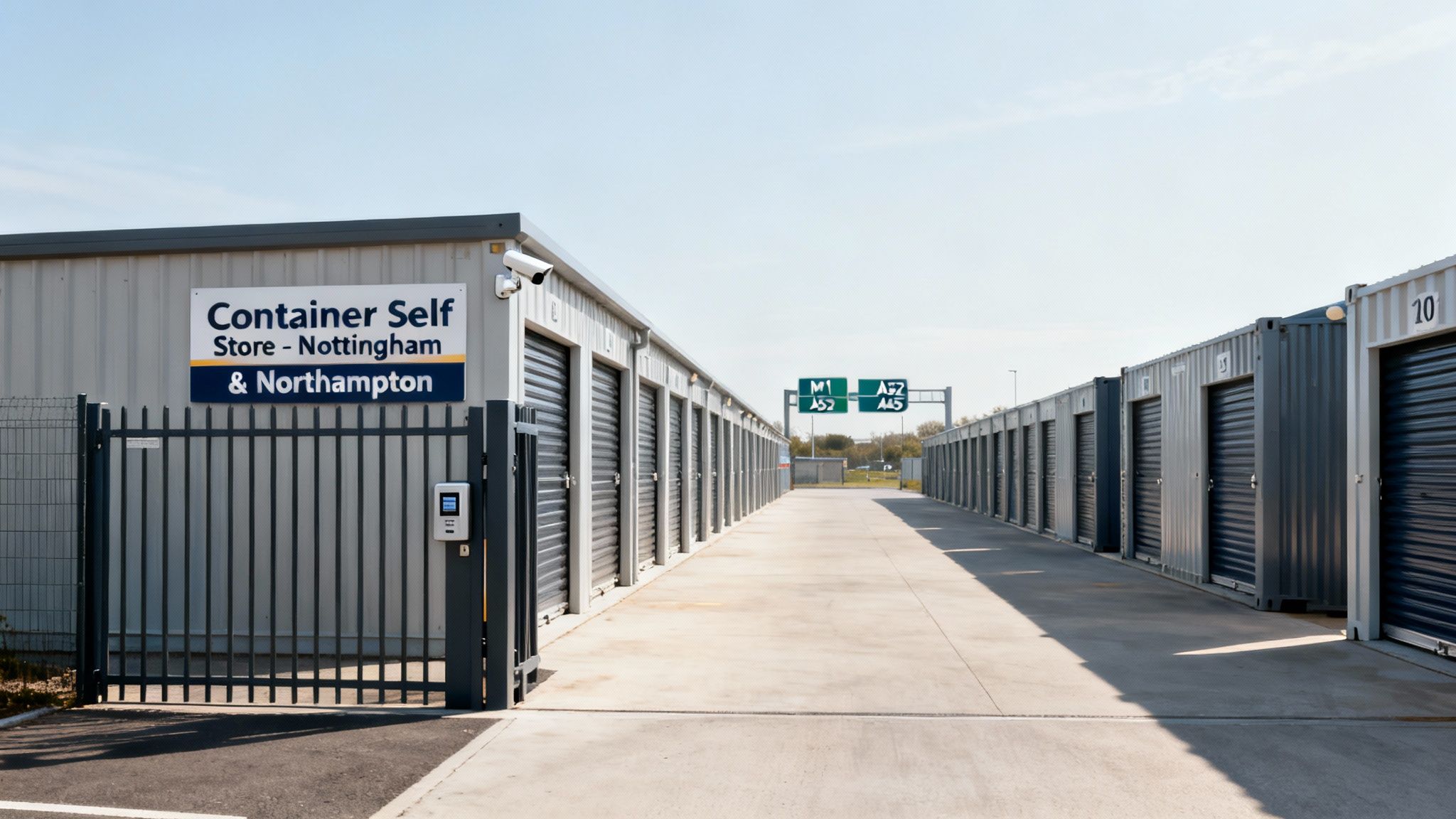
Our Container Self Store sites in Nottingham and Nottingham have a fantastic range of options, designed to fit pretty much any need. Whether you're after a compact 9 sq ft locker for some sentimental bits and bobs or a massive 200 sq ft room to hold the entire contents of your house, we’ve got a space that works. This means you’re never paying for more than you actually need.
What We Offer in Nottingham
When you’re popping back and forth to a storage unit, convenience is everything. Our Nottingham facility is perfectly placed just off major routes like the M1 and A52, so getting to your things is a breeze, whether you’re coming from the city centre or further afield.
Let's put this into perspective. Imagine you’re moving from a 2-3 bedroom house in Nottingham. How much space would you really need? The UK self-storage industry has exploded to 64.3 million square feet for a reason! For a house that size, most people find a 50-100 sq ft unit does the trick. That’s where our 10ft containers (about 80 sq ft) come in. With simple drive-up access, they’re spot on for this kind of move. While national occupancy hovers around 75.1%, areas like the Midlands are hotspots, as you can see in the SSA UK Annual Industry Report 2025.
Peace of Mind is Standard: Both our locations are kitted out with top-notch security, including 24/7 CCTV and secure gated access. You can rest easy knowing your possessions are in safe hands.
To see exactly what we have right now, pop over to our dedicated page for self-storage units in Nottingham.
What We Offer in Nottingham
It’s a similar story over at our Nottingham site. We've focused on security and convenience, with a location that’s dead easy to get to from the A45. It’s an ideal hub for local businesses, tradespeople needing to store tools, or residents having a good old clear-out.
At both our Nottingham and Nottingham locations, you’ll find:
- Indoor Storage Rooms: These range from small 9 sq ft lockers all the way up to large 200 sq ft rooms.
- Drive-Up Containers: Available in 10ft (80 sq ft) and 20ft (160 sq ft) sizes. These are a game-changer if you have heavy items or need to get in and out quickly.
This local focus means the advice in this guide isn't just generic waffle: it's practical, actionable information you can use right on your doorstep.
Common Storage Questions Answered
Even with the best plans, a few questions always pop up when you're trying to nail down the right size storage unit. Here, we've answered some of the queries we hear most often, giving you the straightforward advice you need to choose with confidence.
What Happens If I Choose the Wrong Size Unit?
This is a really common worry, but don't stress: it’s an easy fix. At a flexible facility, you’re never truly stuck with the wrong space. We know it’s tricky to get it perfect first time, especially if you haven't rented storage before.
If you start moving in and realise it's just too snug, you can almost always upgrade to a larger unit that's available. On the flip side, if you've overestimated and have loads of empty space, you can downsize to a smaller, cheaper option. Our agreements are built to be flexible, so just have a word with the team on-site. They’re pros at sizing things up and will make any switch dead simple.
How Much Space Should I Leave for a Walkway?
This is a brilliant question, and one people often forget about until they're trying to dig out a box from the very back! Planning for access is key, especially if you'll need to grab things every now and then. Without a clear path, you could end up unpacking half the unit just to find one item.
As a rule of thumb, we suggest leaving a clear channel down the middle or along one side of your unit. A gap of about 2-3 feet is usually plenty to move around without any hassle.
A Practical Tip for Calculation: When you're adding up your total space, it's smart to add an extra 10-15% on top of your estimate. This buffer not only gives you that crucial access aisle but also helps air circulate around your belongings, which is vital for keeping everything in top condition.
Can I Store a Car or Motorbike in a Storage Container?
Yes, absolutely. Our 20ft drive-up containers are a fantastic and really popular choice for storing vehicles. They’re about the size of a standard single garage, so there’s more than enough room for a family car, a classic you're working on, or a few motorbikes.
The best part is the ground-level access. You can simply drive straight in, no fuss. Before you do, though, it’s vital to prep your vehicle properly. This usually means draining flammable liquids like petrol and disconnecting the battery. It’s also a good idea to check your insurance policy covers vehicle storage. Our ventilated containers give you an extra layer of protection, helping to stop moisture from building up – perfect for long-term care.
Are There Any Items I Am Not Allowed to Store?
Yes, for safety, legal, and insurance reasons, there are some hard and fast rules about what you can keep in a self-storage unit. These restrictions are there to protect your things, other customers' belongings, and the facility itself.
As a general guide, prohibited items always include:
- Flammable or Explosive Materials: Things like petrol, diesel, paint thinner, fireworks, and gas canisters are a definite no.
- Perishable Goods: Any food that can go off, attract pests, or create a smell isn't allowed.
- Illegal or Illicit Substances: Storing anything illegal is strictly forbidden.
- Living Things: This one’s pretty obvious: no plants or animals.
This isn’t the complete list, so it's always best to double-check the specifics with our team when you book. Storing forbidden items can void your agreement and any insurance you have. For more detailed local info, our guide to cheap storage units near me provides extra specifics for our locations.
Picking the right size is the biggest hurdle, but getting these practical details right ensures your whole storage experience is smooth and stress-free.
Ready to find the perfect storage space for your needs? At Container Self Store, we make it easy. Get a no-obligation quote online in minutes and see how our secure, flexible, and convenient storage solutions in Nottingham and Nottingham can work for you. Find your ideal unit today at https://containerselfstore.com.